En Garde! Tutorial
0
En Garde·RifkinHabsburg
Learn to play En Garde! The strategic fencing game by Reiner Knizia, brought to Second Life by Procyon Games. Visit t…
Translation: On guard / In guard (French — directly translates to 'on guard,' the call by the referee announcing readiness for combat)
The En Garde is the fundamental ready position in modern Olympic fencing — feet at right angles with the front foot pointing toward the opponent, rear foot perpendicular and roughly shoulder-width behind, both knees deeply bent so the centre of gravity sits between the feet, weapon arm extended toward the opponent, and rear arm raised behind for balance. [1],[2] The stance enables explosive forward lunges, equally fast retreats, and the small constant footwork (advances, retreats, ballestras, balestra-lunges) that defines fencing engagements. [1] Each fencing weapon (foil, épée, sabre) has subtle variations in en garde depending on target area and tempo conventions, but the core posture — bent knees, sideways body, weapon-out — is universal. [1],[3]
The en garde position evolved from late-medieval and Renaissance European swordsmanship traditions and was codified into modern Olympic fencing pedagogy in the late 19th and early 20th centuries. [1],[2] French and Italian schools developed slightly different orthodox postures, both of which persist as recognised variants today. [1],[3] The deep-knee bent posture is a relatively modern adaptation — earlier engravings of historical fencers show shallower stances, and the deep posture became standard as electrical scoring rewarded the fastest lunges. [2]
En garde is universally recognised as the standard fencing ready position — it is the only sanctioned starting position in FIE (Fédération Internationale d'Escrime) competition and forms the basis of every footwork drill. [1],[2] The depth and bend of the stance directly correlate to lunging speed; world-class fencers can hold deep en garde for entire bouts (15+ touches) without form degradation, while novices typically lose form within minutes. [1],[2],[3] Empirical analysis of Olympic-level matches shows that the distance the lead toe travels during a championship-winning lunge can exceed twice the fencer's leg length — entirely dependent on the loaded en garde from which the lunge is launched. [3] Modern electric-scoring fencing has rewarded ever-deeper en gardes, with the Italian school favoring a more extended posture and the French/Russian schools tending toward a slightly higher, more mobile stance.
Late-Renaissance European swordsmanship (Italian masters Capo Ferro, Marozzo, Agrippa) → 17th-18th century French school (Le Perche du Coudray, Olivier de la Marche) → 19th-century French school under Louis Rondelle and Italian school under Masaniello Parise → 20th-century codification by Aldo Nadi (Italian) and Lucien Gaudin (French) → modern Olympic fencing under FIE codification (founded 1913). [1],[2],[3] The deep-knee bent posture is a relatively modern adaptation: earlier engravings show shallower stances, and the deep posture became standard as electrical scoring (introduced 1933 for épée, 1955 for foil, 1988 for sabre) rewarded the fastest lunges. [1],[4]
Required ready position in every FIE-sanctioned competition since the federation's founding in 1913; foundation of all sport fencing. [1] Has appeared at every modern Summer Olympic Games (1896-present, with brief interruptions). Notable Olympic competitors whose en garde mechanics have been studied as exemplary include Aladár Gerevich (Hungary, sabre, 7-time Olympic gold), Edoardo Mangiarotti (Italy, foil/épée, 6 Olympic golds), and Valentina Vezzali (Italy, foil, 6 Olympic golds). The position is technically present in every NCAA collegiate fencing match (USA), Pan-American Games, World Championships, and World Cup events. [1],[3]
No images yet for this technique.
Sign in to suggest an image.
Learn to play En Garde! The strategic fencing game by Reiner Knizia, brought to Second Life by Procyon Games. Visit t…
No instructional courses yet for this technique.
Sign in to suggest a course.
Risk of injury to the person this technique is applied to
Stance — no inherent danger. Sustained training in deep en garde does load the front knee; alignment matters
Skill level needed to execute this technique reliably
Whether this technique is allowed under major competition rule sets
FIE Rules of Competition (Fédération Internationale d'Escrime, latest annual edition)
Description sources — [1] FIE Rules; [2] Aldo Nadi On Fencing; [3] Italian/French school comparative texts
Description sources — [1] FIE Rules of Competition (current edition is canonical); [2] Aldo Nadi On Fencing (Italian school); [3] Lukovich Fencing: Modern International Style (Hungarian school technical analysis); [4] Gaugler Science of Fencing (comprehensive Italian-school treatment); [5] Maître d'Armes French Master at Arms certification standards
Description sources — [1] FIE Rules of Competition (current edition is canonical); [2] Aldo Nadi On Fencing (Italian school); [3] Lukovich Fencing: Modern International Style (Hungarian school technical analysis); [4] Gaugler Science of Fencing (comprehensive Italian-school treatment); [5] Maître d'Armes French Master at Arms certification standards
quadriceps endurance, ankle dorsiflexion, hip flexor mobility, shoulder endurance for the extended weapon arm
quadriceps (sustaining bent-knee posture), glutes (hip stability), deltoids and forearm extensors (weapon arm)
En garde is sport fencing's universal ready position. Distinct from HEMA longsword 'guards' (Vom Tag, Ochs, Pflug, Alber, Posta di Guardia) which are weapon-specific stances rather than a generic ready position. Sport fencing en garde is foundational and pre-bout-mandatory at all FIE levels. The French and Italian schools use slightly different orthodox postures, both of which persist as recognized variants. Sabre en garde is somewhat squarer than foil/épée to defend the head and shoulders, which are valid target areas in sabre.
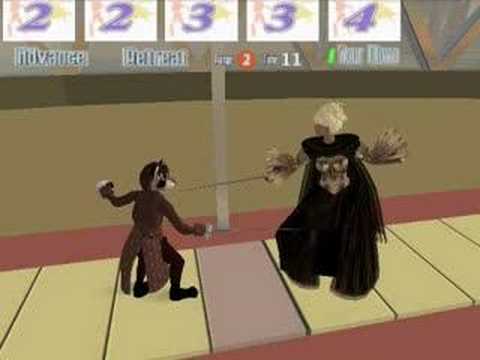
To defend, you need to be holding a card that matches the distance to your opponent. When your opponent attacks, parries happen automatically if you have the right card—you don't need to click anything, but the card is used up and becomes unavailable for your next turn.
To attack, you must play a card that matches the current distance between you and your opponent. A successful attack scores 1 point, and 5 points wins the game.
If you don't have the matching card to attack, you can select any other card and retreat, which dodges the attack but uses up your turn. If neither player has the right card for a last-second attack, whichever player has advanced farther down the board towards their opponent's side wins the point.
The En Garde is the fundamental ready position in modern Olympic fencing — feet at right angles with the front foot pointing toward the opponent, rear foot perpendicular and roughly shoulder-width behind, both knees deeply bent so the centre of gravity sits between the feet, weapon arm extended toward the opponent, and rear arm raised behind for balance. The stance enables explosive forward lunges, equally fast retreats, and the small constant footwork (advances, retreats, ballestras, balestra-lunges) that defines fencing engagements.
The en garde position evolved from late-medieval and Renaissance European swordsmanship traditions and was codified into modern Olympic fencing pedagogy in the late 19th and early 20th centuries. French and Italian schools developed slightly different orthodox postures, both of which persist as recognised variants today.
FIE Fencing: legal — Required ready position; All competitive fencing federations: legal — universal mandatory starting position
Danger rating 1/10. Stance — no inherent danger. Sustained training in deep en garde does load the front knee; alignment matters
The standard setup chain: Step Back from Salute → Drop Hips into Bent-Knee Position → Square Front Foot Toward Opponent → Extend Weapon Arm to Centre Line → Raise Rear Arm for Balance → Hold or Initiate Footwork.
Standard counters include: Disengage attacks that bypass the extended weapon arm / Tempo-disrupting feints that exploit a deeply-set en garde's slow lateral motion / Long-distance running attacks (flèche) that catch the static en garde.
Common variants: Standard French Foil En Garde (orthodox sport fencing posture, bent knees ~100°, weapon …); Italian School En Garde (slightly higher stance, more upright torso); Sabre En Garde (slightly squared body, sabre held with point higher to de…); Épée En Garde (typically deeper stance with weapon arm fully extended (l…); HEMA Longsword 'Posta di Guardia' (adjacent concept; not the same stance).
Required ready position in every FIE-sanctioned competition since the federation's founding in 1913; foundation of all sport fencing. Has appeared at every modern Summer Olympic Games (1896-present, with brief interruptions).
Top errors to watch for: Standing too tall — the bent-knee position is what enables the explosive lunge; high stance loses the spring loading / Squared body — exposes too much of the trunk as a target; the side-on posture is non-negotiable / Weapon arm dropped or bent — slows the parry and reduces reach / Rear foot lifted or pivoted — loses the push platform for the lunge.
The En Garde is also known as An Garudo, On Guard, Guard Position (Fencing), Fencing Stance, En-Guarde.