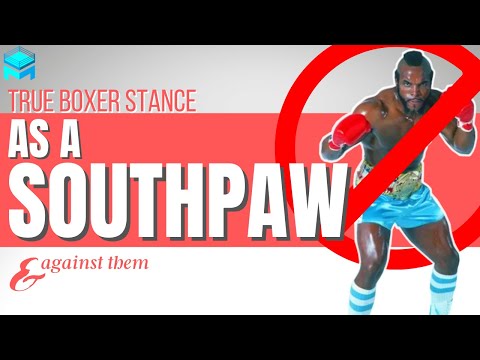
True Boxer Stance For The Southpaw | How To Handle A Southpaw
0
Southpaw Stance·Marvin Cook
The TRUE BOXER STANCE as a SOUTHPAW and as an ORTHODOX boxer works just the same. The geometry in how this works nullifi…
Translation: southpaw stance
The Southpaw Stance subfamily covers the fighting stance with the right foot forward and the left foot back, used by left-handed fighters or as a tactical choice by right-handed fighters who 'switch' stances. [1] The southpaw stance mirrors the orthodox stance, placing the power hand (left) in the rear for maximum power generation. [1],[2] Southpaw fighters have a tactical advantage because most opponents are less experienced fighting against the mirrored stance, and the lead-foot-to-lead-foot positioning creates a different dynamic than orthodox-versus-orthodox. [2],[3]
The southpaw stance (right foot forward, left hand back) provides a tactical advantage against orthodox fighters due to the unfamiliar angle of attacks. [1] Southpaw fighters historically have a higher win rate in boxing due to the difficulty orthodox fighters have adjusting to the mirrored stance. [1]
Southpaw stance (right foot forward, left hand rear) has been used throughout boxing history, with notable southpaw champions including Manny Pacquiao and Marvin Hagler. [1]
Southpaw fighters have a statistical advantage in boxing and MMA due to opponents' unfamiliarity with the stance. [1]
No images yet for this technique.
Sign in to suggest an image.
The TRUE BOXER STANCE as a SOUTHPAW and as an ORTHODOX boxer works just the same. The geometry in how this works nullifi…
No instructional courses yet for this technique.
Sign in to suggest a course.
Risk of injury to the person this technique is applied to
Standing positions are pre-engagement stances; minimal direct risk
Skill level needed to execute this technique reliably
Whether this technique is allowed under major competition rule sets
Advanced Brazilian Jiu-Jitsu Techniques (Marcelo Garcia, 2011)
Alias sources — [1] Mastering Jujitsu (Gracie & Danaher, 2003) [2] Championship Fighting (Dempsey, 1950) [3] Championship Fighting (Dempsey, 1950)
Effectiveness sources — [1] Mastering Jujitsu (Gracie & Danaher, 2003)
Mixed Japanese-Western terminology — combines traditional Japanese terms with katakana loanwords
Alias sources — [1] Mastering Jujitsu (Gracie & Danaher, 2003) [2] Championship Fighting (Dempsey, 1950) [3] Championship Fighting (Dempsey, 1950)
Effectiveness sources — [1] Mastering Jujitsu (Gracie & Danaher, 2003)
hook control, seatbelt grip endurance, hip connection
long legs for deep hooks, strong grip for seatbelt
hip adductors, biceps, forearms, core
Every move, in any martial art, shares a few universal traits. Mix and match below to pinpoint the right tool — or compare equivalents across styles.
Yes. Marvin Cook emphasizes that the true boxer stance style works for both left-handed and right-handed fighters, and all of the fundamental elements are universal and apply both ways.
The key adjustments when facing a left-handed fighter involve maintaining the true boxer stance principles regardless of which side you operate from, rather than relying on hand-tapping or reactive defensive positioning.
Hand-tapping between southpaw and orthodox fighters happens because fighters are standing in an incorrect stance. Marvin Cook advises against this practice, treating your jab as a weapon that should not be controlled or stroked by your opponent.
The Southpaw Stance subfamily covers the fighting stance with the right foot forward and the left foot back, used by left-handed fighters or as a tactical choice by right-handed fighters who 'switch' stances. The southpaw stance mirrors the orthodox stance, placing the power hand (left) in the rear for maximum power generation.
The southpaw stance has been recognised as an alternative fighting position throughout boxing history, with left-handed fighters traditionally using it. The tactical advantages of the southpaw stance have become increasingly studied and exploited in modern combat sports.
Unified MMA: legal — Legal; IBJJF: legal — Legal; IJF: legal — Legal; WBC/Boxing: legal — Legal — stance and footwork are fundamental; WKF: legal — Legal; UWW: legal — Legal
Danger rating 2/10. Low — standing positions are pre-engagement stances; minimal direct risk
The standard setup chain: Achieve Position → Stabilize → Maintain → Attack.
Standard counters include: Hand Fight — grip-fight the choking hand to prevent the rear naked choke / Shoulder Walk — walk shoulders to the mat to escape back control / Turn into Guard — rotate to face the attacker and recover guard position.
Common variants: Back control with hooks (both feet hooked inside the opponent's thighs); Body triangle back control (legs locked in a figure-four around the torso); Rear mount (mounted on the back with both hooks, opponent face-down); Chair sit back control (sitting behind the opponent with hooks, upright position).
Southpaw fighters have a statistical advantage in boxing and MMA due to opponents' unfamiliarity with the stance.
Top errors to watch for: Not training against orthodox opponents specifically — the southpaw advantage only exists with preparation / Mirroring orthodox technique exactly — some techniques must be adapted for southpaw, not just mirrored / Not fighting for the outside lead foot position — in open stance, the outside foot controls the angle / Keeping the left hand low in southpaw — the rear power hand must protect the chin when not punching.
The Southpaw Stance is also known as Sausupō Kamae, Southpaw, Right Foot Forward Stance, Left-Handed Stance.