Introduction to Horse Stance Fundamentals
Horse stance forms the foundation of numerous Chinese kung fu systems. While classified as a basic position, proper execution requires attention to specific structural parameters and common postural errors.
Three Key Parameters for Correct Execution
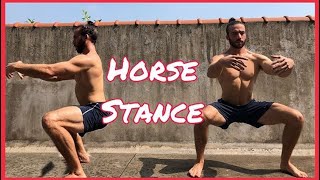
Proper horse stance requires three main structural elements: knees positioned directly over the feet and pointing outward, an upright torso with neutral spine alignment, and feet parallel to each other pointing forward. The ideal position additionally demands that the thighs remain parallel to the ground.
Common Problem: Inward Knee Collapse
A frequent error in horse stance practice is inward collapse of the knees, particularly when settling into deeper positions. This misalignment compromises the stance's structural integrity and effectiveness.
Muscular Causes of Knee Misalignment
Inward knee collapse results from two primary muscular restrictions: tightness in the hip adductor muscles, which limits the abduction necessary to position knees over feet, and tightness in the internal rotator muscles, which prevents the external rotation needed to maintain proper knee alignment.
Corrective Strategy: Flexibility and Strength Development
Addressing knee collapse requires a dual approach: releasing and stretching the adductor and internal rotator muscles while simultaneously strengthening their antagonists—the abductor and external rotator muscle groups. This balanced development restores proper biomechanical positioning.
Horse stance TUTORIAL - Part #1
Key Takeaways
- •Introduction to Horse Stance Fundamentals
- •Three Key Parameters for Correct Execution
- •Common Problem: Inward Knee Collapse
- •Muscular Causes of Knee Misalignment
The horse stance (馬步 - Mǎ bù in Chinese) forms the foundation of every style of chinese Kung Fu. In this first video of the series we will focus on one of the most common problem you may experience when doing the horse stance: 1) Knee caving in (especially when going deeper into the stance) 1:10 For understanding what is causing this problem we have to look at the body biomechanics and at the motion happening at the hip. There are 2 root causes for the knee caving in during the horse stance: 1) Tightness in the hip adductors muscles 2) Tightness in the hip internal rotators muscles. So, I report here a short routine you can use for correcting that, by releasing and stretching these muscles and by strengthening the antagonist muscles (the hip abductors and hip external rotators). ROUTINE 2:11 1) Adductors foam rolling 2:25 2) Piriformis foam rolling 2:54 3) TFL and hip internal rotators foam rolling 3:08 4) Half middle split with external/internal hip rotation 3:35 5) Cross legs hip stretch 3:54 6) Lunge with hip external rotation and adduction 4:22 7) Fire hydrant 4:44 8) Clamshell with elastic band 5:02 9) Monster walk with elastic band 5:32 INTEGRATIVE EXERCISE: Horse stance with light elastic band 5:54
Frequently Asked Questions
What does this video teach about horse stance?
This video covers introduction to horse stance fundamentals, three key parameters for correct execution, common problem: inward knee collapse. It provides detailed instruction from Daniele Riccadonna.
How long does it take to learn horse stance?
The basic mechanics can be understood in a single session, but developing reliable execution requires consistent drilling over weeks of practice. This 5-part breakdown helps structure your training by isolating each phase of the technique.
What are the key details for finishing horse stance?
Inward knee collapse results from two primary muscular restrictions: tightness in the hip adductor muscles, which limits the abduction necessary to position knees over feet, and tightness in the internal rotator muscles, which prevents the external rotation needed to maintain proper knee alignment.