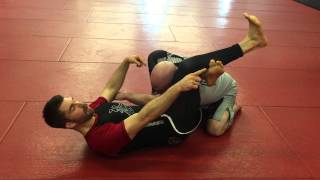
Understanding the Triangle Choke Fundamentals
The triangle choke is a foundational submission in jiu-jitsu, yet many practitioners struggle with finishing. Success depends on understanding that the choke's power comes from eliminating the gap between the neck and the attacking knee, similar to closing a nutcracker. Most practitioners incorrectly close the triangle with visible gaps, reducing effectiveness regardless of how tight it appears externally.
The Nutcracker Principle and Leg Extension
The key to a tight finish involves stretching the attacking leg straight to cut directly into the opponent's neck, allowing the leg to conform around the neck when compressed. This principle—opening the nutcracker fully before closing it—creates maximum pressure without relying solely on pulling the head. All subsequent adjustments should aim to return to this optimal tight finish position.
Breaking Posture Through Arm Dragging
When an opponent frames on the chest or postures the head up, arm dragging becomes essential for breaking posture rather than tightening the choke itself. The practitioner secures a cross grip on the sleeve, underhooks to grab their own wrist, and drives into the opponent's wrist to break any lapel or belt grip. Once the grip breaks, the arm must be dragged across the body before the opponent can re-establish their defense.
Controlling Posture with Elbow Trap and Hip Drive
After dragging the arm across, the practitioner keeps the hand behind the tricep while the other arm latches the elbow in front using the elbow to prevent arm withdrawal. A sit-up motion with knees driven forward breaks the opponent forward while maintaining arm control and preventing posture recovery. This dual-control prevents the opponent from regaining posture while freeing the attacking arm for shin control.
Foot Placement and Sliding Mechanics
The attacking foot should be placed on the hip with minimal gap at the armpit, followed by sliding backward while tightening the top leg across the neck. This backward slide—potentially with slight body rotation—fully closes the nutcracker by opening it completely before final compression. Once fully extended and in position, the bottom leg locks high over the shin rather than at the foot for practitioners with longer legs.
Finishing Details: Positioning and Muscle Engagement
During the finish, feet should remain pointed upward with contraction of all leg muscles rather than relying on head pulling alone. The practitioner initially shifts to the right side to tighten the leg around the neck, then recenter the hips to the left side when finishing to maximize compression. Stack defense is mitigated by maintaining distance and heavy hip positioning, making it difficult for the opponent to elevate the practitioner's hips.
Counter to Elbow-in-Pocket Defense
When opponents dig their elbow into the pocket on the opposite side of the desired arm drag, a hip bridge pops the elbow free from its defensive position. After the elbow is dislodged, the practitioner can drag the arm across the body and drop the hip to resume the finishing position. This counter maintains the same mechanical finishing sequence once the arm is repositioned.
Defending Against Stack Attempts
Stack defense relies on two key mechanics: sliding backward and creating side angle. As the opponent stacks, the practitioner arches the lower back and drives the head in while making the hips heavy to slide back and to the side. If a foot-on-hip position is available, it can be used; however, superior hip movement alone may prevent stacking without additional positioning.
Triangle Choke: The Detail That Changes Everything ( Complete Guide )
Key Takeaways
- •Understanding the Triangle Choke Fundamentals
- •The Nutcracker Principle and Leg Extension
- •Breaking Posture Through Arm Dragging
- •Controlling Posture with Elbow Trap and Hip Drive
The Triangle Choke is one of the most important submissions in jiu jitsu, but so many people struggle to finish it. This video I go through an entire system for finishing the triangle choke and how to defend all the primary counters. Omoplata Overview: https://youtu.be/chj936MTyaE more content on my website https://www.jonthomasbjj.com/collections Kimonos: https://vitalkimonos.eu/
Related Techniques
Frequently Asked Questions
What does this video teach about triangle from open guard?
This video covers understanding the triangle choke fundamentals, the nutcracker principle and leg extension, breaking posture through arm dragging. It provides detailed instruction from JonThomasBJJ.
How long does it take to learn triangle from open guard?
The basic mechanics can be understood in a single session, but developing reliable execution requires consistent drilling over weeks of practice. This 8-part breakdown helps structure your training by isolating each phase of the technique.
What are the key details for finishing triangle from open guard?
When opponents dig their elbow into the pocket on the opposite side of the desired arm drag, a hip bridge pops the elbow free from its defensive position. After the elbow is dislodged, the practitioner can drag the arm across the body and drop the hip to resume the finishing position. This counter maintains the same mechanical finishing sequence once the arm is repositioned.