Transition from Gi to No-Gi Jiu-Jitsu
Practitioners accustomed to gi jiu-jitsu often struggle with grip transitions when training no-gi, relying instead on overhooks, underhooks, and hand control. No-gi techniques prove more applicable to fighting and street situations where collar grips and traditional gi handles are unavailable. The instructor demonstrates a triangle choke setup specifically designed for no-gi closed guard play.
Posture Break and Overhook Control
From closed guard, the defender executes a basic posture break by driving under the opponent's hands and using leg pressure to pull them closer. An overhook is secured by pinching the back of the tricep with the bend of the arm, creating downward control. When the opponent's hand pushes into the defender's stomach to create space, the defender immediately grips this hand with thumbs facing inward.
Arm Control and Triangle Setup
After securing the hand grip, the defender locks their other hand over top to establish complete control of the opponent's arm. The defender then hips forward or throws their leg over top to begin the triangle configuration. This position serves as a strong setup for multiple submissions, including armbars, even if the defender is not primarily a triangle specialist.
Arm Placement and Finishing Position
To set up the triangle finish, the defender moves the trapped arm across the opponent's body while simultaneously grabbing their own shin with one hand and the opponent's head with the other. The defender then cuts their angle to tighten the triangle. Proper positioning ensures the leg over the armpit is on top, creating downward pressure that prevents the opponent from straightening out and escaping.
Knee-Driven Compression Technique
Rather than simply pulling and squeezing, the defender drives their knee inward toward their neck, which naturally extends the foot and creates more effective compression. The foot should remain pointed upward to prevent locking the ankle joint, which risks injury when facing strong wrestlers who may extend explosively. This knee-driven approach engages the stronger hamstring muscles rather than relying solely on adductor strength, making the submission more efficient.
Closing the Triangle Gap
The triangle choke requires closing the gap created between the defender's legs. While squeezing the knees together engages smaller muscles, turning the leg outward and clamping down engages the larger hamstring group, providing significantly greater power. This biomechanical adjustment represents a more efficient use of the body's leverage and musculature for completing the submission.
Alternative Grip and Arm Control
A secondary approach uses a C-clamp grip on the opponent's hand, pressing it downward to the chest before securing the overhook. The defender pulls their arm away to maintain pressure on the opponent's wrist and hand, ensuring a secure grip. As the opponent reacts to the discomfort by sitting back, the defender pushes and throws the leg over to establish the basic triangle lock.
Critical Triangle Positioning
Proper positioning requires the leg passing under the armpit to be positioned on top, creating downward pressure that secures the grip. If this leg placement is incorrect, the opponent can straighten their body and escape the triangle. The defender then hips upward and pulls the arm across while maintaining knee-to-knee pressure to work toward the finish.
Ratcheting Finish and Angle Adjustment
The ratcheting technique involves alternating extension and compression while maintaining constant contact with the opponent's body, similar to how a ratchet tool operates. The defender slides gradually, extending the knee outward then clamping down while pulling the head inward in a coordinated motion. Even substantial opponents can be finished with this method by continuously reducing the space within the triangle through repeated ratcheting and angle adjustments.
No Gi Triangle Choke From Closed Guard
Key Takeaways
- •Transition from Gi to No-Gi Jiu-Jitsu
- •Posture Break and Overhook Control
- •Arm Control and Triangle Setup
- •Arm Placement and Finishing Position
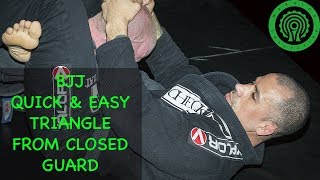
WWW.CHEWJITSU.NET In this video I show a triangle choke from guard. This is a great setup for either gi or no gi Brazilian Jiu-jitsu. I also go into a couple of details about finishing the triangle. Give it a try. Also, for more instructional videos, recipes and all sorts of helpful BJJ related information. Check out my blog www.chewjitsu.net.
Related Techniques
Frequently Asked Questions
What does this video teach about standard triangle?
This video covers transition from gi to no-gi jiu-jitsu, posture break and overhook control, arm control and triangle setup. It provides detailed instruction from Chewjitsu.
How long does it take to learn standard triangle?
The basic mechanics can be understood in a single session, but developing reliable execution requires consistent drilling over weeks of practice. This 9-part breakdown helps structure your training by isolating each phase of the technique.
What are the key details for finishing standard triangle?
Proper positioning requires the leg passing under the armpit to be positioned on top, creating downward pressure that secures the grip. If this leg placement is incorrect, the opponent can straighten their body and escape the triangle. The defender then hips upward and pulls the arm across while maintaining knee-to-knee pressure to work toward the finish.