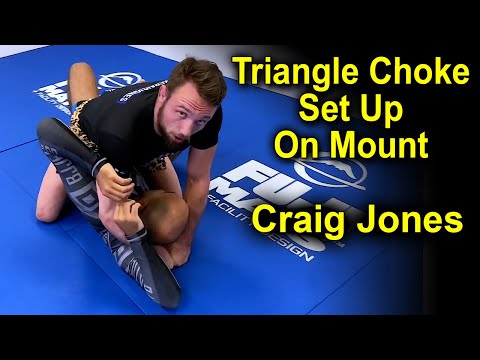
New BJJ Triangle Choke Set Up On The Mount by Craig Jones
0
Triangle From Mount·Bernardo Faria BJJ Fanatics
New BJJ Triangle Choke Set Up On The Mount by Craig Jones - In this video, Craig Jones teaches a great Triangle Choke se…
Translation: Triangle Strangle — From Mount
The triangle choke from mount is applied when the mounted attacker isolates one of the opponent's arms and swings a leg over the head while maintaining the mount position, then transitions to the triangle configuration with the opponent's arm and head trapped inside the legs. [1],[2] The mount provides a gravitational advantage that makes it difficult for the opponent to defend the leg swing, and the attacker can finish by either staying in the mounted triangle or rolling to the back. [1] The mounted triangle is particularly tight due to the downward pressure of the attacker's weight. [1],[2]
The mounted triangle developed in BJJ competition as practitioners combined the positional dominance of mount with the choking mechanics of sankaku-jime. [1],[2] The technique became more prevalent in competition during the 2000s as athletes developed systematic transitions from mount to triangle rather than relying solely on arm attacks from top position. [1] The mounted triangle offers a high-control alternative that minimizes the risk of guard recovery during the submission attempt. [1],[2]
The mount triangle combines the dominant mount position with triangle choke mechanics for a powerful finishing position. [1]
Mount-to-triangle transitions were refined in BJJ and MMA as advanced mount attacks. [1]
Mount triangles are finished in both BJJ competition and MMA. [1]
No images yet for this technique.
Sign in to suggest an image.
New BJJ Triangle Choke Set Up On The Mount by Craig Jones - In this video, Craig Jones teaches a great Triangle Choke se…
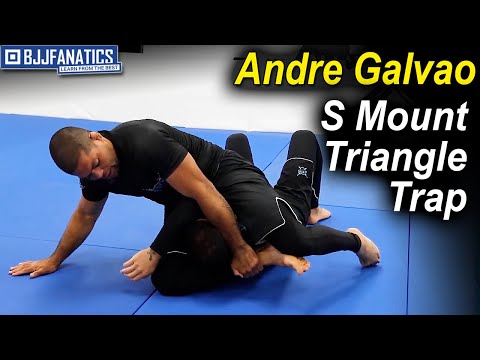
THE S MOUNT TRIANGLE TRAP https://bjjfanatics.com In this BJJ Moves video, Andre Galvao teaches the S Mount triangle Tr…
The triangle from mount is a high-percentage submission attack that maintains top position control throughout its setup and execution. Both Craig Jones (via Bernardo Faria BJJ Fanatics) and Andre Galvao (BJJ Fanatics) emphasize methodical progression from mount position without surrendering positional advantage. Jones prioritizes hand placement on the opponent's neck and under the armpit, using a two-fist reinforcement to elevate the opponent onto their side—a detail he notes is necessary for larger grapplers. He then transitions to a knee-behind-the-head position while immediately securing his own ankle to prevent the opponent from inserting their hands and escaping. Jones emphasizes keeping the body weight distributed to prevent reversal. Galvao's approach focuses on the s-mount variant, where the attacker pushes the opponent's triceps aside, positions one leg behind the head, and transitions by scooping the calf under the neck before securing a figure-four with the opposite leg. Galvao stresses proper hand placement and weight distribution to prevent the opponent from bridging or escaping. Both instructors highlight multiple finishing options: the choke (by driving the knee forward), the strangle (by falling back with elbow-to-floor pressure), and secondary attacks including armbars and wristlocks. The technique's primary advantage is that it avoids conceding top position even if the initial setup fails.
Synthesized from 2 instructors
No instructional courses yet for this technique.
Sign in to suggest a course.
Risk of injury to the person this technique is applied to
Mounted triangle adds top pressure to the leg choke, making escape more difficult
Skill level needed to execute this technique reliably
Whether this technique is allowed under major competition rule sets
Kodokan Judo — Sankaku-jime
Japanese terminology sourced from Kodokan Judo — Sankaku-jime
Official Kodokan ground technique classification system
Standard Japanese martial arts terminology (kanji/hiragana)
Established Japanese martial arts naming convention — native Japanese term (和語/漢語)
Japanese terminology sourced from Kodokan Judo — Sankaku-jime
hip flexibility, long legs relative to torso
longer limbs for easier figure-four lock around head and arm
hip adductors, hamstrings, quadriceps
Every move, in any martial art, shares a few universal traits. Mix and match below to pinpoint the right tool — or compare equivalents across styles.
Andre Galvao emphasizes always pulsing your hand on the floor to maintain stability—never leave it unsupported, as this helps you control the position while advancing your knee and adjusting your setup.
Instead of forcing your leg under, Andre Galvao shows going over the arm and scooping your calf under the neck while controlling your shin, which allows you to trap the leg and set up the figure-four position.
Andre Galvao stresses keeping your forearm directly under the neck rather than allowing the opponent's head to rest on the floor, because once their head contacts the floor, you lose the ability to finish the triangle.
Craig Jones notes that from this mount position, you have multiple finishing options available including an armbar or wrist lock, in addition to the triangle choke.
The triangle choke from mount is applied when the mounted attacker isolates one of the opponent's arms and swings a leg over the head while maintaining the mount position, then transitions to the triangle configuration with the opponent's arm and head trapped inside the legs. The mount provides a gravitational advantage that makes it difficult for the opponent to defend the leg swing, and the attacker can finish by either staying in the mounted triangle or rolling to the back.
The mounted triangle developed in BJJ competition as practitioners combined the positional dominance of mount with the choking mechanics of sankaku-jime. The technique became more prevalent in competition during the 2000s as athletes developed systematic transitions from mount to triangle rather than relying solely on arm attacks from top position.
IBJJF: legal — Legal at all belt levels, gi and no-gi — chokes are the safest submission cat…; IJF: legal — Legal (shime-waza) — strangulation techniques are one of three permitted subm…; ADCC: legal — Legal; Unified MMA: legal — Legal — choke submissions are among the most common finishes in MMA; FIAS Sport Sambo: banned — All chokes prohibited in Sport Sambo; FIAS Combat Sambo: legal — Legal
Danger rating 8/10. Mounted triangle adds top pressure to the leg choke, making escape more difficult
The standard setup chain: Achieve Controlling Position → Isolate the Neck → Set the Grip → Apply Pressure.
Standard counters include: Tuck Chin — protect the neck by lowering the chin to prevent the choke from sinking / Two-on-One Grip Fight — use both hands to strip the choking grip before it locks / Turn Into — rotate toward the choking arm to relieve carotid pressure / Posture Up — straighten the spine and create distance to break the choking angle.
Common variants: Standard triangle (classic figure-four leg lock around the head and one arm …); Reverse triangle (legs locked from behind or inverted angle for different a…); Mounted triangle (applied from mount position with gravity assisting the sq…); No-arm triangle (both arms excluded, legs-only compression on the neck).
Mount triangles are finished in both BJJ competition and MMA.
Top errors to watch for: Forcing the leg under the neck against a defending opponent — the transition requires timing; force it only when the … / Sitting up too high during the transition — keep weight low and forward as the leg threads; sitting up allows the opp… / Not trapping the arm before the leg entry — an uncontrolled arm blocks the leg; secure the arm first, then thread / Falling off to the side without maintaining the lock — the transition from mount to triangle involves a body shift; e….
The Triangle From Mount is also known as Sankaku-jime — From Mount, Mounted Triangle, Top Triangle, Mount Sankaku.