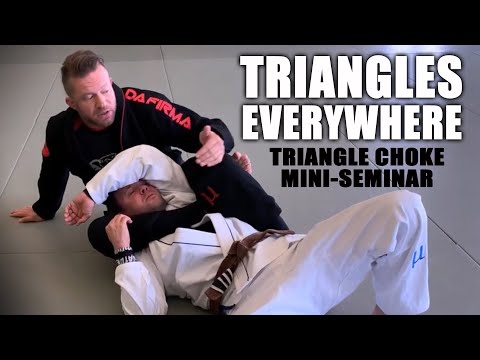
Triangle Chokes from Almost Everywhere | A Mini-Seminar
0
Triangle From Standing·Knight Jiu-Jitsu
Perhaps the most powerful submission technique there is in Jiu-Jitsu is the Triangle Choke. It's no wonder why it is the…
Translation: Flying Triangle Strangle
The triangle choke from standing is applied by jumping guard and simultaneously shooting the legs into a triangle configuration around the opponent's head and arm, or by using a flying triangle entry where the attacker leaps from the ground and wraps the legs mid-air. [1],[2] The standing triangle requires explosive hip elevation and precise timing to lock the legs before both fighters reach the ground. [1] Once locked in the air, the attacker pulls the opponent down while maintaining the triangle squeeze, often finishing the choke upon landing. [1],[2]
The flying triangle gained notoriety through its use in MMA by fighters like Anderson Silva, who demonstrated the technique's viability against standing opponents. [1],[2] The technique has judo competition precedent in the form of standing sankaku-jime entries and was systematized in BJJ as guard-pulling strategies evolved. [1] While considered a high-risk, high-reward technique, the flying triangle has produced memorable finishes in both MMA and sport grappling competition. [1],[2]
Standing triangles jump into the triangle from the feet, requiring explosive hips and timing. [1]
Standing triangle entries were developed in BJJ competition by athletic practitioners. [1]
Standing triangles have been finished in both high-level BJJ and UFC competition. [1]
No images yet for this technique.
Sign in to suggest an image.
Perhaps the most powerful submission technique there is in Jiu-Jitsu is the Triangle Choke. It's no wonder why it is the…
No instructional courses yet for this technique.
Sign in to suggest a course.
Risk of injury to the person this technique is applied to
Standing triangle requires jumping to the neck; risk of falling impact for both athletes
Skill level needed to execute this technique reliably
Whether this technique is allowed under major competition rule sets
Japanese Judo — Tobi-sankaku-jime
Japanese terminology sourced from Japanese Judo — Tobi-sankaku-jime
Standard Japanese martial arts terminology (kanji/hiragana)
Established Japanese martial arts naming convention — native Japanese term (和語/漢語)
Japanese terminology sourced from Japanese Judo — Tobi-sankaku-jime
hip flexibility, long legs relative to torso
longer limbs for easier figure-four lock around head and arm
hip adductors, hamstrings, quadriceps
Every move, in any martial art, shares a few universal traits. Mix and match below to pinpoint the right tool — or compare equivalents across styles.
Keep your knees facing the same way, make the bite, and squeeze to finish. Knight Jiu-Jitsu emphasizes that proper knee positioning is essential to the technique's success.
Think of mount as an upside-down guard and use the same punch-pole grip on the wrist while keeping one arm pressed against your opponent, then rotate to lock the triangle.
If you recognize your opponent attempting to reach underneath to escape, you can attack their arm in response before they complete the escape.
Instead of going inside the arm, punch the arm inside and then go around the outside of it, which is a common setup variation for the triangle.
The triangle choke from standing is applied by jumping guard and simultaneously shooting the legs into a triangle configuration around the opponent's head and arm, or by using a flying triangle entry where the attacker leaps from the ground and wraps the legs mid-air. The standing triangle requires explosive hip elevation and precise timing to lock the legs before both fighters reach the ground.
The flying triangle gained notoriety through its use in MMA by fighters like Anderson Silva, who demonstrated the technique's viability against standing opponents. The technique has judo competition precedent in the form of standing sankaku-jime entries and was systematized in BJJ as guard-pulling strategies evolved.
IBJJF: legal — Legal at all belt levels, gi and no-gi — chokes are the safest submission cat…; IJF: legal — Legal (shime-waza) — strangulation techniques are one of three permitted subm…; ADCC: legal — Legal; Unified MMA: legal — Legal — choke submissions are among the most common finishes in MMA; FIAS Sport Sambo: banned — All chokes prohibited in Sport Sambo; FIAS Combat Sambo: legal — Legal
Danger rating 8/10. Standing triangle requires jumping to the neck; risk of falling impact for both athletes
The standard setup chain: Achieve Controlling Position → Isolate the Neck → Set the Grip → Apply Pressure.
Standard counters include: Tuck Chin — protect the neck by lowering the chin to prevent the choke from sinking / Two-on-One Grip Fight — use both hands to strip the choking grip before it locks / Turn Into — rotate toward the choking arm to relieve carotid pressure / Posture Up — straighten the spine and create distance to break the choking angle.
Common variants: Standard triangle (classic figure-four leg lock around the head and one arm …); Reverse triangle (legs locked from behind or inverted angle for different a…); Mounted triangle (applied from mount position with gravity assisting the sq…); No-arm triangle (both arms excluded, legs-only compression on the neck).
Standing triangles have been finished in both high-level BJJ and UFC competition.
Top errors to watch for: Sitting back without controlling the arm — the guard pull must include arm isolation; sitting without control results… / Pulling guard too aggressively and landing in a poor position — the guard pull should be controlled; crashing to the … / Not locking the triangle immediately upon landing — the standing-to-ground transition is the critical moment; the tri… / Attempting against an opponent with a low, defensive posture — the standing triangle needs the opponent to be upright….
The Triangle From Standing is also known as Tobi-sankaku-jime, Standing Triangle, Flying Triangle, Tobi-sankaku.