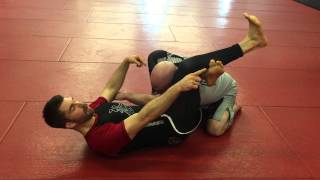
Introduction to Reverse Triangle from Back Control
The instructor demonstrates a reverse triangle submission variation executed from back control. This technique represents an alternative approach to leg lock transitions typically employed from this position.
Establishing Control and Arm Positioning
From back control, the instructor focuses on controlling the opponent's wrist and positioning the leg across the hip with tension. The key is to prevent the opponent from escaping by using the choking hand to work the opponent's hand off while maintaining neck control.
Transition to Triangle Position
The instructor posts on the mat and shoves backward to catch their own shin under the opponent's neck, then falls to the side to close the triangle. Critical spacing must be eliminated between the carotid artery and the knee to ensure an effective choke rather than leaving gaps the opponent can exploit.
Arm Bar Alternative When Triangle Fails
If the opponent removes their arm to escape the triangle, the instructor pivots to attacking the elbow by swimming underneath and collecting it similar to a heel hook grip. This forces the opponent to choose between maintaining arm position or surrendering to the triangle choke.
Fist-in-Triangle and Head Position Adjustments
The instructor demonstrates inserting the fist into the triangle to apply choking pressure when the opponent turns their head to defend. If the opponent positions their head to the left, the instructor responds with a collar-tie grip to keep the head centered and maintain squeeze pressure.
Shoulder Lock Variation
As a final option when the triangle is fully defended, the instructor can transition to a shoulder lock by using a gable grip heel hook position and falling to the side. This variation provides an additional finishing option if the opponent successfully defends the choke.
Pressure and Spacing Details
The instructor emphasizes maintaining close pressure on the neck to prevent the opponent from bridging or weaving underneath to escape. Proper hip positioning and leg extension are critical to closing the triangle effectively while hiding the leg position behind the opponent's hips.
Multiple Finishing Options Summary
The reverse triangle offers multiple submission pathways: the standard choke, fist-in-triangle variation, arm bar, and shoulder lock. The instructor can switch between these options based on the opponent's defensive responses, allowing for continuous pressure and attack options.
How To Do A Reverse Triangle From The Back
Key Takeaways
- •Introduction to Reverse Triangle from Back Control
- •Establishing Control and Arm Positioning
- •Transition to Triangle Position
- •Arm Bar Alternative When Triangle Fails
How To Do A Reverse Triangle From The Back - In this video, Tum shows some cool details from the Reverse Triangle. Tum starts with a quick setup from the back to enter the Reverse Triangle. The Reverse Triangle is in my book by far the most dominant position available in Jiu Jitsu. Not only can you finish with the standard Triangle Choke, you also have acces to the Armbar, Wristlock, Shoulder Lock, as well as Leg Attacks. In MMA you can strike from this position as well, leaving the opponent very few options to defend. Tum shows the details on one of his favorite attacks from the Reverse Triangle: the Fist Choke. Check out "Leglocks Unlocked" at BJJ Fanatics: https://bjjfanatics.com/products/the-keys-to-leg-locks-by-tum-energia-voorn Tum has many more amazing techniques on his Youtube Channel! You can find them here: https://www.youtube.com/channel/UCPAm-P3ypZuwwzhDoqahqyA Check out this video to see my take on the Reverse Triangle Choke From Mount on Tum's Channel: https://www.youtube.com/watch?v=F_c27ZrInj8 #ReverseTriangle #TumEnergia #WimDeputter #ReverseTriangleChoke #TriangleChoke #Choke #ReverseTriangleFromTheBack #MirroringPrinciple #JiuJitsu #BJJ #BrazilianJiuJitsu #OffensiveDefense
Related Techniques
Frequently Asked Questions
What does this video teach about reverse triangle?
This video covers introduction to reverse triangle from back control, establishing control and arm positioning, transition to triangle position. It provides detailed instruction from Wim Deputter BJJ.
How long does it take to learn reverse triangle?
The basic mechanics can be understood in a single session, but developing reliable execution requires consistent drilling over weeks of practice. This 8-part breakdown helps structure your training by isolating each phase of the technique.
What are the key details for finishing reverse triangle?
The instructor emphasizes maintaining close pressure on the neck to prevent the opponent from bridging or weaving underneath to escape. Proper hip positioning and leg extension are critical to closing the triangle effectively while hiding the leg position behind the opponent's hips.