MOUNTED triangle from side control - Brazilian jiu-jitsu submission
0
Triangle From Side Control·Grappling Nerds
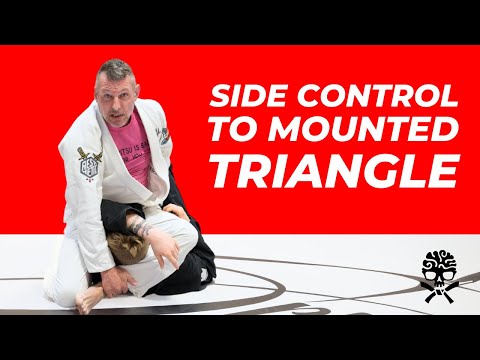
Hey everyone! Welcome back to Grappling Nerds. Today, we're excited to teach you how to set up a mounted triangle starti…
Translation: Triangle Strangle — From Side Control
The triangle choke from side control is applied by the bottom player who creates space from underneath the side control pin, threads one leg across the opponent's neck, and locks the triangle by trapping the head and near-side arm inside the leg configuration. [1],[2] This is a defensive submission that converts a disadvantageous position into a choking threat, requiring precise timing when the top player transitions or reaches. [1] The attacker must bridge and shrimp to create enough space to shoot the leg across the shoulder line and lock the triangle. [1],[2]
The triangle from bottom side control developed as BJJ practitioners explored submission options from inferior positions, reflecting the art's emphasis on the bottom player's ability to threaten from any position. [1],[2] The technique became a recognized option in competition during the 2000s, though it remains a lower-percentage attempt due to the difficulty of creating enough space from underneath a tight side control. [1] Successful application requires precise timing during the top player's transitions between pins. [1],[2]
The triangle from side control bottom is a counter-attack submission, catching the top player during transitions. [1]
Side control triangles developed in BJJ as fighters found triangle opportunities from unexpected positions. [1]
Side control triangles appear at advanced BJJ competition levels. [1]
No images yet for this technique.
Sign in to suggest an image.
Hey everyone! Welcome back to Grappling Nerds. Today, we're excited to teach you how to set up a mounted triangle starti…
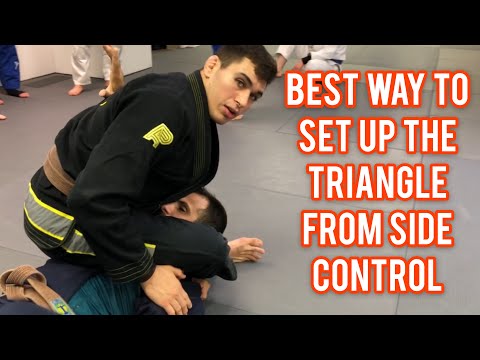
Best Way To Set Up The Triangle Choke From Side Control // Side Control is often a position that people who are unfamil…
The triangle choke from side control begins with strong arm isolation, a prerequisite both Grappling Nerds and Giancarlo Bodoni emphasize. Grappling Nerds describes a direct approach: maintain side control with tricep control, then slide the knees in gradually to avoid telegraphing, transfer weight onto one knee, and drive the opponent's arm across their face to create the triangle geometry. The top player sits to the side of the opponent's chest rather than directly on top, enabling weight distribution and preventing the opponent from striking or grabbing. Bodoni offers a lapel-based setup that provides additional control: isolate one arm, open the opponent's lapel, pass it over the elbow, trap it with an underhook grip at the neck, then step over the head into the triangle. Both instructors stress keeping knees in contact with the body and maintaining chest-to-chest positioning during the transition. Bodoni provides additional finishing details: once mounted in the triangle, lock the shin, place the knee on the floor for stability, and finish either by squeezing the knees while pulling the head or by turning the opponent's wrist inward toward an armlock. Both acknowledge that if the mount position fails, the practitioner can adjust and finish the triangle from guard position.
Synthesized from 2 instructors
No instructional courses yet for this technique.
Sign in to suggest a course.
Risk of injury to the person this technique is applied to
Side triangle requires threading the legs from a perpendicular angle; less common but effective
Skill level needed to execute this technique reliably
Whether this technique is allowed under major competition rule sets
Kodokan Judo — Sankaku-jime
Japanese terminology sourced from Kodokan Judo — Sankaku-jime
Official Kodokan ground technique classification system
Standard Japanese martial arts terminology (kanji/hiragana)
Established Japanese martial arts naming convention — native Japanese term (和語/漢語)
Japanese terminology sourced from Kodokan Judo — Sankaku-jime
hip flexibility, long legs relative to torso
longer limbs for easier figure-four lock around head and arm
hip adductors, hamstrings, quadriceps
Every move, in any martial art, shares a few universal traits. Mix and match below to pinpoint the right tool — or compare equivalents across styles.
The reverse triangle from side control locks the triangle choke in reverse orientation — the attacker's legs wrap around the opponent's head and arm from the opposite direction compared to the standard triangle. [1] From side control, the attacker threads the near leg over the opponent's neck and under the far arm, then locks the reverse triangle by hooking the ankle behind the opposite knee from a top or perpendicular position. [1,2] The reverse orientation means the compression angle comes from above rather than below, using the attacker's weight to press down into the triangle. [2] This variant catches opponents who are focused on defending standard side control attacks and don't anticipate the leg-based threat. [2,3]
The side triangle from side control applies the triangle choke while maintaining the perpendicular side control position, with the legs wrapping around the opponent's head and arm from a lateral angle. [1] The attacker slides the near knee over the opponent's throat while controlling the far arm, then locks the figure-four leg configuration to establish the triangle from this side-mounted position. [1,2] The side triangle provides top-position control throughout the submission attempt, meaning the attacker retains a dominant position even if the choke fails. [2] The lateral angle of compression can be equally effective as the standard front-facing triangle when properly tightened. [2,3]
Keep your toes on the mat rather than flat feet, spread your knees, maintain hips down, and stay chest to chest with your opponent, according to Giancarlo Bodoni. This foundational positioning gives you control before executing the submission.
Grappling Nerds emphasizes sliding your knees in slowly—don't rush or jump immediately into mount. Establish tricep control first before bringing your knee up and transferring your weight, allowing you to isolate the arm properly before entering the triangle.
Bring the opponent's arm across their face and position yourself slightly to the side rather than directly on top, then sit with your buttocks on their chest while pinching your legs together like a triangle from bottom, according to Grappling Nerds. Positioning to the side also prevents them from striking or grabbing your face.
The triangle choke from side control is applied by the bottom player who creates space from underneath the side control pin, threads one leg across the opponent's neck, and locks the triangle by trapping the head and near-side arm inside the leg configuration. This is a defensive submission that converts a disadvantageous position into a choking threat, requiring precise timing when the top player transitions or reaches.
The triangle from bottom side control developed as BJJ practitioners explored submission options from inferior positions, reflecting the art's emphasis on the bottom player's ability to threaten from any position. The technique became a recognized option in competition during the 2000s, though it remains a lower-percentage attempt due to the difficulty of creating enough space from underneath a tight side control.
IBJJF: legal — Legal at all belt levels, gi and no-gi — chokes are the safest submission cat…; IJF: legal — Legal (shime-waza) — strangulation techniques are one of three permitted subm…; ADCC: legal — Legal; Unified MMA: legal — Legal — choke submissions are among the most common finishes in MMA; FIAS Sport Sambo: banned — All chokes prohibited in Sport Sambo; FIAS Combat Sambo: legal — Legal
Danger rating 8/10. Side triangle requires threading the legs from a perpendicular angle; less common but effective
The standard setup chain: Achieve Controlling Position → Isolate the Neck → Set the Grip → Apply Pressure.
Standard counters include: Tuck Chin — protect the neck by lowering the chin to prevent the choke from sinking / Two-on-One Grip Fight — use both hands to strip the choking grip before it locks / Turn Into — rotate toward the choking arm to relieve carotid pressure / Posture Up — straighten the spine and create distance to break the choking angle.
Common variants: Standard triangle (classic figure-four leg lock around the head and one arm …); Reverse triangle (legs locked from behind or inverted angle for different a…); Mounted triangle (applied from mount position with gravity assisting the sq…); No-arm triangle (both arms excluded, legs-only compression on the neck).
Side control triangles appear at advanced BJJ competition levels.
Top errors to watch for: Releasing upper body control to thread the legs — maintain crossface or underhook while the legs move; losing upper b… / Stepping over the head without controlling the near arm — the arm must be isolated before the leg crosses; without ar… / Not locking the figure-four before attempting to finish — the connection must be solid; squeezing without the lock wa… / Threading the legs too slowly — the transition must be smooth; slow leg threading allows the opponent to block with t….
The Triangle From Side Control is also known as Sankaku-jime — From Side Control, Side Triangle, Side Control Sankaku.