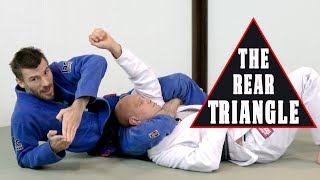
Flying Triangle Overview
The flying triangle is an aerial submission technique in which a practitioner launches from a standing position to apply a triangle choke. The technique requires precise timing and body positioning to execute safely and effectively against a resisting opponent.
Fundamental Setup from Necktie Control
The flying triangle begins from a necktie clinch position where one fighter controls the opponent's neck and head. From this position, the attacker breaks the opponent's grip, jumps with a leading leg over the shoulder, locks the triangle, and immediately secures the opponent's leg to prevent a slam.
Guard Triangle Mechanics Apply Standing
The flying triangle uses identical leg positioning to a traditional guard triangle choke. The key difference is executing the setup while standing rather than on the ground, requiring the attacker to isolate one of the opponent's arms before jumping.
Arm Isolation and Leg Entry Technique
The attacking leg leads over the opponent's shoulder while the defending arm is trapped inside the triangle. Once the first leg clears the shoulder, the second leg locks to complete the submission, and the attacker immediately grabs the opponent's leg to prevent being slammed.
Defense Against Slamming
The flying triangle mitigates slam risk because the attacker's body weight acts as an unexpected load on the opponent's neck, causing natural postural resistance. By the time the opponent reacts to this pressure, the attacker is already airborne and securing leg control, making the throw mechanically difficult.
Practical Context and Sport Application
The flying triangle is presented as a sport-specific technique suited for controlled training environments rather than street altercations. The risk of skull injury from landing inverted makes this technique inappropriate for self-defense situations outside the gym.
Wrist Grab Variation and Arm Distraction
An alternative setup involves the opponent grabbing the attacker's wrist. The attacker creates arm isolation by faking an arm drag motion to distract the opponent's grip, then executes the flying triangle while one hand remains on the neck.
Double Underhook Barrier and Commitment
The technique fails if the opponent establishes double underhooks, as this prevents the attacker from jumping effectively. The opponent must maintain some contact with the attacker's neck or upper body for the flying triangle to be viable.
Submission Completion and Transitions
Once airborne, the attacker locks both legs in triangle position and immediately secures the opponent's leg. If the triangle lock cannot be achieved, the position transitions to an armlock as an alternative submission before landing.
Partner Safety and Weight Considerations
Practitioners should only attempt flying triangles with partners capable of supporting their body weight during the jump. Attempting the technique with partners unable to bear the load increases injury risk through uncontrolled landing and impact.
Flying Triangle
Key Takeaways
- •Flying Triangle Overview
- •Fundamental Setup from Necktie Control
- •Guard Triangle Mechanics Apply Standing
- •Arm Isolation and Leg Entry Technique
http://www.GracieAcademy.com Rener Gracie, head instructor of the world famous Gracie Jiu-Jitsu Academy in Torrance, CA, teaches you the secrets of the flying triangle. He is joined by Brian Ortega who shows us why they call him T-city.
Frequently Asked Questions
What does this video teach about flying triangle?
This video covers flying triangle overview, fundamental setup from necktie control, guard triangle mechanics apply standing. It provides detailed instruction from Gracie Jiu-jitsu Academy.
How long does it take to learn flying triangle?
The basic mechanics can be understood in a single session, but developing reliable execution requires consistent drilling over weeks of practice. This 10-part breakdown helps structure your training by isolating each phase of the technique.
What are the key details for finishing flying triangle?
Once airborne, the attacker locks both legs in triangle position and immediately secures the opponent's leg. If the triangle lock cannot be achieved, the position transitions to an armlock as an alternative submission before landing.