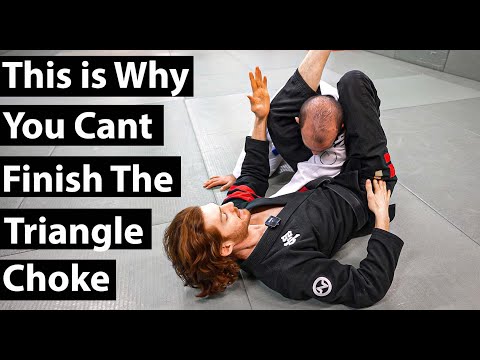
Triangle Choke: The Detail That Changes Everything ( Complete Guide )
0
Triangle From Open Guard·JonThomasBJJ
The Triangle Choke is one of the most important submissions in jiu jitsu, but so many people struggle to finish it. Thi…
Translation: Triangle Strangle — From Open Guard
The triangle choke from open guard is applied from various open guard configurations — spider guard, lasso guard, De La Riva guard, or simply open guard with feet on hips — by shooting one leg across the opponent's shoulder line and trapping the head and one arm inside the triangle lock. [1],[2] Open guard provides greater range of motion for leg elevation and hip movement compared to closed guard, allowing faster and more dynamic triangle entries. [1] The attacker uses grips on sleeves, collar, or wrists to control distance and create the opening for the triangle lock. [1],[2]
Open guard triangles evolved alongside the expansion of modern BJJ guard systems in the 2000s, as competitors moved away from closed guard toward more dynamic open guard positions. [1],[2] The development of spider guard, De La Riva guard, and other open guard frameworks provided new entry angles for the triangle that were faster and less dependent on breaking posture. [1] Competitors like Braulio Estima and Leandro Lo demonstrated the effectiveness of open-guard triangle setups at the highest levels of competition. [1],[2]
Open guard triangles use hip mobility and leg dexterity to lock the triangle from various open guard positions. [1]
Open guard triangles were developed as open guard systems expanded in modern BJJ. [1]
Open guard triangles are common in IBJJF and ADCC competition. [1]
No images yet for this technique.
Sign in to suggest an image.
The Triangle Choke is one of the most important submissions in jiu jitsu, but so many people struggle to finish it. Thi…
No instructional courses yet for this technique.
Sign in to suggest a course.
Risk of injury to the person this technique is applied to
Triangle chokes compress the carotid arteries using the legs; loss of consciousness in 8-12 seconds
Skill level needed to execute this technique reliably
Whether this technique is allowed under major competition rule sets
Kodokan Judo — Sankaku-jime
Japanese terminology sourced from Kodokan Judo — Sankaku-jime
Official Kodokan ground technique classification system
Standard Japanese martial arts terminology (kanji/hiragana)
Established Japanese martial arts naming convention — native Japanese term (和語/漢語)
Japanese terminology sourced from Kodokan Judo — Sankaku-jime
hip flexibility, long legs relative to torso
longer limbs for easier figure-four lock around head and arm
hip adductors, hamstrings, quadriceps
Every move, in any martial art, shares a few universal traits. Mix and match below to pinpoint the right tool — or compare equivalents across styles.
Jon Thomas emphasizes stretching your leg straight so it cuts into the neck, and when your leg chops down, it conforms around the neck naturally—this creates tightness on its own. The key is contracting all the small muscles in your leg rather than just pulling the head; you want everything squeezing together to finish.
As your opponent starts stacking, drop your hip to the floor and arch your low back, driving to slide back and to the side rather than straight back. This side angle movement prevents them from collapsing your triangle, and you can also put your foot on the hip to maintain control.
Bridge your hips all the way up to pop their elbow out of that pocket, then come behind the elbow and drag it across. Once you drag it across, drop your hip and return to your standard finishing mechanic.
Jon Thomas recommends that if you have longer legs or are fighting someone with a smaller neck, avoid locking at the foot. Instead, take your top knee and drive the head into the crook of your knee while latching high over your shin, which creates a very tight finish.
The triangle choke from open guard is applied from various open guard configurations — spider guard, lasso guard, De La Riva guard, or simply open guard with feet on hips — by shooting one leg across the opponent's shoulder line and trapping the head and one arm inside the triangle lock. Open guard provides greater range of motion for leg elevation and hip movement compared to closed guard, allowing faster and more dynamic triangle entries.
Open guard triangles evolved alongside the expansion of modern BJJ guard systems in the 2000s, as competitors moved away from closed guard toward more dynamic open guard positions. The development of spider guard, De La Riva guard, and other open guard frameworks provided new entry angles for the triangle that were faster and less dependent on breaking posture.
IBJJF: legal — Legal at all belt levels, gi and no-gi — chokes are the safest submission cat…; IJF: legal — Legal (shime-waza) — strangulation techniques are one of three permitted subm…; ADCC: legal — Legal; Unified MMA: legal — Legal — choke submissions are among the most common finishes in MMA; FIAS Sport Sambo: banned — All chokes prohibited in Sport Sambo; FIAS Combat Sambo: legal — Legal
Danger rating 8/10. Triangle chokes compress the carotid arteries using the legs; loss of consciousness in 8-12 seconds
The standard setup chain: Achieve Controlling Position → Isolate the Neck → Set the Grip → Apply Pressure.
Standard counters include: Tuck Chin — protect the neck by lowering the chin to prevent the choke from sinking / Two-on-One Grip Fight — use both hands to strip the choking grip before it locks / Turn Into — rotate toward the choking arm to relieve carotid pressure / Posture Up — straighten the spine and create distance to break the choking angle.
Common variants: Standard triangle (classic figure-four leg lock around the head and one arm …); Reverse triangle (legs locked from behind or inverted angle for different a…); Mounted triangle (applied from mount position with gravity assisting the sq…); No-arm triangle (both arms excluded, legs-only compression on the neck).
Open guard triangles are common in IBJJF and ADCC competition.
Top errors to watch for: Not hip-scooting as the leg shoots — the hips must advance toward the opponent during the leg entry; stationary hips … / Abandoning all open guard grips during the entry — maintain at least one controlling grip to prevent the opponent fro… / Shooting the leg at a standing opponent with good posture — the triangle entry requires compromised posture; if they'… / Not angling after locking — the same angle requirement applies from open guard; failure to pivot leaves the triangle ….
The Triangle From Open Guard is also known as Sankaku-jime — From Open Guard, Open Guard Triangle, Spider Guard Triangle.