Learning the "DUCK Under" Takedown
0
Standard Duck Under Back Take·TeachMeGrappling Coach Brian
This video I breakdown another duck under. Sometimes I teach it differently so there is always new details that aren't …
Translation: standard duck under back take
The Standard Duck Under Back Take executes the fundamental duck under to rear position where the attacker, from a collar tie or clinch, pushes the opponent's arm upward, ducks the head and body underneath the raised arm, and continues circling behind the opponent to secure a rear body lock. [1] The push-then-duck creates the space needed to pass under the arm, and the circular motion behind the opponent completes the back take. [1],[2] Once behind, the attacker locks the hands around the waist for a rear body lock and can proceed with any rear takedown — mat return, rear lift, or trip. [2],[3]
The standard duck under back take is the baseline version of this technique taught in wrestling. [1]
Commonly used in NCAA and freestyle competition. [1]
No images yet for this technique.
Sign in to suggest an image.
This video I breakdown another duck under. Sometimes I teach it differently so there is always new details that aren't …
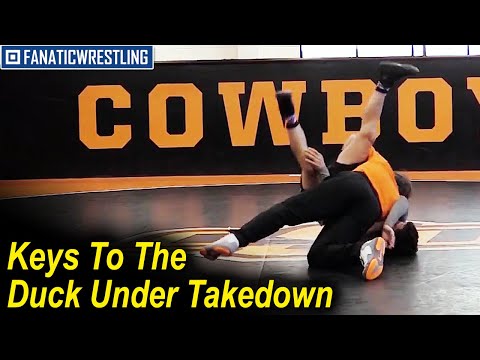
Keys To The Duck Under Takedown by John Smith https://fanaticwrestling.com/ This wrestling training video teaches the K…
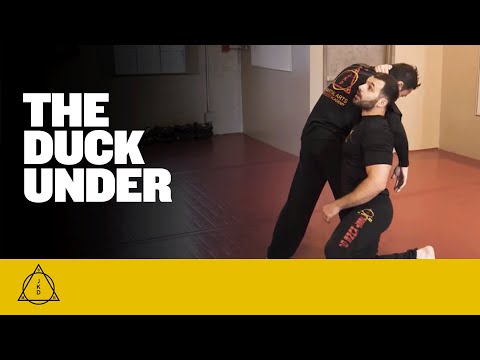
https://www.nymaa.com/ Adult program https://bit.ly/2G4cMJ2 Kids program https://bit.ly/2X3B64G Private lessons https:/…
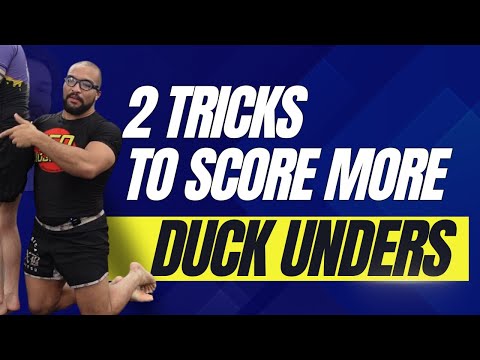
Learn one of my favorite Duck Under Takedowns for Wrestling that translates extremely well to Brazilian Jiu-Jitsu & ALL …
The standard duck under back take is a fundamental upper-body takedown executed from a collar tie or similar control, emphasizing neck pressure and timing to transition an opponent to their back. All four instructors agree on core mechanical principles: establishing a strong collar tie as the primary control point, creating minimal space to duck underneath an opponent's posted arm, and changing levels rather than lifting the arm high. NY Martial Arts Academy and FANATIC WRESTLING (John Smith) both stress the monkey grip on the tricep as a critical secondary control that facilitates the pull-down motion. The technique involves an inside step followed by an outside step—entering at an angle that prevents throws—with the head kept high and the back straight to avoid being trapped. FANATIC WRESTLING emphasizes penetrating with shoulder rotation while maintaining the monkey grip pull straight downward, noting that proper elbow control allows the duck under to function as a setup for combinations like double-leg transitions. TeachMeGrappling Coach Brian stresses maintaining weight on the opponent by staying on active feet rather than dropping to the knees immediately, allowing for side control transitions if the opponent rolls. Brandon Reed Wrestle-Jitsu Online introduces tactical variation, noting that duck unders function differently depending on opponent response—distinguishing between opponents who sprawl versus those who don't—and emphasizing that feinting to a leg attack often triggers the sprawl that creates ideal duck under positioning. Once behind or beside the opponent, instructors demonstrate two finishing options: either pulling the opponent directly to the mat using body weight and spiral momentum (NY Martial Arts Academy), or using a claw grip (high crotch lift) to explosively elevate then drive the opponent down (NY Martial Arts Academy, TeachMeGrappling).
Synthesized from 4 instructors
No instructional courses yet for this technique.
Sign in to suggest a course.
Risk of injury to the person this technique is applied to
Duck under to rear; minimal impact, position-based
Skill level needed to execute this technique reliably
Whether this technique is allowed under major competition rule sets
Japanese amateur wrestling terminology
Japanese amateur wrestling terminology
Standard katakana transliteration of Western martial arts terminology (外来語) — used in Japanese MMA, boxing, and BJJ communities
Standard katakana transliteration used in Japanese wrestling (レスリング)
upper body squeeze strength, lifting power, hip drive
thick chest and arms for tight lock, strong lower back for lifts
pectorals, biceps, erector spinae, glutes
John Smith recommends starting with the duck hunter first if you've never worked elbow controls, as it's easier to understand the pulling mechanics without attacking the legs or going to the mat right away.
John Smith emphasizes wrapping right below the butt is the sweet spot—if you can lock your hands there and control the legs together, you control your opponent and can take them to the mat effectively.
Coach Brian advises staying on your toes, keeping hanging on, and pulling your opponent down again—being heavy and maintaining control is critical if they attempt to pop back up like a tripod.
Coach Brian stresses stepping deep and staying close to your opponent; if you're too far away, they can escape through the gap you create.
The Standard Duck Under Back Take executes the fundamental duck under to rear position where the attacker, from a collar tie or clinch, pushes the opponent's arm upward, ducks the head and body underneath the raised arm, and continues circling behind the opponent to secure a rear body lock. The push-then-duck creates the space needed to pass under the arm, and the circular motion behind the opponent completes the back take.
The standard duck under to back take is one of the first intermediate-level wrestling techniques taught, serving as a gateway to understanding angle creation and positional advantage. The technique has been fundamental to wrestling instruction for generations.
IJF: legal — Legal takedown technique; IBJJF: legal — Legal at all belt levels, scored as takedown (2 points); UWW: legal — Legal in both freestyle and Greco-Roman; Unified MMA: legal — Legal takedown technique; ADCC: legal — Legal, scored 2-4 points in second half of match; FIAS Sport Sambo: legal — Legal — all takedowns permitted; FIAS Combat Sambo: legal — Legal; NCAA Folkstyle: legal — Legal, scored as takedown (2 points)
Danger rating 3/10. Moderate — duck under to rear; minimal impact, position-based
The standard setup chain: Establish Contact → Create Off-Balance → Execute the Takedown → Follow to Ground.
Standard counters include: Sprawl — drop hips back and drive weight down to stuff the takedown attempt / Underhook — establish inside position to control distance and prevent the takedown entry / Post and Circle — post on the attacker's head and circle away to break their angle / Level Change Defence — recognize the shot early and react with appropriate hip defence.
Common variants: Front body lock (securing the lock face-to-face and driving laterally or b…); Rear body lock (securing from behind for mat returns or lifts); Side body lock (angled body lock for trips and throws); Body lock to trip (combining the lock with a foot trip for the finish).
Commonly used in NCAA and freestyle competition.
Top errors to watch for: Not pushing the arm high enough before ducking, getting your head trapped under their armpit / Ducking without changing level — your head needs to go under the arm, not through it / Stopping mid-duck beside the opponent instead of circling all the way behind / Not wrapping the waist immediately, letting the opponent turn back to face you.
The Standard Duck Under Back Take is also known as Dakku Andā Bakku Teiku, Standard Duck-Under to Back, Duck-Through Back Take, Go-Behind from Duck.