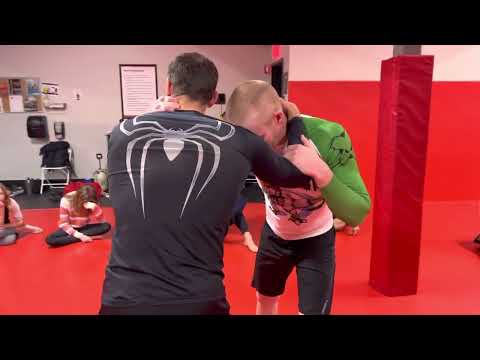
No gi duck under takedown
0
Duck Under Takedown·BJJ4Breakfast
No gi duck under takedown to the back
Translation: duck under takedown (katakana)
The Duck Under Takedown family covers takedowns where the attacker ducks underneath the opponent's arm to achieve a behind or side position, then completes a takedown from the advantageous angle. [1] The duck under is a misdirection technique: the attacker creates pressure or a feint in one direction, then quickly ducks the head and body underneath the opponent's arm in the opposite direction. [1],[2] The resulting position — behind or beside the opponent — provides access to back takes, body locks, and various takedown finishes. [2] Duck unders are energy-efficient and low-risk, making them valuable at all levels of competition. [2],[3]
The duck under is a fundamental technique in both freestyle and folkstyle wrestling, taught at all levels from youth through Olympic competition. [1]
The duck under is a standard technique in NCAA and international freestyle wrestling. [1]
No images yet for this technique.
Sign in to suggest an image.
No gi duck under takedown to the back
No instructional courses yet for this technique.
Sign in to suggest a course.
Risk of injury to the person this technique is applied to
Duck under to rear; minimal impact, position-based
Skill level needed to execute this technique reliably
Whether this technique is allowed under major competition rule sets
Japanese amateur wrestling terminology
Japanese amateur wrestling terminology
Standard katakana transliteration of Western martial arts terminology (外来語) — used in Japanese MMA, boxing, and BJJ communities
Standard katakana transliteration used in Japanese wrestling (レスリング)
upper body squeeze strength, lifting power, hip drive
thick chest and arms for tight lock, strong lower back for lifts
pectorals, biceps, erector spinae, glutes
Every move, in any martial art, shares a few universal traits. Mix and match below to pinpoint the right tool — or compare equivalents across styles.
The Duck Under To Back Take subfamily specifically uses the duck under to achieve a rear body position, from which the attacker can complete a body lock takedown, mat return, or rear lift. [1] After ducking under the opponent's arm, the attacker continues the motion behind the opponent, securing a rear body lock or rear clinch position. [1,2] The back take is the most advantageous outcome of a successful duck under because it gives the attacker access to the full suite of rear takedowns while the opponent has minimal defensive options. [2,3]
The Standard Duck Under subfamily represents the basic duck under technique used as a general offensive tool, where the attacker ducks under the opponent's arm to achieve any advantageous position — side, behind, or angle — for a takedown. [1] The standard duck under prioritises creating an angular advantage over specifically achieving the back, giving the attacker flexibility to chain into whichever takedown is most available. [1,2] The technique works from various tie-up positions including collar tie, underhook, and overhook, making it one of the most versatile positional-advantage techniques in wrestling. [2,3]
The duck under appears in 59 passages across 34 books — one of the most widely documented wrestling techniques. Blitz Martial Arts Magazine (2015) describes: 'As he swings for the fences, we duck under and take his back. With the rear body-lock in place, we then stomp through the back of his knee.' A fundamental wrestling and self-defense technique. (34 books in corpus; Blitz Martial Arts, April 2015)
Get inside bicep control rather than allowing them to establish a wrestler's tie, which gives them the ability to move your head around. This control is essential before you execute the duck under.
Create a reaction by surprising your opponent with a snap down or a faked snap down on their head. This forces them to react and opens the timing window for you to execute the technique.
Anticipate their reach for your thigh by making a c-cup with your hand and popping their arm up over your head as they come in. This keeps you tight while creating pressure through your head and arm.
The Duck Under Takedown family covers takedowns where the attacker ducks underneath the opponent's arm to achieve a behind or side position, then completes a takedown from the advantageous angle. The duck under is a misdirection technique: the attacker creates pressure or a feint in one direction, then quickly ducks the head and body underneath the opponent's arm in the opposite direction.
Duck unders have been part of wrestling technique for centuries, appearing in both stand-up wrestling and clinch work across multiple traditions. The technique was systematised in modern wrestling programmes as a fundamental positional-advantage tool.
IJF: legal — Legal takedown technique; IBJJF: legal — Legal at all belt levels, scored as takedown (2 points); UWW: legal — Legal in both freestyle and Greco-Roman; Unified MMA: legal — Legal takedown technique; ADCC: legal — Legal, scored 2-4 points in second half of match; FIAS Sport Sambo: legal — Legal — all takedowns permitted; FIAS Combat Sambo: legal — Legal; NCAA Folkstyle: legal — Legal, scored as takedown (2 points)
Danger rating 3/10. Moderate — duck under to rear; minimal impact, position-based
The standard setup chain: Establish Contact → Create Off-Balance → Execute the Takedown → Follow to Ground.
Standard counters include: Sprawl — drop hips back and drive weight down to stuff the takedown attempt / Underhook — establish inside position to control distance and prevent the takedown entry / Post and Circle — post on the attacker's head and circle away to break their angle / Level Change Defence — recognize the shot early and react with appropriate hip defence.
Common variants: Front body lock (securing the lock face-to-face and driving laterally or b…); Rear body lock (securing from behind for mat returns or lifts); Side body lock (angled body lock for trips and throws); Body lock to trip (combining the lock with a foot trip for the finish).
The duck under is a standard technique in NCAA and international freestyle wrestling.
Top errors to watch for: Ducking too slowly, letting the opponent crossface or re-square before you get through / Looking at the floor during the duck, losing awareness of the opponent's position / Not pushing the arm up high enough before ducking — you get stuck under a heavy arm / Stopping after the duck without continuing to the back — you're beside them with no control.
The Duck Under Takedown is also known as Dakku Andā Teikudaun, Duck Under, Duck, Dip Under.