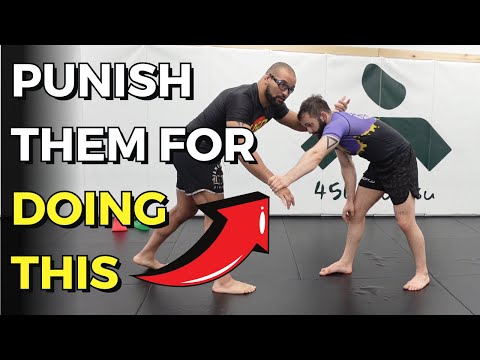
The Slickest Way to Take the Back Fast in BJJ (Duck Under Technique)
0
Duck Under To Back Take·Brandon Reed BJJ
Today's video is going to show a sneak peek of the Duck Unders in my newest Instructional "Duck Unders: The Slickest Way…
Translation: duck under to back take (katakana)
The Duck Under To Back Take subfamily specifically uses the duck under to achieve a rear body position, from which the attacker can complete a body lock takedown, mat return, or rear lift. [1] After ducking under the opponent's arm, the attacker continues the motion behind the opponent, securing a rear body lock or rear clinch position. [1],[2] The back take is the most advantageous outcome of a successful duck under because it gives the attacker access to the full suite of rear takedowns while the opponent has minimal defensive options. [2],[3]
This is the standard duck under completion taught in wrestling programmes. [1]
The duck under to back take is a common scoring sequence in wrestling competition. [1]
No images yet for this technique.
Sign in to suggest an image.
Today's video is going to show a sneak peek of the Duck Unders in my newest Instructional "Duck Unders: The Slickest Way…
No instructional courses yet for this technique.
Sign in to suggest a course.
Risk of injury to the person this technique is applied to
Duck under to rear; minimal impact, position-based
Skill level needed to execute this technique reliably
Whether this technique is allowed under major competition rule sets
Japanese amateur wrestling terminology
Japanese amateur wrestling terminology
Standard katakana transliteration of Western martial arts terminology (外来語) — used in Japanese MMA, boxing, and BJJ communities
Standard katakana transliteration used in Japanese wrestling (レスリング)
upper body squeeze strength, lifting power, hip drive
thick chest and arms for tight lock, strong lower back for lifts
pectorals, biceps, erector spinae, glutes
Every move, in any martial art, shares a few universal traits. Mix and match below to pinpoint the right tool — or compare equivalents across styles.
Brandon Reed emphasizes that the V block allows you to keep your hand on your opponent as they move, so if they shoot a takedown attempt, you're already connected and can defend.
Rather than trying to pull your arm out against a strong grip, slap your own buttock to create space—this sudden movement breaks their grip and allows you to free your arm.
Brandon Reed notes you need some space between you and your opponent's head; being too crowded kills your positioning and limits your ability to execute the technique properly.
The Duck Under To Back Take subfamily specifically uses the duck under to achieve a rear body position, from which the attacker can complete a body lock takedown, mat return, or rear lift. After ducking under the opponent's arm, the attacker continues the motion behind the opponent, securing a rear body lock or rear clinch position.
The duck under to back take has been a core wrestling chain for generations, representing one of the most common pathways from neutral position to rear body control. The technique is equally effective in gi and no-gi grappling contexts.
IJF: legal — Legal takedown technique; IBJJF: legal — Legal at all belt levels, scored as takedown (2 points); UWW: legal — Legal in both freestyle and Greco-Roman; Unified MMA: legal — Legal takedown technique; ADCC: legal — Legal, scored 2-4 points in second half of match; FIAS Sport Sambo: legal — Legal — all takedowns permitted; FIAS Combat Sambo: legal — Legal; NCAA Folkstyle: legal — Legal, scored as takedown (2 points)
Danger rating 3/10. Moderate — duck under to rear; minimal impact, position-based
The standard setup chain: Establish Contact → Create Off-Balance → Execute the Takedown → Follow to Ground.
Standard counters include: Sprawl — drop hips back and drive weight down to stuff the takedown attempt / Underhook — establish inside position to control distance and prevent the takedown entry / Post and Circle — post on the attacker's head and circle away to break their angle / Level Change Defence — recognize the shot early and react with appropriate hip defence.
Common variants: Front body lock (securing the lock face-to-face and driving laterally or b…); Rear body lock (securing from behind for mat returns or lifts); Side body lock (angled body lock for trips and throws); Body lock to trip (combining the lock with a foot trip for the finish).
The duck under to back take is a common scoring sequence in wrestling competition.
Top errors to watch for: Stopping at the side instead of continuing all the way to the back / Not reaching around the waist immediately after ducking through, so the opponent turns / Feet stationary after the duck — you must keep moving to get fully behind them / Head position in front of their shoulder, allowing them to turn and face you.
The Duck Under To Back Take is also known as Dakku Andā Bakku Teiku, Duck Under Back Take, Duck-To-Back, Dip Under to Rear.