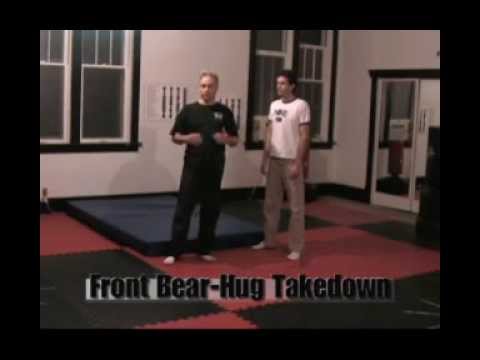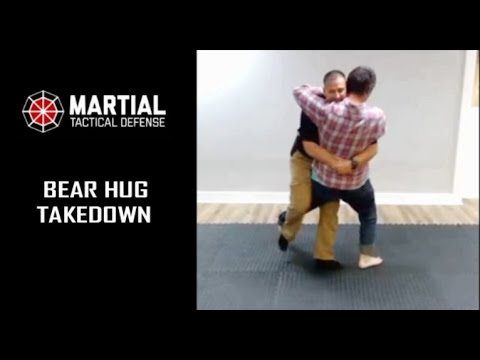
Bear hug trip takedown pin
0
Upper Body Takedown·Martial Tactical Defense
Learn a simple and effective takedown pin from the classic bear hug. This is easy to learn and very effective in a stre…
Translation: upper body takedown
The Upper Body Takedown group encompasses takedowns initiated through upper body control — arm drags, collar ties, wrist control, and head manipulation — that redirect the opponent's balance and create takedown opportunities without directly attacking the legs or using a body lock. [1] Upper body takedowns work by disrupting the opponent's posture, balance, and structural alignment through pulling, pushing, and redirecting forces applied above the waist. [1],[2] This group includes arm drags, snap-downs, duck-unders, and drag takedowns, all of which use the opponent's own upper body structure as the handle for off-balancing. [2] Upper body takedowns are valuable in all combat contexts but are particularly important in Greco-Roman wrestling where leg attacks are prohibited. [2],[3]
Upper body takedowns have deep roots in Greco-Roman wrestling, judo, and traditional wrestling styles worldwide where controlling the opponent's upper body was the primary offensive strategy. [1] The arm drag, snap-down, and duck-under were refined in American wrestling as foundational techniques for creating angles and attacking the opponent's balance. [2],[3]
No images yet for this technique.
Sign in to suggest an image.
Learn a simple and effective takedown pin from the classic bear hug. This is easy to learn and very effective in a stre…
Takedown from a front bearhug clinch. -~-~~-~~~-~~-~- -~-~~-~~~-~~-~-
No instructional courses yet for this technique.
Sign in to suggest a course.
Risk of injury to the person this technique is applied to
Upper body takedowns use leverage rather than impact; lower injury risk
Skill level needed to execute this technique reliably
Whether this technique is allowed under major competition rule sets
Japanese amateur wrestling terminology
Japanese amateur wrestling terminology
Mixed Japanese-Western terminology — combines traditional Japanese terms with katakana loanwords
Standard katakana transliteration used in Japanese wrestling (レスリング)
upper body squeeze strength, lifting power, hip drive
thick chest and arms for tight lock, strong lower back for lifts
pectorals, biceps, erector spinae, glutes
Every move, in any martial art, shares a few universal traits. Mix and match below to pinpoint the right tool — or compare equivalents across styles.
The Arm Drag Takedown family covers takedowns initiated by an arm drag — a technique where the attacker grabs the opponent's arm at the wrist or tricep and pulls it across the body, creating an angle behind the opponent. [1] The arm drag redirects the opponent's arm and rotates their body, exposing their back or side and creating a clear path to attack from an advantageous angle. [1,2] Arm drags can be executed from standing and seated positions, and they typically chain into back takes, single legs, or body lock takedowns once the angle is achieved. [2] The arm drag is one of the most versatile offensive tools in grappling because it works in both gi and no-gi contexts and creates opportunities across multiple takedown families. [2,3]
The Drag Takedown family covers takedowns that use a drag-and-redirect mechanism to off-balance the opponent and pull them past the attacker's body, creating a takedown from the resulting positional advantage. [1] Unlike arm drags that pull a single arm, drag takedowns use two-on-one control (Russian tie) or similar double-grip configurations to redirect the opponent's entire upper body. [1,2] The drag creates momentum that carries the opponent past the attacker, exposing the back or side for a takedown finish. [2] Drag takedowns are particularly effective against aggressive forward-pressuring opponents whose momentum can be redirected. [2,3]
The Duck Under Takedown family covers takedowns where the attacker ducks underneath the opponent's arm to achieve a behind or side position, then completes a takedown from the advantageous angle. [1] The duck under is a misdirection technique: the attacker creates pressure or a feint in one direction, then quickly ducks the head and body underneath the opponent's arm in the opposite direction. [1,2] The resulting position — behind or beside the opponent — provides access to back takes, body locks, and various takedown finishes. [2] Duck unders are energy-efficient and low-risk, making them valuable at all levels of competition. [2,3]
The Snap Down Takedown family covers takedowns initiated by snapping the opponent's head and upper body downward using a sharp pulling action on the head, neck, or collar tie, causing the opponent to stumble forward and lose posture. [1] The snap down exploits the opponent's forward weight distribution or creates it through a pull-and-release action — pulling the opponent forward then snapping their posture down. [1,2] The resulting postural collapse creates openings for front headlock entries, go-behinds, and various takedown finishes. [2] Snap downs are among the most commonly used offensive tools in wrestling, serving as both primary attacks and setups for other techniques. [2,3]
Upper body takedowns — arm drags, snap-downs, duck-unders, drag takedowns — use upper body control to create takedown angles without attacking the legs. Arm drag appears in 106 passages, duck under in 59 across 34 books, snap down in 21 across 13. (34+ books; 1943 US Navy H2H; wrestling manuals)
If your hips are out, you're in a defensive posture and make it hard for the other guy to throw you. If your hips are in, you're assuming the offensive posture needed to execute the takedown effectively.
According to Martial Tactical Defense, this is best used one-on-one or in a personal self defense situation, or when you're on a security team—not when there are multiple people around who might be involved.
Target the knee rather than the heel because it puts more of an arc to the opponent's body and is more reliable; targeting the heel is riskier because if you don't get it cleanly and they're planted, you might miss it and slide off.
You might have to fish for the leg and keep working it rather than giving up on the first try; what matters most is using your hips to get your opponent off balance.
The Upper Body Takedown group encompasses takedowns initiated through upper body control — arm drags, collar ties, wrist control, and head manipulation — that redirect the opponent's balance and create takedown opportunities without directly attacking the legs or using a body lock. Upper body takedowns work by disrupting the opponent's posture, balance, and structural alignment through pulling, pushing, and redirecting forces applied above the waist.
Upper body takedowns have deep roots in Greco-Roman wrestling, judo, and traditional wrestling styles worldwide where controlling the opponent's upper body was the primary offensive strategy. The arm drag, snap-down, and duck-under were refined in American wrestling as foundational techniques for creating angles and attacking the opponent's balance.
IJF: legal — Legal takedown technique; IBJJF: legal — Legal at all belt levels, scored as takedown (2 points); UWW: legal — Legal in freestyle, may be restricted in Greco-Roman depending on technique; Unified MMA: legal — Legal takedown technique; ADCC: legal — Legal, scored 2-4 points in second half of match; FIAS Sport Sambo: legal — Legal — all takedowns permitted; FIAS Combat Sambo: legal — Legal; NCAA Folkstyle: legal — Legal, scored as takedown (2 points)
Danger rating 4/10. Moderate — upper body takedowns use leverage rather than impact; lower injury risk
The standard setup chain: Establish Contact → Create Off-Balance → Execute the Takedown → Follow to Ground.
Standard counters include: Sprawl — drop hips back and drive weight down to stuff the takedown attempt / Underhook — establish inside position to control distance and prevent the takedown entry / Post and Circle — post on the attacker's head and circle away to break their angle / Level Change Defence — recognize the shot early and react with appropriate hip defence.
Common variants: Front body lock (securing the lock face-to-face and driving laterally or b…); Rear body lock (securing from behind for mat returns or lifts); Side body lock (angled body lock for trips and throws); Body lock to trip (combining the lock with a foot trip for the finish).
Upper body takedowns are the only permitted takedown category in Greco-Roman wrestling at the Olympic and World Championship level. In MMA, upper body takedowns are used by fighters with Greco-Roman and clinch-fighting backgrounds.
Top errors to watch for: Static hand fighting without attacking — touching the opponent's arms without purpose / Reaching with straight arms instead of keeping elbows bent and hands close to your body / Only using upper body attacks in isolation instead of chaining them into leg attacks / Giving up your own inside position while trying to establish upper body control.
The Upper Body Takedown is also known as Jōhanshin Teikudaun, Upper Body Attack, Tie-Up Takedown, Clinch Takedown.