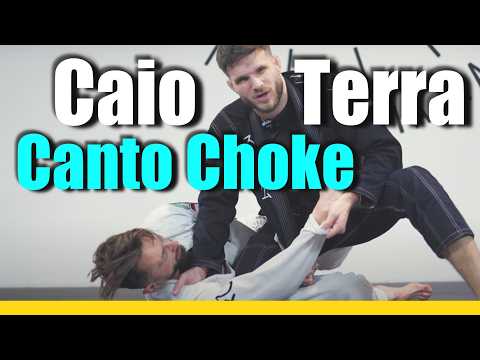
Canto choke | Caio terra BREAKDOWN
0
Fundamental Choke·Energia Martial Arts
Canto choke | Caio terra BREAKDOWN Guys did you see that short clip from Caio Terra where he chokes Mason Fowler with th…
Translation: Fundamental choke
The Fundamental Choke family covers the core choking techniques that form the foundation of submission grappling's choke curriculum — the essential air chokes, collar chokes, and hybrid chokes that every grappler learns first and that remain effective at the highest levels of competition. [1] This family includes the cross-collar choke (the most fundamental gi choke, applied from mount, guard, and side control), the ezekiel choke (sleeve-assisted forearm choke), guillotine variations (front headlock chokes), and the baseball bat choke. [1],[2] These 'fundamental' chokes are distinguished from specialised system chokes (like 10th Planet chokes) by their universal applicability across all grappling styles and their presence in virtually every BJJ curriculum worldwide. [2],[3] Many of these chokes have decided World Championship matches and UFC title fights, demonstrating that mastery of fundamentals trumps exotic technique at every level. [3]
Choking techniques are among the oldest known combat techniques — they appear in virtually every ancient martial arts tradition. [1] In BJJ, the cross-collar choke was established as a fundamental technique by the Gracie family and remains the most commonly taught gi submission worldwide. [1],[2] The guillotine choke gained modern prominence through MMA, where the front headlock position is reached naturally from wrestling exchanges. [2],[3] The ezekiel choke is named after Brazilian judoka Ezequiel Paraguassú, who famously used the technique in training at the Gracie academy while visiting from the Brazilian judo team. [3]
Fundamental chokes are the highest-percentage submission category in BJJ and MMA combined. [1] Roger Gracie won multiple World Championships finishing opponents with the cross-collar choke from mount — the most basic choke in BJJ. [2] The guillotine choke is one of the most common submission finishes in UFC history. [3]
No images yet for this technique.
Sign in to suggest an image.
Canto choke | Caio terra BREAKDOWN Guys did you see that short clip from Caio Terra where he chokes Mason Fowler with th…
No instructional courses yet for this technique.
Sign in to suggest a course.
Risk of injury to the person this technique is applied to
Chokes are the most dangerous submissions because they can cause unconsciousness (blood chokes in 6-10 seconds) or airway damage (air chokes with sustained pressure); the line between 'putting someone to sleep' and causing harm is thin; always tap early in training
Skill level needed to execute this technique reliably
Whether this technique is allowed under major competition rule sets
Jiu-Jitsu University (Saulo Ribeiro, 2008)
Description sources — [1] Jiu-Jitsu University (Ribeiro, 2008) [2] Roger Gracie competition analysis [3] Ezequiel Paraguassú history
History sources — [1] Ancient choking traditions [2] Gracie family BJJ curriculum [3] Ezekiel choke naming
Official Kodokan ground technique classification system
Description sources — [1] Jiu-Jitsu University (Ribeiro, 2008) [2] Roger Gracie competition analysis [3] Ezequiel Paraguassú history
History sources — [1] Ancient choking traditions [2] Gracie family BJJ curriculum [3] Ezekiel choke naming
grip strength (especially for gi chokes — collar grips must be deep and sustained), forearm endurance, proper head and chest positioning
long arms (easier to wrap around the neck), strong grip, heavy upper body (weight assists the choke from mount)
forearms (grip and squeezing), biceps (pulling the choking arm tight), chest (expansion for cross-collar squeeze), core (maintaining position while choking)
Every move, in any martial art, shares a few universal traits. Mix and match below to pinpoint the right tool — or compare equivalents across styles.
The Arm-In Guillotine from Guard traps the opponent's arm alongside their neck inside the guillotine grip, creating a different choking angle that combines blood choke and neck crank elements. [1]
The Arm Trap Triangle controls the opponent's arm first (trapping it across the body), then uses the trapped arm as leverage to lock in a triangle choke from guard. [1]
The Arm Wrap Choke is a closed guard submission where the attacker wraps the opponent's arm across their own neck and secures a deep collar grip on the far side, creating a choking mechanism that uses the opponent's trapped arm as a wedge against one side of the neck while the collar grip compresses the other side. [1] The technique begins with the guard player controlling one of the opponent's arms (typically by gripping the wrist or sleeve), threading the arm under the opponent's elbow, and wrapping it diagonally across the opponent's throat so that the opponent's own forearm presses against one carotid artery. [1] The attacker then reaches across with the wrapping hand to grip the far collar deep (four fingers inside), and pulls the collar tight while simultaneously squeezing the wrapped arm into the neck. [1] The result is a cross-collar choking mechanism where half the pressure comes from the collar grip and half comes from the opponent's own trapped arm — making the choke uniquely difficult to defend because the opponent cannot strip a grip that is their own arm. [1] Saulo Ribeiro presents this as a foundational closed guard attack in Jiu-Jitsu University, emphasising that the Arm Wrap is not just a standalone choke but the entry point for a chain of attacks: if the opponent defends the choke by pulling their arm free, the attacker transitions immediately to a straight armlock on the freed arm. [1] This choke-to-armlock chain (arm wrap choke → straight armlock) is one of the most reliable attack sequences from closed guard in Brazilian Jiu-Jitsu, as the opponent must choose between defending the choke (exposing the arm) or defending the armlock (exposing the neck). [1,2]
The Baseball Choke is a gi-based collar choke that uses a distinctive split grip — one hand gripping the collar palm-up and the other palm-down in opposite directions — creating a powerful rotational wringing action around the opponent's neck that compresses both carotid arteries simultaneously. [1] The name derives from the grip's resemblance to how a baseball batter holds the bat: one hand above the other with palms facing opposite directions. [1] What makes the Baseball Choke uniquely dangerous in competition is its versatility of entry: unlike most collar chokes that require a specific dominant position, the Baseball Choke can be initiated from knee-on-belly, side control, bottom half guard, and even bottom mount — and in several cases, the grip is set from a disadvantageous position but finishes after the attacker transitions to a dominant one. [1,2] The most common and tactically significant application is the 'bottom-to-top' Baseball Choke: the attacker sets the split grip while on bottom (in half guard or during a guard pass), allows the opponent to complete the pass, and then tightens the choke as the opponent settles into side control — meaning the opponent effectively chokes themselves by advancing their position. [2,3] This counter-intuitive mechanic — where the attacker appears to give up position to finish the choke — makes the Baseball Choke one of the most deceptive submissions in competitive BJJ. [2] Magid Hage famously won his IBJJF World Championship match in 2013 at black belt with the Baseball Choke, cementing the technique's reputation as a legitimate world-class weapon. [3]
The Bread Cutter Choke is a gi-based submission applied from side control where the attacker reaches across the opponent's neck to grip the far collar, then drives the blade edge of the forearm across the throat while dropping body weight to create a cutting compression against the trachea and carotid arteries. [1] The technique derives its name from the slicing motion of the forearm across the neck — the sharp ulnar edge of the forearm acts like a bread knife, pressing into the soft tissue of the throat while the collar grip anchors one side and the body weight provides the downward force. [1,2] Unlike many side control submissions that require threading an arm under the head or transitioning to a different position, the Bread Cutter is applied directly from a standard cross-face side control, making it one of the most accessible side control submissions in Brazilian Jiu-Jitsu. [1] The choke can function as both a blood choke (compressing the carotid arteries via the collar and forearm) and a windpipe choke (the forearm presses directly against the trachea), depending on the exact angle and depth of the forearm placement. [2] Saulo Ribeiro demonstrates this technique as a high-percentage attack from side control that chains naturally with the kimura, americana, and step-over choke when the opponent defends. [1] The technique gained widespread competition use in the 2010s as practitioners recognised its efficiency: it requires minimal positional adjustment from side control, provides strong pinning pressure while attacking, and finishes with mechanical advantage (the attacker's full body weight assists the choke). [2,3]
Double Attack to Kata-Gatame transitions from the double attack mount position directly into a kata-gatame arm triangle, using the dual threat to force the opponent's arm across their neck. [1]
The Ezequiel Choke from the Back applies the Ezequiel (Sode Guruma Jime) choking mechanism from the back control position rather than the traditional mount. [1] The attacker threads one arm under the opponent's chin using the sleeve of the opposite arm as a choking surface, while the hooks maintain back control. [1] This variant is particularly effective because opponents defending rear naked choke attempts often create openings for the Ezequiel grip. [1] Ribeiro specifically demonstrates this as an alternative when the opponent's collar defence is too tight for standard chokes. [1]
The Guillotine from Clinch is applied directly from the standing clinch by wrapping the arm around the opponent's neck and falling backward into guard. [1] Renzo Gracie and John Danaher emphasise the importance of the squeeze direction and chin position for finishing. [1]
The Hand-Clasp Guillotine is a guillotine choke variant that uses a palm-to-palm grip (both palms pressed together around the opponent's neck, like praying hands) rather than the traditional interlocked fingers, gable grip, or figure-four grip used in standard guillotine variations. [1] The palm-to-palm grip offers specific advantages: it can be established faster than more complex grip configurations (critical during scrambles and takedown defence), it provides a natural squeezing angle that compresses the throat directly rather than through the forearm blade, and it is more secure than interlocked fingers (which can be stripped by grip-fighting). [1] BJ Penn documented the Hand-Clasp Guillotine in The Book of Knowledge (2007) as a quick-application guillotine specifically designed for MMA's scramble-heavy environment, where the traditional guillotine setup (which requires precise forearm positioning and a specific grip sequence) may not be achievable before the opponent escapes or changes position. [1] The technique is most commonly applied when the opponent shoots for a takedown: as the attacker lowers their head for the double-leg or single-leg, the defender wraps one arm around the opponent's neck, clasps both palms together under the chin, and squeezes — the entire setup takes approximately 0.5-1.0 seconds, compared to 1.5-2.0 seconds for a traditional guillotine with figure-four grip. [1] The Hand-Clasp Guillotine can be finished from standing (dropping to guard as the opponent shoots), from guard (closed guard or half guard after pulling the opponent down), or from the sprawl position (maintaining the grip while sprawling on the takedown attempt). [1] The grip is sometimes called the 'emergency guillotine' because it is used when the standard guillotine cannot be established in time — the palm-to-palm clasp provides ENOUGH choking pressure to threaten a tap while the standard grip would take too long to set up. [1]
The Kata-Gatame Arm Triangle Variation adapts the traditional arm triangle for MMA, incorporating strikes to set up the choke and maintaining top pressure throughout. [1]
Kata Gatame to Ezequiel is a combination technique where a kata gatame (arm triangle) attempt transitions to an Ezequiel choke when the opponent defends the head-and-arm choke. [1] The grip transitions smoothly from the arm triangle to the sleeve choke. [1]
The Palm Up Palm Down Choke is a cross-collar choke variation where one hand grips the collar palm-up and the other palm-down, creating a scissoring action across the carotid arteries. [1] This mixed grip creates a different angle of pressure compared to the standard palm-up/palm-up cross choke, often catching opponents who have trained defences against the conventional grip. [1] Ribeiro demonstrates this from both closed guard and mount positions. [1]
The Palm Up Palm Up Choke is the standard cross-collar choke where both hands grip the collar with palms facing upward, creating bilateral pressure on the carotid arteries. [1] This is the most fundamental collar choke in Brazilian Jiu-Jitsu and judo, taught as one of the first submissions from mount and guard. [1] Ribeiro emphasises the depth of the grips and the downward pull of the elbows as the keys to finishing this choke. [1]
Pull Out of Armbar to Triangle transitions from a failed armbar attempt directly into a triangle choke, using the opponent's escape movement to set up the leg position for the triangle. [1]
The Step-Over Choke is executed from side control by stepping the far leg over the opponent's head while maintaining a collar grip, creating a choking mechanism that combines collar pressure with leg compression. [1] The leg stepping over the head adds downward pressure that amplifies the collar choke while simultaneously isolating the opponent's head and preventing escape. [1] Ribeiro presents this as a high-percentage side control submission. [1]
You should control the sleeve and base it out, which allows your knee to cut through effectively to secure the choke.
Focus on opening the arm and cutting your knee through cleanly—these details are critical to the technique's success.
The Fundamental Choke family covers the core choking techniques that form the foundation of submission grappling's choke curriculum — the essential air chokes, collar chokes, and hybrid chokes that every grappler learns first and that remain effective at the highest levels of competition. This family includes the cross-collar choke (the most fundamental gi choke, applied from mount, guard, and side control), the ezekiel choke (sleeve-assisted forearm choke), guillotine variations (front headlock chokes), and the baseball bat choke.
Choking techniques are among the oldest known combat techniques — they appear in virtually every ancient martial arts tradition. In BJJ, the cross-collar choke was established as a fundamental technique by the Gracie family and remains the most commonly taught gi submission worldwide.
IBJJF: legal — Legal at all belt levels, gi and no-gi — chokes are the safest submission cat…; IJF: legal — Legal (shime-waza) — strangulation techniques are one of three permitted subm…; ADCC: legal — Legal; Unified MMA: legal — Legal — choke submissions are among the most common finishes in MMA; FIAS Sport Sambo: banned — All chokes prohibited in Sport Sambo; FIAS Combat Sambo: legal — Legal
Danger rating 7/10. High — chokes are the most dangerous submissions because they can cause unconsciousness (blood chokes in 6-10 seconds) or airway damage (air chokes with sustained pressure); the line between 'putting someone to sleep' and causing harm is thin; always tap early in training
The standard setup chain: Achieve Position → Control Posture → Secure Grips → Isolate Defence → Apply Compression → Finish.
Standard counters include: Hand Fighting — stripping collar grips before the choke is established / Posture Up — extending the head and shoulders away to relieve choking pressure / Two-on-One Grip Fight — using both hands to strip the choking grip / Tuck the Chin — tucking the chin into the choking arm to prevent the forearm from accessing the throat.
Common variants: Cross-collar choke (juji jime) (the most fundamental gi choke; gripping both collars in a…); Guillotine choke (arm wrapped around the neck from front headlock; arm-in a…); Ezekiel choke (sode guruma jime) (sleeve-assisted forearm choke; effective from mount and i…); Baseball bat choke (crossed collar grips in a baseball bat configuration; tig…); Loop choke (gi choke using a single collar grip looped over the oppon…); Bread cutter choke (paper cutter) (forearm-on-collar choke from side control); Palm-up palm-down choke (gi choke from mount or side control using opposing palm o…).
Chokes are the most common submission finish category in both IBJJF and UFC. The cross-collar choke from mount and the guillotine are the two most commonly finished fundamental chokes in competition.
Top errors to watch for: Shallow collar grips — gripping only the edge of the collar produces a weak choke; the grip must be deep, past the ce… / Squeezing with arm strength only — effective chokes use chest expansion (pulling elbows wide then squeezing together)… / Not tucking the chin into the choke — for maximum pressure, the choker's chin should drive into the back of their own… / Attempting chokes without controlling posture — a choke against an opponent who can posture up and pull away will fai….
The Fundamental Choke is also known as Fandamentaru Chōku, Core Choke, Basic Choke, General Choke, Tracheal Choke.