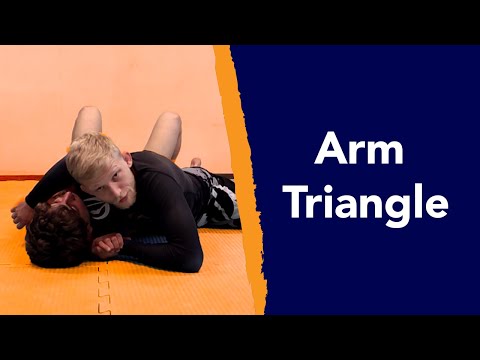
The Arm Triangle Explained (Kata Gatame)- De Groot BJJ
0
Kata-Gatame Arm Triangle Variation·Haven BJJ
The arm triangle or kata gatame is a very strong, relatively low-risk way of finishing your opponents from top position.…
Translation: kata-gatame arm triangle variation
The Kata-Gatame Arm Triangle Variation adapts the traditional arm triangle for MMA, incorporating strikes to set up the choke and maintaining top pressure throughout. [1]
MMA-adapted submission. [1]
Proven at highest levels of MMA competition. [1]
MMA submission methodology. [1]
Used in UFC and professional MMA competition
No images yet for this technique.
Sign in to suggest an image.
The arm triangle or kata gatame is a very strong, relatively low-risk way of finishing your opponents from top position.…
No instructional courses yet for this technique.
Sign in to suggest a course.
Risk of injury to the person this technique is applied to
Submission with fight-ending potential
Skill level needed to execute this technique reliably
Whether this technique is allowed under major competition rule sets
Mixed Martial Arts: The Book of Knowledge (Penn, Cordoza & Krauss, 2007)
description, historyOrigin: sourced from Penn, B
description, historyOrigin: sourced from Penn, B
Good grip strength
Submission finishing ability
Kata gatame (head-and-arm choke) appears in 17 passages across 4 books. The arm triangle traps the opponent's own arm against their neck, using the attacker's shoulder as the choking surface. One of the most powerful chokes from side control. (4 books; Kano, Kodokan Judo; Kyokushin manuals)
The most common mistake is trying to push your shoulder into the opponent's face rather than using proper choking mechanics. Instead, you need to cut off both carotid arteries by getting your arm deep and pulling it all the way through to close off the space between the opponent's neck and your arm.
You want to get the opponent's elbow above their shoulder line—not just halfway through. Walk your head out and to the end of the lever, then push at the elbow (not at the armpit) to extend their arm, since people are stronger close to their hips and weaker the further you move them away.
When your opponent turns away, use your grip to pull through into a back take position. Get the seat belt grip behind the shoulder, lean forward, step over, and pull your heel tight toward their hip to prevent them from getting their knees in and escaping.
Build pressure gradually and consistently rather than squeezing with everything you have at the start—go 10%, 20%, 30% pressure until reaching 100%. This prevents giving your opponent a breather and allows you to hold the choke longer.
The Kata-Gatame Arm Triangle Variation adapts the traditional arm triangle for MMA, incorporating strikes to set up the choke and maintaining top pressure throughout.
MMA-adapted submission.
IBJJF: legal — Legal at all belt levels, gi and no-gi — chokes are the safest submission cat…; IJF: legal — Legal (shime-waza) — strangulation techniques are one of three permitted subm…; ADCC: legal — Legal; Unified MMA: legal — Legal — choke submissions are among the most common finishes in MMA; FIAS Sport Sambo: banned — All chokes prohibited in Sport Sambo; FIAS Combat Sambo: legal — Legal
Danger rating 8/10. Submission with fight-ending potential
The standard setup chain: Position → Strikes → Kata-Gatame Arm Triangle Variation.
Standard counters include: Posture / Stack / Guard pass.
Common variants: Standard Kata-Gatame Arm Triangle Variation.
Used in UFC and professional MMA competition
Top errors to watch for: Abandoning position for the submission / Poor grip.
The Kata-Gatame Arm Triangle Variation is also known as Kata-Gatame Arm Triangle Variation, MMA Arm Triangle, Modified Kata Gatame.