Knee on Hip to Step Over Triangle by Benji Silva
0
Step-Over Choke·BJJ Fanatics
KNEE ON HIP TO STEP OVER TRIANGLE https://bjjfanatics.com This Jiu Jitsu Training video explains the Knee on Hip to Ste…
Translation: Step-over choke
The Step-Over Choke is executed from side control by stepping the far leg over the opponent's head while maintaining a collar grip, creating a choking mechanism that combines collar pressure with leg compression. [1] The leg stepping over the head adds downward pressure that amplifies the collar choke while simultaneously isolating the opponent's head and preventing escape. [1] Ribeiro presents this as a high-percentage side control submission. [1]
Step-over attacks from side control are a classic BJJ development, combining positional control with submission threats. [1]
High-percentage from side control; the leg step-over makes the position very secure. [1]
Brazilian Jiu-Jitsu side control methodology. [1]
Used in UFC and professional MMA competition
No images yet for this technique.
Sign in to suggest an image.
Not yet documented
KNEE ON HIP TO STEP OVER TRIANGLE https://bjjfanatics.com This Jiu Jitsu Training video explains the Knee on Hip to Ste…
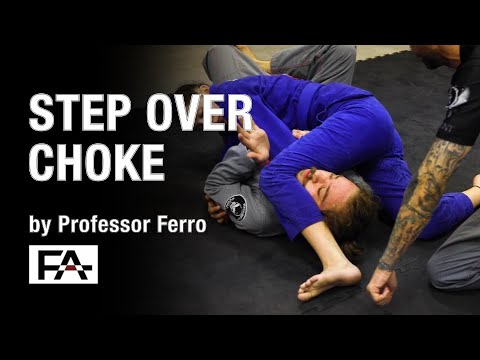
Step over choke from side control and knee on belly. Instagram: Sickness81 Instagram: Ferroacademnybjj6612
The step-over choke is a submission technique executed from side control or knee-on-belly position that both BJJ Fanatics and Sickness Ferro emphasize as a high-percentage attack. Both instructors agree on the fundamental mechanics: the attacker secures a grip behind the opponent's neck or head, then steps one leg over the opponent's arm or body while using knee pressure to control the hips and create positional dominance. BJJ Fanatics describes the setup through a progression from a knee-on-hip position, where the defender's instinctive hand placement on the attacker's knee becomes a cue to transition into the step-over entry, followed by continuous rolling momentum to finalize a triangle position. Sickness Ferro presents the technique as either a direct choke from side control or as a more effective knee-on-belly variation where the attacker slices the shin across the opponent's hand to neutralize defense before executing the step-over. A critical distinction Ferro emphasizes is proper wrist rotation—turning the thumb inward to target the carotid artery effectively rather than creating only pain, and maintaining sufficient head-to-thigh contact during the squeeze for maximum pressure. Both instructors stress maintaining shoulder and chest pressure throughout the setup and emphasize that the attack should come quickly once positioning is established. The knee-on-belly version is presented as technically superior because it pre-positions the attacker's limb and restricts the opponent's defensive arm placement.
Synthesized from 2 instructors
No instructional courses yet for this technique.
Sign in to suggest a course.
Risk of injury to the person this technique is applied to
Combination of collar choke and positional control makes escape very difficult
Skill level needed to execute this technique reliably
Whether this technique is allowed under major competition rule sets
Jiu-Jitsu University (Ribeiro & Howell, 2008)
description, historyOrigin: sourced from Ribeiro, S
description, historyOrigin: sourced from Ribeiro, S
Requires hip flexibility for the step-over
Good top pressure
The step-over choke transitions from side control by stepping over the opponent's head while maintaining collar control — the rotation tightens the choke. A dynamic transition that combines position change with submission. (BJJ instructionals; competition records)
Place your thumb behind the neck, slightly to the left side, to get a good grip. Sickness Ferro emphasizes avoiding turning your thumb inward, as this creates excessive pain and can restrict blood flow rather than execute a clean choke.
The step-over choke can be executed from both side control and knee on belly. According to Sickness Ferro, the knee on belly version is a nastier variation because you can control the opponent's arm more effectively as they attempt to escape.
The Step-Over Choke is executed from side control by stepping the far leg over the opponent's head while maintaining a collar grip, creating a choking mechanism that combines collar pressure with leg compression. The leg stepping over the head adds downward pressure that amplifies the collar choke while simultaneously isolating the opponent's head and preventing escape.
Step-over attacks from side control are a classic BJJ development, combining positional control with submission threats.
IBJJF: legal — Legal at all belt levels, gi and no-gi — chokes are the safest submission cat…; IJF: legal — Legal (shime-waza) — strangulation techniques are one of three permitted subm…; ADCC: legal — Legal; Unified MMA: legal — Legal — choke submissions are among the most common finishes in MMA; FIAS Sport Sambo: banned — All chokes prohibited in Sport Sambo; FIAS Combat Sambo: legal — Legal
Danger rating 7/10. Combination of collar choke and positional control makes escape very difficult
The standard setup chain: Side control → Establish deep collar grip → Step far leg over head → Tighten and finish.
Standard counters include: Frame against the step-over / Bridge and roll before the leg crosses / Fight the collar grip early.
Used in UFC and professional MMA competition
Top errors to watch for: Stepping over before securing the grip / Losing side control during the transition / Not keeping hips low.
The Step-Over Choke is also known as Suteppu Ōbā Chōku, Step Over Collar Choke, Leg-Over Choke.