Translation: Hand-clasp guillotine — a guillotine choke using a palm-to-palm grip (clasped hands) rather than the traditional interlocked fingers or gable grip, providing a different leverage angle for the choking mechanism
Range & classification
Category
Strike & defenceLocksClose rangeFighting multiple people
Distance
CloseMiddleLong
Body target
Upper bodyMiddle bodyLower body
Overview
The Hand-Clasp Guillotine is a guillotine choke variant that uses a palm-to-palm grip (both palms pressed together around the opponent's neck, like praying hands) rather than the traditional interlocked fingers, gable grip, or figure-four grip used in standard guillotine variations. [1] The palm-to-palm grip offers specific advantages: it can be established faster than more complex grip configurations (critical during scrambles and takedown defence), it provides a natural squeezing angle that compresses the throat directly rather than through the forearm blade, and it is more secure than interlocked fingers (which can be stripped by grip-fighting). [1] BJ Penn documented the Hand-Clasp Guillotine in The Book of Knowledge (2007) as a quick-application guillotine specifically designed for MMA's scramble-heavy environment, where the traditional guillotine setup (which requires precise forearm positioning and a specific grip sequence) may not be achievable before the opponent escapes or changes position. [1] The technique is most commonly applied when the opponent shoots for a takedown: as the attacker lowers their head for the double-leg or single-leg, the defender wraps one arm around the opponent's neck, clasps both palms together under the chin, and squeezes — the entire setup takes approximately 0.5-1.0 seconds, compared to 1.5-2.0 seconds for a traditional guillotine with figure-four grip. [1] The Hand-Clasp Guillotine can be finished from standing (dropping to guard as the opponent shoots), from guard (closed guard or half guard after pulling the opponent down), or from the sprawl position (maintaining the grip while sprawling on the takedown attempt). [1] The grip is sometimes called the 'emergency guillotine' because it is used when the standard guillotine cannot be established in time — the palm-to-palm clasp provides ENOUGH choking pressure to threaten a tap while the standard grip would take too long to set up. [1]
The Hand-Clasp Guillotine evolved in MMA as a quick-application variant of the traditional guillotine choke, developed to address the speed demands of defending takedowns in professional MMA. [1] In early MMA (UFC 1-10, PRIDE), the guillotine choke was one of the first techniques demonstrated to be effective across styles — Royce Gracie used the guillotine in multiple early UFC fights, and it quickly became one of the most commonly attempted submissions. [2] As takedown shooters became faster and more proficient, the traditional guillotine's setup time (1.5-2.0 seconds) became insufficient — the Hand-Clasp variant developed as a faster-application option that could be established during the brief window when the shooter's head is accessible. [1] BJ Penn documented the technique in 2007 as one of several guillotine variants optimised for MMA's pace. [1] The technique has been used for numerous UFC finishes where the defender caught the choke during the takedown attempt. [2]
Country of origin· shown in random order
🇧🇷BrazilMMA, Brazilian Jiu-Jitsu, No-Gi Grappling
🇺🇸USAMMA, No-Gi Grappling, Wrestling (defensive application against takedowns)
🇯🇵JapanBrazilian Jiu-Jitsu
🇬🇷GreeceWrestling (defensive application against takedowns)
Effectiveness
The Hand-Clasp Guillotine is effective as a SPEED submission — its value lies in the fast application time (0.5-1.0 seconds) rather than in mechanical superiority over other guillotine grips. [1] Against takedown shooters, the technique is highly effective because the shooter's focus is on the takedown mechanics, not on defending a choke, and the brief window when the head is accessible is sufficient for the palm-to-palm clasp but NOT sufficient for a traditional figure-four grip. [1] In UFC competition, guillotine finishes during takedown defence account for a significant percentage of all guillotine victories — many of these use the hand-clasp or similar quick-grip variants. [2] The technique's limitation is that the palm-to-palm grip provides approximately 60-70% of the compression of a figure-four grip, meaning the opponent has a larger survival window. [1]
Lineage
Traditional guillotine choke (Gracie Jiu-Jitsu, demonstrated in early UFC) → speed variants developed for MMA's faster takedown game → Hand-Clasp Guillotine documented by BJ Penn (2007) → standard MMA takedown-defence counter. [1],[2]
Competition Record
The guillotine choke (including the hand-clasp variant) is one of the top 5 most common submissions in UFC history. Notable guillotine finishes during takedown defence include Charles Oliveira's multiple guillotine victories, BJ Penn's guillotine finishes, and Demian Maia's standing guillotine wins. The hand-clasp grip is commonly used as the initial catch before converting to a stronger grip for the finish.
Images
No images yet for this technique.
Sign in to suggest an image.
Biomechanical Mechanism
Primary Action — Both palms press together around the opponent's neck (one arm wraps around the neck from above, the other hand clasps palm-to-palm from below), creating a ring of forearm pressure around the throat. The wrists and forearms compress the throat bilaterally as the hands clasp tighter.
Joints Involved — Choking arm: shoulder (flexion to wrap the arm around the opponent's neck from above), elbow (flexion to bring the forearm across the front of the throat), wrist (neutral, palm facing inward); Support hand: reaches up from below to clasp palm-to-palm with the choking hand; Both forearms (compression of the throat between the two forearm surfaces); Hips (either closed guard pulling the opponent down, or hip extension in the sprawl)
Force Vector — Bilateral compression — the two forearms squeeze the throat from both sides, compressing the trachea and the carotid arteries simultaneously. The palm-to-palm grip allows the squeeze to tighten by pulling the elbows together (adduction).
Leverage Principle — The palm-to-palm grip creates a DIRECT squeeze rather than the lever-based compression of the standard guillotine (which uses the forearm blade against the throat). The direct squeeze requires less precise positioning but also less mechanical advantage — the trade-off is SPEED of application (fast) versus STRENGTH of compression (moderate). For the Hand-Clasp to produce a tap, the squeeze must be more aggressive than a standard guillotine because the mechanical advantage is lower.
Position & Entry
Against a takedown shot (primary application) — The opponent shoots for a double-leg or single-leg → wrap one arm around their neck as their head lowers → clasp both palms together under the chin → pull guard (fall backward bringing the opponent into closed guard) → squeeze for the choke
From the sprawl — The opponent shoots → instead of pulling guard, sprawl on the shot while maintaining the hand-clasp around the neck → the opponent's neck is compressed between the sprawling defender's forearms while their body is driven downward
Standing guillotine — Wrap the neck and clasp the hands while both fighters are standing → drop to guard for the finish, or knee the opponent's body while maintaining the standing choke
From front headlock — When the opponent is in the front headlock position (head under the defender's armpit), convert the headlock to the Hand-Clasp Guillotine by reaching the second hand under the chin and clasping
Emergency application — During a scramble where the opponent's head is briefly accessible, grab the neck with one arm and clasp the other hand immediately — the speed of the palm-to-palm grip makes this possible when other guillotine grips cannot be established in time
Variants
Standard Hand-Clasp Guillotine — palm-to-palm grip from the front headlock, finished in guard
Standing Hand-Clasp — maintaining the grip while standing (not pulling guard), using body weight and hip pressure to tighten
Sprawling Hand-Clasp — maintaining the grip while sprawling on a takedown, using the sprawl's downward pressure to tighten
Hand-Clasp to traditional grip — if time allows, converting the quick palm-to-palm grip to a more powerful figure-four or gable grip for better mechanical advantage
Hand-Clasp to front headlock — if the choke fails, maintaining the grip position for front headlock control rather than releasing
Half guard Hand-Clasp — finishing the guillotine from half guard with the palm-to-palm grip
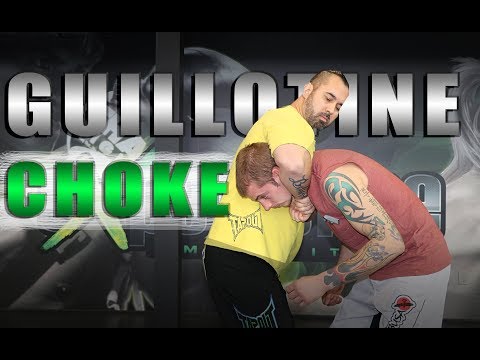
ON THE MAT THURSDAYS | The Standing Guillotine Choke | Self-Defense | Street Fight | BJJ | MMA
0
Hand-Clasp Guillotine·Danny Fung
In this video, I go over the Guillotine Choke. This technique can be used offensively against an attacker whose sole exi…
1 video
Learn This Technique
No instructional courses yet for this technique.
Sign in to suggest a course.
Ratings
Danger Rating
Risk of injury to the person this technique is applied to
7
Very High7/10
The Hand-Clasp Guillotine can produce a blood choke (carotid compression) and/or a windpipe choke (tracheal compression) depending on the exact arm positioning. Unconsciousness from the blood choke component occurs in 5-10 seconds. The tracheal compression component causes immediate choking, gagging, and panic. The fast application speed means opponents may not recognise the threat until the choke is already partially locked. [1]
Difficulty
Skill level needed to execute this technique reliably
Intermediate
Competition Legality
Whether this technique is allowed under major competition rule sets
Illegal
— FIAS Sport Sambo — All chokes prohibited in Sport Sambo
✓The Hand-Clasp Guillotine is an EMERGENCY technique — it trades mechanical advantage for speed of application. Use it when the standard guillotine cannot be established fast enough, not as a primary guillotine choice (Penn, Cordoza & Krauss, 2007). [1] The grip is fast to establish: wrap one arm around the neck, bring the other hand up from below, press both palms together. Drill the grip establishment against a partner shooting for takedowns: the partner shoots, and the defender must wrap-and-clasp in under 1 second. [1] The squeeze must be MORE AGGRESSIVE than a standard guillotine because the palm-to-palm grip provides less mechanical advantage than a figure-four grip. Pull the elbows together hard and drive the hips forward to tighten the choke. [1] Pulling guard enhances the Hand-Clasp Guillotine: when the defender falls backward into closed guard, the opponent's weight falls forward into the choke, adding gravitational compression. The guard pull should be IMMEDIATE after the grip is established — standing with the clasp allows the opponent to fight the grip. [1] Drill the transition from Hand-Clasp to stronger grip: clasp the palms → begin squeezing → if the opponent doesn't tap immediately → transition to a figure-four grip (one hand grips the choking arm's wrist) or a gable grip for stronger compression. The hand-clasp is the ENTRY; the stronger grip is the FINISH. [1] In sparring, the Hand-Clasp Guillotine is most effective when used as a COUNTER to takedown shots: the opponent focuses on the takedown mechanics and the choke arrives before they can adjust their defensive awareness. [1]
Common Mistakes
!Grip too loose — the palm-to-palm clasp must be TIGHT; a loose clasp allows the opponent to pull their head free
!Not pulling guard — maintaining the standing position with the Hand-Clasp allows the opponent to fight the grip with their hands; pulling guard adds body weight to the choke and removes the opponent's base
!Wrapping too high on the neck — the choking arm must be UNDER the chin (across the throat), not behind the head (across the back of the neck). If the arm is behind the head, there is no throat compression.
!Forgetting to squeeze the elbows — the choke tightens by pulling the elbows together (adduction); just clasping the hands without squeezing produces a hug, not a choke
!Holding the clasp too long without converting — the Hand-Clasp provides less compression than stronger grips; if the opponent doesn't tap within 5-10 seconds, CONVERT to a figure-four or gable grip for more power
!Not recognising the opportunity — the Hand-Clasp Guillotine's window is brief (the opponent's head is accessible for approximately 1-3 seconds during a shot); hesitating means the opportunity closes
1Opponent shoots for a takedown (double-leg or single-leg) → Opponent's head lowers toward the defender's midsection → Defender wraps one arm around the opponent's neck (forearm across the throat, arm over the neck) → Second hand reaches up from below and clasps palm-to-palm with the choking hand → IMMEDIATELY pull guard (fall backward into closed guard) → The opponent's weight falls forward into the choke → Squeeze the elbows together to tighten the compression → Opponent taps from throat/carotid compression
2If the opponent doesn't tap within 5-10 seconds → convert to a stronger grip (figure-four, gable grip) for greater compression
3If the opponent escapes the guillotine → maintain front headlock control for further attacks
Sources & References
Primary Source
Mixed Martial Arts: The Book of Knowledge (Penn, Cordoza & Krauss, 2007)
1Book[1] Penn, B.J., Cordoza, G. and Krauss, E. (2007). Mixed Martial Arts: The Book of Knowledge. Victory Belt Publishing. ISBN 978-0-9777315-6-5. Countering the Takedown section (Guillotine variants). [2] UFC fight records — guillotine finishes during takedown defence.pp. Penn 2007, Countering the Takedown section (Hand-Clasp Guillotine, pp. 82-84)
description: [1] Penn 2007 guillotine section
2OtherJapanese Combat Sports Katakana Convention
Standard katakana transliteration of Western martial arts terminology (外来語) — used in Japanese MMA, boxing, and BJJ communities
3Citation[1] Penn, B.J., Cordoza, G. and Krauss, E. (2007). Mixed Martial Arts: The Book of Knowledge. Victory Belt Publishing. ISBN 978-0-9777315-6-5. Countering the Takedown section (Guillotine variants). [2] UFC fight records — guillotine finishes during takedown defence.pp. Penn 2007, Countering the Takedown section (Hand-Clasp Guillotine, pp. 82-84)
description: [1] Penn 2007 guillotine section
Community
Athletics
Quick hands for the rapid wrap-and-clasp (must be established in under 1 second)
Grip strength for the palm-to-palm compression
Core and hip strength for pulling guard and maintaining the choke
Arm strength for the elbow squeeze
Timing and defensive awareness to recognise takedown shots and counter with the guillotine
Notes
The hand-clasp (ten-finger) guillotine uses both hands clasped together around the neck — no arm included. Creates a tighter squeeze on the trachea. The simplest guillotine variation but can cause more tracheal pressure than the arm-in version. (BJJ instructionals; MMA competition records)
Frequently Asked Questions
How should I position my hands when setting up a hand-clasp guillotine?
Wrap your opponent's neck and make sure your thumb goes across your stomach, then use your free hand to trap your own wrist to secure the grip. According to Danny Fung, once locked in, step in and establish a comfortable base.
What's the biggest mistake people make when applying a standing guillotine?
Danny Fung warns against trying to raise up without tension or stretching all the way up on your toes, as this wastes energy and reduces leverage. Instead, squat down and use your hips forward with shoulders backward to create proper leverage.
How do I generate maximum leverage in a standing guillotine choke?
Squat down and drive your hips forward while pulling your shoulders backward—this body mechanics approach creates significantly more leverage than simply raising up, according to Danny Fung.
How do I prevent my opponent from escaping by turning away?
Step with one foot and place it on top of your opponent's foot to control their base, then lie down to complete the technique, as demonstrated by Danny Fung.
How does the Hand-Clasp Guillotine work?
The Hand-Clasp Guillotine is a guillotine choke variant that uses a palm-to-palm grip (both palms pressed together around the opponent's neck, like praying hands) rather than the traditional interlocked fingers, gable grip, or figure-four grip used in standard guillotine variations. The palm-to-palm grip offers specific advantages: it can be established faster than more complex grip configurations (critical during scrambles and takedown defence), it provides a natural squeezing angle that compresses the throat directly rather than through the forearm blade, and it is more secure than interlocked fingers (which can be stripped by grip-fighting).
Where does the Hand-Clasp Guillotine come from?
The Hand-Clasp Guillotine evolved in MMA as a quick-application variant of the traditional guillotine choke, developed to address the speed demands of defending takedowns in professional MMA. In early MMA (UFC 1-10, PRIDE), the guillotine choke was one of the first techniques demonstrated to be effective across styles — Royce Gracie used the guillotine in multiple early UFC fights, and it quickly became one of the most commonly attempted submissions.
Is the Hand-Clasp Guillotine legal in competition?
IBJJF: legal — Legal at all belt levels, gi and no-gi — chokes are the safest submission cat…; IJF: legal — Legal (shime-waza) — strangulation techniques are one of three permitted subm…; ADCC: legal — Legal; Unified MMA: legal — Legal — choke submissions are among the most common finishes in MMA; FIAS Sport Sambo: banned — All chokes prohibited in Sport Sambo; FIAS Combat Sambo: legal — Legal
How dangerous is the Hand-Clasp Guillotine?
Danger rating 7/10. The Hand-Clasp Guillotine can produce a blood choke (carotid compression) and/or a windpipe choke (tracheal compression) depending on the exact arm positioning. Unconsciousness from the blood choke component occurs in 5-10 seconds. The tracheal compression component causes immediate choking, gagging, and panic. The fast application speed means opponents may not recognise the threat until the choke is already partially locked.
How do I set up the Hand-Clasp Guillotine?
The standard setup chain: Opponent shoots for a takedown (double-leg or single-leg) → Opponent's head lowers toward the defender's midsection → Defender wraps one arm around the opponent's neck (forearm across the throat, arm over the neck) → Second hand reaches up from below and clasps palm-to-palm with the choking hand → IMMEDIATELY pull guard (fall backward into closed guard) → The opponent's weight falls forward into the choke → Squeeze the elbows together to tighten the compression → Opponent taps from throat/carotid compression → If the opponent doesn't tap within 5-10 seconds → convert to a stronger grip (figure-four, gable grip) for greater compression → If the opponent escapes the guillotine → maintain front headlock control for further attacks.
How do I defend against the Hand-Clasp Guillotine?
Standard counters include: Tuck the chin — tucking the chin prevents the choking arm from getting under the jaw onto the throat / Pull the head free — if the clasp is not yet tight, driving backward and pulling the head out defeats the choke / Von Flue choke — if the defender pulls guard while holding a loose guillotine, the top player can pin the choking arm… / Pass to side control — passing the guard while the guillotine is held defeats the choke because side-control pressure….
What are the variants of the Hand-Clasp Guillotine?
Common variants: Standard Hand-Clasp Guillotine (palm-to-palm grip from the front headlock, finished in guard); Standing Hand-Clasp (maintaining the grip while standing (not pulling guard), …); Sprawling Hand-Clasp (maintaining the grip while sprawling on a takedown, using…); Hand-Clasp to traditional grip (if time allows, converting the quick palm-to-palm grip to…); Hand-Clasp to front headlock (if the choke fails, maintaining the grip position for fro…); Half guard Hand-Clasp (finishing the guillotine from half guard with the palm-to…).
How effective is the Hand-Clasp Guillotine in competition?
The guillotine choke (including the hand-clasp variant) is one of the top 5 most common submissions in UFC history. Notable guillotine finishes during takedown defence include Charles Oliveira's multiple guillotine victories, BJ Penn's guillotine finishes, and Demian Maia's standing guillotine wins.
What are common mistakes when doing the Hand-Clasp Guillotine?
Top errors to watch for: Grip too loose — the palm-to-palm clasp must be TIGHT; a loose clasp allows the opponent to pull their head free / Not pulling guard — maintaining the standing position with the Hand-Clasp allows the opponent to fight the grip with … / Wrapping too high on the neck — the choking arm must be UNDER the chin (across the throat), not behind the head (acro… / Forgetting to squeeze the elbows — the choke tightens by pulling the elbows together (adduction); just clasping the h….
What are other names for the Hand-Clasp Guillotine?
The Hand-Clasp Guillotine is also known as Hando Kuraspu Girochin, Grip Guillotine, Palm-to-Palm Guillotine, Clasped Guillotine, Quick Guillotine.