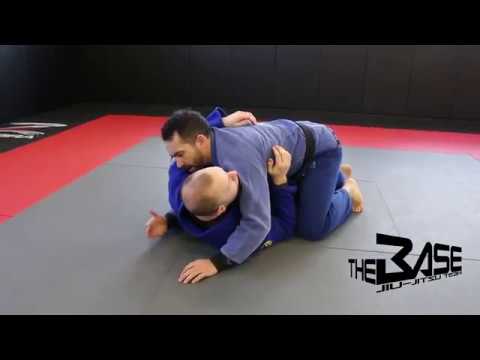
Jiu Jitsu Fundamentals - Half Guard Passing - Esgrima Pass
0
Esgrima Pass·The Base Jiu Jitsu
In this Technique of the Week, Professor Ben Buttars demonstrates the Esgrima Pass from inside Half Guard. If you found…
Translation: Esgrima pass — 'esgrima' is Portuguese/Spanish for 'fencing', referring to the fencing-like leg threading motion used to extract the trapped leg from half guard
The Esgrima Pass is a half guard passing technique where the passer uses a fencing-like leg threading motion — sliding the shin forward and through the opponent's half guard like a sword being drawn from a scabbard — to extract the trapped leg and establish mount or side control. [1] The name 'esgrima' (fencing in Portuguese) perfectly describes the mechanic: rather than muscling the leg free or using a wide circular motion, the passer slides the trapped shin forward along the opponent's inner thigh in a straight, blade-like motion that is difficult to resist because it follows the natural gap between the opponent's legs. [1] Saulo Ribeiro presents multiple Esgrima Pass variations in Jiu-Jitsu University, including the standard version, the Esgrima Mount (threading directly to mount rather than side control), and Fredson Alves' variation (named after the Ribeiro affiliate instructor who refined a specific grip and angle). [1] The Esgrima Pass is particularly effective against the lockdown and deep half guard — positions where many other passing methods fail because the bottom player's legs are tightly entangled with the passer's. [1] The key mechanical principle is that the pass uses a FORWARD sliding motion rather than a backward extraction: instead of trying to pull the trapped leg backward out of half guard (which the bottom player can resist by squeezing), the passer slides the shin FORWARD through the guard, using the top of the foot and the shin as a wedge that opens the bottom player's guard from the inside. [1] This forward sliding direction is counter-intuitive — most passers instinctively try to extract backward, which plays into the bottom player's squeezing strength — and this counter-intuitive nature is what makes the Esgrima Pass so effective once learned. [1]
The Esgrima Pass was developed and refined within the Brazilian Jiu-Jitsu competition community during the 2000s as practitioners sought more effective solutions to the half guard — which had evolved from a transitional position into a sophisticated offensive guard through the work of practitioners like Roberto 'Gordo' Correa, Eddie Bravo, and Bernardo Faria. [1] Saulo Ribeiro documented the Esgrima Pass in Jiu-Jitsu University (2008), presenting it alongside several variations including Fredson Alves' version. [1] The name 'esgrima' (fencing) was likely chosen by Brazilian practitioners because the shin-sliding motion visually resembles the straight thrust of a fencing sword — the same forward, linear, piercing quality that characterises both movements. [1] The Esgrima Pass represents a conceptual innovation in BJJ: the insight that moving FORWARD through a guard rather than BACKWARD out of it is mechanically superior — an insight that has influenced passing methodology more broadly. [1]
The Esgrima Pass is considered one of the most reliable half guard passes in BJJ because it works against the bottom player's mechanics rather than against their strength. [1] The forward sliding direction exploits a biomechanical weakness (the adductors cannot resist a wedge from the inside as effectively as they can resist a pull from the outside), making the pass effective regardless of the bottom player's leg strength. [1] The technique is particularly valued against the lockdown (where backward extraction is impossible) and against deep half guard (where conventional passing angles are compromised). [1] At IBJJF competition level, the Esgrima and its variations are among the most commonly used half guard passes at brown and black belt. [1]
BJJ half guard passing evolution → Saulo Ribeiro and Fredson Alves development → documented in Jiu-Jitsu University (2008) → standard competition half guard pass at brown/black belt level. [1]
Widely used in IBJJF competition at brown and black belt level, particularly against lockdown and deep half guard specialists. The Esgrima's forward-sliding concept has influenced half guard passing methodology broadly, with many modern BJJ competitors incorporating the forward-pass principle even in non-Esgrima passing sequences.
No images yet for this technique.
Sign in to suggest an image.
In this Technique of the Week, Professor Ben Buttars demonstrates the Esgrima Pass from inside Half Guard. If you found…
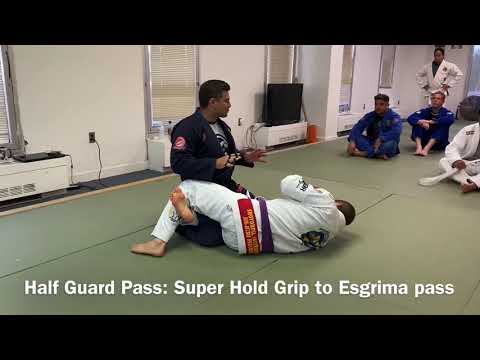
In this class I show my variation of the “Super Hold” to flatten my opponent out from the half guard. Once I am abel to…
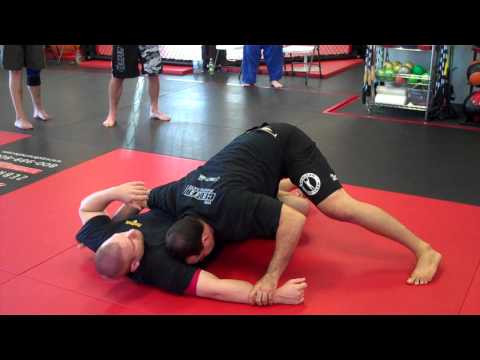
Brazilian Jiu-Jitsu: Half Guard Cross Knee Esgrima Guard Pass In this video, you will see one of many ways to pass the …
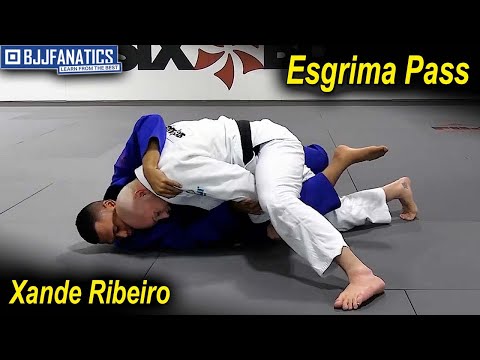
ESGRIMA PASS https://bjjfanatics.com Xande Ribeiro teaches the Esgrima pass in this bjj training video. Xande Ribeiro …
구독과 좋아요 부탁드립니다 http://jiujitsuland.co.kr 서면역 7번 출구(도보 2분 거리, 롯데백화점 후문 도보 1분)에서 쉽게 찾아 오실 수 있습니다. 관심있는 분들은 수업시간에 맞춰서 언제든지…
The Esgrima Pass is a fundamental half-guard guard pass executed from the top position, aimed at flattening the opponent and advancing to side control or scarce fold. All four instructors—PitBlackBelt, BJJ Fanatics (Xande Ribeiro), Six Blades NOVA Emil Takeuchi, and The Base Jiu Jitsu—emphasize establishing body-to-body pressure with the hips elevated and a wide base. The pass begins with the passer controlling the opponent's head using a forehead or shoulder placement rather than full head pressure, combined with either an underhook or cross-face control. A critical distinction emerges in approach: most instructors stress flattening the opponent first by driving the outside knee into the hip or body to neutralize framing, then executing a controlled lateral walk on the toes with maximum hip elevation. PitBlackBelt and Ribeiro emphasize pushing the top knee of the opponent, while Takeuchi details the 'super hold' position as a foundational control point before the pass. The Base Jiu Jitsu describes a variation involving ear-to-ear head placement and teepee-style leg drive. Leg clearance is unanimous: the passer slides their trapped leg free by maintaining pressure, shifting hips, and controlling the opponent's arm before transitioning to side control. All instructors stress that premature movement exposes the passer to sweeps, requiring disciplined pressure maintenance throughout.
Synthesized from 4 instructors
No instructional courses yet for this technique.
Sign in to suggest a course.
Risk of injury to the person this technique is applied to
The Esgrima Pass is a positional technique with minimal injury risk to either participant. The shin sliding through the guard can cause mild discomfort to the bottom player's inner thighs from friction, but no structural damage.
Skill level needed to execute this technique reliably
Whether this technique is allowed under major competition rule sets
Jiu-Jitsu University (Ribeiro & Howell, 2008)
description: [1] Ribeiro 2008 techniques 39-7 through 39-9
Standard katakana transliteration of Western martial arts terminology (外来語) — used in Japanese MMA, boxing, and BJJ communities
description: [1] Ribeiro 2008 techniques 39-7 through 39-9
Good hip pressure (the ability to maintain heavy top weight throughout the pass)
Ankle flexibility for the pointed-toe 'blade' shape
Core stability to maintain cross-face pressure while sliding the shin
Does NOT require exceptional strength — the technique uses mechanics (wedge principle) rather than force
Benefits from shin conditioning (the shin slides against the opponent's inner thigh, which can cause discomfort to an unconditioned shin)
According to Xande Ribeiro, your whole body has to match your opponent's body—your hip on their groin, your head in position, and you maintain constant pressure with your ribcage pushing their ribcage as you work through the pass.
Xande Ribeiro prefers controlling the knee because it's much easier to execute the pass from that position, though the hand can technically go to either location.
PitBlackBelt emphasizes keeping a deep hook and ensuring your shoulder pins your opponent, while maintaining control of both the arm and toes with constant pressure as you move up.
If your opponent is sideways, a horse collar grip or trap grab works well to prevent them from escaping, since the underhook alone cannot fully protect against hip escape on that side.
The Esgrima Pass is a half guard passing technique where the passer uses a fencing-like leg threading motion — sliding the shin forward and through the opponent's half guard like a sword being drawn from a scabbard — to extract the trapped leg and establish mount or side control. The name 'esgrima' (fencing in Portuguese) perfectly describes the mechanic: rather than muscling the leg free or using a wide circular motion, the passer slides the trapped shin forward along the opponent's inner thigh in a straight, blade-like motion that is difficult to resist because it follows the natural gap between the opponent's legs.
The Esgrima Pass was developed and refined within the Brazilian Jiu-Jitsu competition community during the 2000s as practitioners sought more effective solutions to the half guard — which had evolved from a transitional position into a sophisticated offensive guard through the work of practitioners like Roberto 'Gordo' Correa, Eddie Bravo, and Bernardo Faria. Saulo Ribeiro documented the Esgrima Pass in Jiu-Jitsu University (2008), presenting it alongside several variations including Fredson Alves' version.
IBJJF: legal — Legal, guard pass scores 3 points; IJF: legal — Legal — transitioning past opponent's legs is part of newaza; ADCC: legal — Legal, guard pass scores 3 points; Unified MMA: legal — Legal; FIAS Sport Sambo: legal — Legal
Danger rating 2/10. The Esgrima Pass is a positional technique with minimal injury risk to either participant. The shin sliding through the guard can cause mild discomfort to the bottom player's inner thighs from friction, but no structural damage.
The standard setup chain: Establish half guard top → Cross-face the opponent to flatten them onto their back → Hip pressure: drop the hips heavy onto the opponent's body → Point the toes of the trapped foot (create the 'blade' shape) → Slide the shin FORWARD through the opponent's half guard along their inner thigh → The wedge-shaped shin separates the opponent's legs from the inside → Continue the slide until the leg is free → Immediately step over to mount (Esgrima Mount) or establish side control → Settle and consolidate the position.
Standard counters include: Maintain the underhook — if the bottom player keeps an underhook on the passing side, they can follow the Esgrima mot… / Stay on the side — the Esgrima requires the bottom player to be flat; maintaining a strong side position with frames … / Lockdown deeper — a deeper lockdown can resist the forward sliding motion (though the Esgrima is specifically designe… / Frame against the cross-face — preventing the cross-face removes the passer's primary flattening tool, keeping the bo….
Common variants: Standard Esgrima (shin slides forward through half guard to establish side …); Esgrima Mount (same sliding motion but the passer continues directly to …); Fredson Alves Esgrima (uses a far-side lapel grip (threading the lapel across th…); Esgrima with knee block (placing the free knee against the opponent's hip to preve…); Reverse Esgrima (sliding the shin backward (the conventional extraction di…).
Widely used in IBJJF competition at brown and black belt level, particularly against lockdown and deep half guard specialists. The Esgrima's forward-sliding concept has influenced half guard passing methodology broadly, with many modern BJJ competitors incorporating the forward-pass principle even in non-Esgrima passing sequences.
Top errors to watch for: Trying to extract the leg BACKWARD — the most fundamental error; backward extraction works against the body's mechani… / Lifting the hips during the slide — raising the hips creates space that the bottom player uses to recompose guard; th… / Not flattening the opponent first — attempting the Esgrima against an opponent who is on their side with an underhook… / Dorsiflexed ankle — a flexed foot catches on the opponent's legs and jams the sliding motion; the toes must be pointe….
The Esgrima Pass is also known as Esugurima Pasu, Sword Pass, Fencing Pass, Shin Slide Pass, Esgrima Guard Pass.
![[주랜기술#201] 니쉴드 to 언더훅 esgrima 패스 (Half Guard Underhook Esgrima Pass)](https://img.youtube.com/vi/YQAbGOd87gc/hqdefault.jpg)