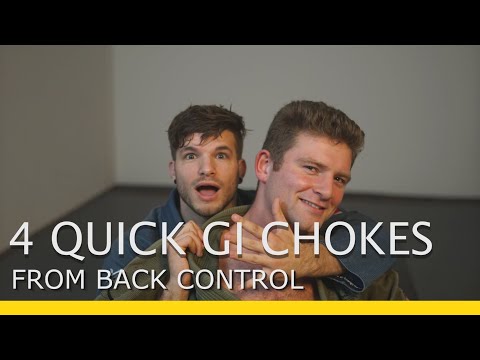
Gi chokes from back control
0
Back Control Choke·Energia Martial Arts
Gi chokes from back control Next up on our Brazilian Jiu-Jitsu Gi series; chokes! Chapters 0:00 - Start 1:00 - Lapel …
Перевод: Chokes and Strangles Applied from Back Control
Back control chokes are submission techniques applied when the attacker has secured a position behind the opponent, typically with hooks (legs wrapped around the torso) or a body triangle for control. [1] This family includes the rear naked choke (hadaka-jime), collar chokes from the back (okuri-eri-jime, kata-ha-jime), lapel-feed chokes, and hybrid variations that combine arm compression with rear choking mechanics. The rear naked choke — a no-gi technique using the forearm and biceps to compress both carotids — is statistically the most successful submission in UFC history and one of the highest-percentage finishes in all grappling competition. Back control represents the most dominant position in submission grappling because the attacker can attack the neck while the defender has no offensive options and limited defensive tools. [2]
Hadaka-jime (裸絞め, naked strangle) and okuri-eri-jime (送襟絞め, sliding collar choke) are classical Kodokan Judo shime-waza techniques codified by Jigoro Kano. [1] The rear naked choke specifically was developed as a no-gi adaptation, gaining prominence in vale tudo and early MMA. Marcelo Garcia's competitive career (2003–2013) demonstrated that the rear naked choke could be systematically achieved against elite opposition, winning multiple ADCC and World Championship titles primarily via back control chokes. [2] John Danaher's back attack system further systematized the positional hierarchy leading to rear choke finishes.
Back control chokes are the highest-percentage submission family in grappling and MMA, as the attacker maintains a dominant position behind the opponent with both hooks controlling the hips, leaving the defender with extremely limited offensive options. [1],[2] UFC statistics consistently show rear chokes as the most common submission finish. [3]
Back control chokes were refined in BJJ from judo's shimewaza, with the rear naked choke becoming the definitive back control finish. [1]
Изображений для этой техники пока нет.
Войдите, чтобы предложить изображение.
Gi chokes from back control Next up on our Brazilian Jiu-Jitsu Gi series; chokes! Chapters 0:00 - Start 1:00 - Lapel …
Учебных курсов по этой технике пока нет.
Войдите, чтобы предложить курс.
Риск травмы для человека, к которому применяется техника
Extremely high risk due to rapid unconsciousness potential and limited escape options
Уровень мастерства, необходимый для надёжного выполнения техники
Разрешена ли техника по основным соревновательным правилам
Kodokan Judo — Official Katame-waza Classification
Japanese terminology sourced from Kodokan Judo — Official Katame-waza Classification
Established Japanese martial arts naming convention — native Japanese term (和語/漢語)
Japanese terminology sourced from Kodokan Judo — Official Katame-waza Classification
hip flexibility, long legs relative to torso
longer limbs for easier figure-four lock around head and arm
hip adductors, hamstrings, quadriceps
Каждое движение в любом боевом искусстве обладает рядом универсальных свойств. Комбинируйте параметры ниже, чтобы найти нужный инструмент или сравнить аналоги из разных стилей.
A subset of back control chokes where the attacker uses a cross-grip baseball bat configuration on the opponent’s lapel or collar while maintaining back control. [1] The arms rotate around the opponent’s neck in a bat-swinging motion, creating intense rotational and compressive force against the carotid arteries. [1,2] This configuration is particularly effective when the opponent is turtled or seated and the attacker has established back hooks or a body triangle. [1] The cross-grip setup distinguishes this subfamily from standard rear lapel chokes — both hands grip the collar on the same side, then rotate in opposite directions to create a scissoring compression. [2,3]
Cross lapel rear chokes are back control strangles where the attacker reaches across the opponent's neck to grip the far-side lapel, then feeds the collar across the throat to create a cross-collar compression. [1,2] From back mount or back hooks, the attacker's forearm presses against one carotid while the crossed lapel compresses the other side. [1] The cross-collar grip from behind is one of the most fundamental gi choke configurations in judo (jūji-jime variations from ushiro) and Brazilian Jiu-Jitsu. [2,3] The cross-grip provides a mechanical advantage because the fabric distributes pressure broadly across the neck, and the attacker can incrementally tighten by pulling elbows toward their own chest. [1,4]
Forearm compression rear strangles use direct forearm-to-neck pressure from back control without relying on the gi collar or lapel. [1] The attacker threads the forearm across the opponent's throat and locks a figure-four or clasp grip behind the head, creating bilateral carotid compression. [1,2] The crucifix position — where the opponent's arms are trapped by the attacker's legs — is the primary platform for this subfamily, as it eliminates defensive hand-fighting. [1] Without the gi, the attacker must rely on bone-to-tissue contact, making precise forearm placement critical for a blood choke rather than a painful but less effective air choke. [2,3]
Lapel feed rear chokes involve pulling, threading, or feeding the opponent's lapel (or the attacker's own lapel) around the neck from back control to create a choking loop. [1,2] Unlike standard cross-collar grips, lapel feed techniques use the extra length of gi fabric as a noose or lever, often wrapping it under the chin and back through the collar to maximize compression distance. [1] The bow-and-arrow choke is the most well-known technique in this subfamily — the attacker feeds the lapel across the neck while gripping the opponent's pants to create opposing forces that tighten the strangle. [1,2] Gift wrap and lapel tail feed variations offer alternative fabric routing for different back control configurations. [1,3]
The rear choke subfamily encompasses all no-gi strangles applied from behind the opponent without using collar or lapel grips. [1,2] The rear naked choke (hadaka-jime) is the defining technique: from back control, the attacker slides one arm under the opponent's chin and across the front of the throat, places the choking hand on the opposite bicep, and uses the free hand behind the opponent's head to push it forward into a figure-four compression of both carotid arteries. [1,2,3] Variations include the one-arm rear naked choke (finishing with only the choking arm), the short choke (a compact version using less arm length), and the arm-triangle rear naked crossover (incorporating the opponent's trapped arm). [1] The rear naked choke is widely regarded as the highest-percentage submission in all of grappling and mixed martial arts due to the dominant positional control from which it is applied. [1,4]
Self lapel rear chokes use the attacker's own gi lapel — pulled out and fed around the opponent's neck — to create a choking loop from back control. [1,2] Unlike standard lapel feed chokes that use the opponent's collar, self-lapel techniques give the attacker a longer fabric tail that can be threaded in unexpected routes. [1] The own-lapel rear noose choke is the primary technique: the attacker pulls their own lapel free, feeds it under the opponent's chin, catches it with the other hand, and tightens from behind. [1,3] Self-lapel chokes are difficult to defend because the opponent cannot simply strip the grip from their own collar — the fabric comes from an unfamiliar angle. [1,4]
Single hand collar rear chokes use only one hand gripping the opponent's collar from back control, while the other arm reinforces or controls posture. [1,2] The one-hand collar choke is the defining technique: the attacker inserts one hand deep into the collar, rotates the wrist to press the knuckles or forearm blade against the carotid artery, and uses body weight or the free arm to prevent escape. [1,3] This subfamily is mechanically distinct from cross-collar chokes because only a single grip point creates the choking pressure, relying on the collar fabric and wrist rotation rather than scissoring two grips. [2,3] Single hand collar chokes are often used as surprise attacks or when the opponent successfully defends against the second hand reaching across. [1,4]
Single wing lapel chokes use one arm threaded under the opponent's armpit (creating a 'wing' control) while the other hand grips the collar to apply a strangle from back control. [1,2] The one-wing collar choke is the primary technique: the attacker controls one arm by underhooking it and threading the hand to the collar, while the choking hand grips the opposite collar across the neck. [1,3] The wing control serves dual purposes — it traps one of the opponent's defensive arms and provides a stable anchor point that prevents the opponent from turning into the attacker. [1] This configuration creates an asymmetric strangle where one side is compressed by the collar grip and the other by the underhook arm's pressure against the neck. [2,4]
Sleeve-assisted rear strangles use the attacker's own gi sleeve — threaded behind the opponent's head — as a fulcrum or lever to enhance forearm compression from back control. [1,2] The sleeve wheel choke is the signature technique: the attacker threads one arm behind the opponent's head, feeds the sleeve of that arm across the throat with the opposite hand, and squeezes to create a powerful forearm-and-fabric compression. [1,3] The sleeve provides a grip anchor that prevents the choking arm from slipping, and the fabric distributes pressure more broadly than bare forearm contact. [1] From back control, sleeve-assisted strangles are particularly effective because the opponent cannot easily strip the sleeve grip while both arms are occupied defending. [2,4]
Sliding lapel rear chokes involve gripping the opponent's collar from back control and sliding the hand across the neck to tighten the strangle progressively. [1,2] The sliding collar choke is the primary technique: the attacker establishes a deep collar grip on one side, then slides or walks the grip across to the opposite side of the neck while maintaining back hooks. [1,3] The sliding motion creates increasing pressure against the carotid arteries as the fabric tightens around the circumference of the neck. [1] Unlike static cross-collar grips, the sliding action allows the attacker to gradually overcome the opponent's defensive hand-fighting by incrementally advancing the choke. [2,4]
Two hand collar rear chokes use both hands gripping the opponent's collar simultaneously from back control to create a symmetric bilateral strangle. [1,2] Both hands insert into the collar on opposite sides of the neck, then pull outward or rotate inward to compress both carotid arteries at once. [1,3] This configuration provides maximum grip security because two independent collar holds must both be stripped to relieve the choke, making defense extremely difficult. [1] Two hand collar chokes require the opponent's collar to be loose enough for both hands to penetrate deeply, which makes them more common in training and competition when the gi has loosened during scrambles. [2,4]
Oftentimes described as the “king of submissions.” Mastery of back control chokes is considered essential in modern grappling.
Use your underhook arm to control the lapel—it doesn't matter if you grab high or low, or if your opponent grabs above or below your hand. Once you have lapel control, grab the second lapel with your thumb, prevent the turn, extend and choke.
Instead of controlling the lapel, control their hand directly by grabbing their pinky finger and maintaining control across their body.
Open up and use a half Nelson grip (similar to a half Nelson wrestling move) underneath the opponent's armpit, then chop down behind their neck as you lift their armpit, extending your wrist and elbow to complete the choke.
Grab your own gi instead and perform an Ezekiel choke—get four fingers in your sleeve, slide it to the backside, then extend your wrists and arms to finish.
Back control chokes are submission techniques applied when the attacker has secured a position behind the opponent, typically with hooks (legs wrapped around the torso) or a body triangle for control. This family includes the rear naked choke (hadaka-jime), collar chokes from the back (okuri-eri-jime, kata-ha-jime), lapel-feed chokes, and hybrid variations that combine arm compression with rear choking mechanics.
Hadaka-jime (裸絞め, naked strangle) and okuri-eri-jime (送襟絞め, sliding collar choke) are classical Kodokan Judo shime-waza techniques codified by Jigoro Kano. The rear naked choke specifically was developed as a no-gi adaptation, gaining prominence in vale tudo and early MMA.
Оценка опасности 10/10. Extremely high risk due to rapid unconsciousness potential and limited escape options
Стандартная цепочка подготовки: Back mount with double hooks → Body triangle → Seatbelt control → Transition from guard, mount, or turtle to the back.
Стандартные контрприёмы: Tuck Chin — protect the neck by lowering the chin to prevent the choke from sinking / Two-on-One Grip Fight — use both hands to strip the choking grip before it locks / Turn Into — rotate toward the choking arm to relieve carotid pressure / Posture Up — straighten the spine and create distance to break the choking angle.
Распространённые варианты: Rear Naked Choke; Short Choke; Bow-and-Arrow Choke; Baseball Bat Collar Choke (from back); Gi Lapel Chokes; Figure-Four Collar Strangles.
Back control chokes (RNC, collar chokes) are the highest-percentage finishing position in both BJJ competition and MMA.
Основные ошибки, на которые стоит обратить внимание: Losing hooks before establishing choke / Attacking neck without securing seatbelt or control / Crossing feet with hooks (risk of ankle lock) / Overcommitting arms and losing back control.
Back Control Choke также известен как Haigo-jime, Rear Chokes, Chokes from the Back, Haigo-jime Variants.