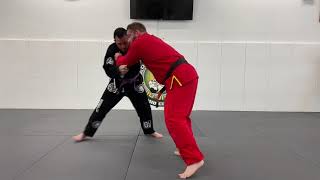
Bear Hug Clinch Takedown Overview
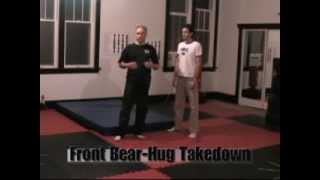
The bear hug clinch takedown with a trip is a gross motor skill technique suitable for one-on-one situations and security applications. It is not recommended when multiple assailants may be present, as success depends primarily on proper footwork and positioning.
Leg Sweep Options
The practitioner has two primary sweep directions: outside-to-inside or inside-to-outside. Targeting the knee rather than the heel is preferred because it creates a greater arc in the opponent's body, increasing the likelihood of a successful takedown.
Adapting to Opponent Resistance
If the opponent resists the initial leg sweep by sitting back or planting weight, the practitioner can transition to sweep the other leg. The technique remains viable by shifting to either an inside or outside sweep path based on where the opponent's weight is distributed.
Torso Control and Ground Position
Beyond leg sweeps, the practitioner can use torso rotation to create additional locking mechanisms or takedown variations. Proper body control during the transition allows for multiple finishing options including chokes and joint locks.
Security Considerations
Practitioners in security roles must maintain awareness of weapon positioning, including concealed firearms, to prevent access during the technique. Impact from falling with a weapon on the body can cause significant bruising, requiring additional safety considerations during training.
Control on the Ground
Once the takedown is successful, keeping weight forward on the opponent's upper torso restricts hip mobility and prevents them from escaping. Practitioners can transition to secondary controls such as wrist locks or positional chokes to subdue and control the opponent.
Principle-Based Practice
The technique requires patience and deliberate hip movement to achieve off-balance positioning rather than relying on speed alone. If the initial leg sweep attempt fails, practitioners should continue working the technique by maintaining pressure and adjusting their approach.
Bear hug trip takedown pin
Key Takeaways
- •Bear Hug Clinch Takedown Overview
- •Leg Sweep Options
- •Adapting to Opponent Resistance
- •Torso Control and Ground Position
Learn a simple and effective takedown pin from the classic bear hug. This is easy to learn and very effective in a street fight or for law enforcement. Email: [email protected] DISCLAIMER: Martial Arts, like any sport, involve a potential risk for serious injury. By viewing the Martial Tactical Defense YouTube channel, website, videos, book or any of the links or web page information provided to you, it is agreed by you, in full, that the Martial Tactical Defense instructors and video production company producing its videos are released of any and all liability, nor do we assume any third party liability arising out of any legal actions you may be involved in as a result of the training you receive by engaging, participating or learning concepts, principles, tactics and techniques taught by Martial Tactical Defense and its instructors. Any self defense law discussions on this channel and website are for informational purposes only and not for the purpose of providing legal advice. You should contact your attorney or legal professional who specialize in self defense law to obtain advice with respect to any particular issue, question or problem. Copyright Disclaimer. Under Section 107 of the Copyright Act 1976, allowance is made for "fair use" for purposes such as criticism, comment, news reporting, teaching, scholarship, and research. Fair use is a use permitted by copyright statute that might otherwise be infringing. Non-profit, educational or personal use tips the balance in favor of fair use.
Related Techniques
Frequently Asked Questions
What does this video teach about upper body takedown?
This video covers bear hug clinch takedown overview, leg sweep options, adapting to opponent resistance. It provides detailed instruction from Martial Tactical Defense.
How long does it take to learn upper body takedown?
The basic mechanics can be understood in a single session, but developing reliable execution requires consistent drilling over weeks of practice. This 7-part breakdown helps structure your training by isolating each phase of the technique.
What are the key details for finishing upper body takedown?
Once the takedown is successful, keeping weight forward on the opponent's upper torso restricts hip mobility and prevents them from escaping. Practitioners can transition to secondary controls such as wrist locks or positional chokes to subdue and control the opponent.