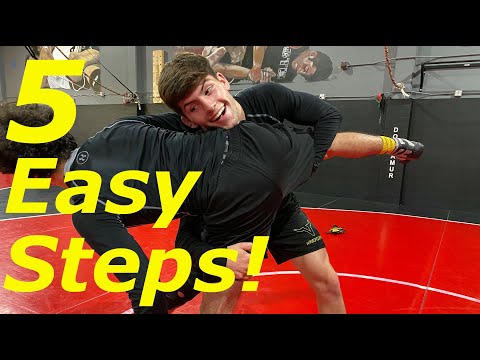
#1 Ranked D1 Wrestler’s Single Leg Takedown
0
Leg Attack Takedown·Athletes Ocean
Mitchell Mesenbrink is a high-pace wrestling machine - a misdirection single leg takedown is only one of his weapons, b…
Translation: leg-grab takedown
The Leg Attack Takedown group encompasses all takedowns that primarily target the opponent's legs as the point of attack, including single legs, double legs, and ankle picks. [1] Leg attacks are the most common takedown category in freestyle wrestling and MMA because they allow the attacker to change level and penetrate from outside the clinch, attacking the opponent's base directly. [1],[2] The fundamental mechanical principle is level change — the attacker drops their hips below the opponent's hips and drives forward to attack the legs, removing the opponent's base of support. [2] Leg attacks require a penetration step (shooting), where the attacker closes distance explosively while lowering the centre of gravity. [2],[3] This group is prohibited in Greco-Roman wrestling but forms the backbone of freestyle, folkstyle, and MMA takedown systems. [3]
Leg attacks have ancient origins, appearing in historical wrestling traditions worldwide including Indian kushti, Mongolian wrestling, and Turkish oil wrestling. [1] The modern systematisation of leg attacks occurred primarily through American folkstyle and international freestyle wrestling programmes during the 20th century. [2] The penetration step — the foundational movement for all leg attacks — was refined in American collegiate wrestling and became the standard entry method taught globally. [2],[3]
No images yet for this technique.
Sign in to suggest an image.
Mitchell Mesenbrink is a high-pace wrestling machine - a misdirection single leg takedown is only one of his weapons, b…
This video I breakdown the basic double leg form to start a beginner. This is great for BJJ/MMA/Wrestling. Check out t…
No instructional courses yet for this technique.
Sign in to suggest a course.
Risk of injury to the person this technique is applied to
Leg attacks are low-impact takedowns; primary risk is knee/ankle injury to defender
Skill level needed to execute this technique reliably
Whether this technique is allowed under major competition rule sets
Japanese amateur wrestling terminology
Japanese amateur wrestling terminology
Mixed Japanese-Western terminology — combines traditional Japanese terms with katakana loanwords
Standard katakana transliteration used in Japanese wrestling (レスリング)
explosive lower body power, level change speed, forward drive
stocky build with strong legs and low centre of gravity
quadriceps, glutes, hamstrings, core, shoulders
Every move, in any martial art, shares a few universal traits. Mix and match below to pinpoint the right tool — or compare equivalents across styles.
The Ankle Pick family covers takedowns where the attacker controls the opponent's upper body with one hand while reaching down to pick up or block the opponent's ankle with the other hand, collapsing their base. [1] The ankle pick is a snap-down-to-attack technique: the attacker uses a collar tie, wrist control, or post to snap the opponent's weight forward onto one foot, then reaches down to capture that loaded ankle and pulls it toward them. [1,2] The technique requires minimal level change compared to full shots, making it energy-efficient and low-risk. [2] Ankle picks are effective in both gi and no-gi contexts and are commonly used as setups or chain-wrestling transitions. [2,3]
The Double Leg Takedown family is one of the most important and frequently used takedown categories across all grappling and combat sports. [1] The double leg involves the attacker changing level with a penetration step, wrapping both arms around the opponent's legs (typically at thigh level), and driving forward to bring the opponent to the mat. [1,2] Double legs are classified by the depth and style of penetration: blast doubles drive through the opponent with explosive forward momentum, low doubles attack below the knees, run-the-pipe doubles redirect the opponent laterally, and snatch doubles use a quick pull-and-lift without deep penetration. [2] The double leg is the most commonly attempted takedown in both wrestling and MMA competition. [2,3]
The Single Leg Takedown family is one of the most versatile and commonly used takedown categories, where the attacker captures and controls one of the opponent's legs while maintaining head position and driving to complete the takedown. [1] Single legs are categorised by the height of the initial attack — high crotch (attacking above the knee at hip level), sweep singles (attacking at the knee), and low singles (attacking at the ankle) — and by the finishing method used once the leg is captured. [1,2] The single leg is the most frequently attempted takedown in folkstyle wrestling and is extremely common in MMA due to its versatility, multiple finishing options, and relatively low risk compared to double legs. [2,3] The technique allows the attacker to chain between different finishes based on the opponent's defensive reactions. [3]
Leg attack takedowns — single legs, double legs, ankle picks — are the most common takedown category in wrestling and MMA. Single leg appears in 175 passages across 42 books, double leg in 166 across 39. These attacks target the legs for mechanical advantage. (42+ books; Gable, Coaching Wrestling Successfully; Couture, Wrestling for Fighting)
Coach Brian breaks it down into three essential steps: level change (lowering your center of gravity), take a step forward to close distance, and finish with a trail leg sweep. The entire sequence should be practiced fluidly without rushing, maintaining proper foot positioning toe-to-toe with your opponent.
Start with the fundamentals by drilling the footwork and body positioning with a partner using hands-on-shoulders drills before live practice. Coach Brian emphasizes repeating these basic steps over and over so the movement becomes automatic, rather than trying to progress too quickly to advanced variations.
According to Athletes Ocean's D1 wrestler Mitchell, you need to be relentless with your attacks and keep working until you end up on the leg you want to get, using misdirection and continuous pressure.
The Leg Attack Takedown group encompasses all takedowns that primarily target the opponent's legs as the point of attack, including single legs, double legs, and ankle picks. Leg attacks are the most common takedown category in freestyle wrestling and MMA because they allow the attacker to change level and penetrate from outside the clinch, attacking the opponent's base directly.
Leg attacks have ancient origins, appearing in historical wrestling traditions worldwide including Indian kushti, Mongolian wrestling, and Turkish oil wrestling. The modern systematisation of leg attacks occurred primarily through American folkstyle and international freestyle wrestling programmes during the 20th century.
IJF: banned — Banned since 2010 leg grab prohibition — direct hansoku-make for touching opp…; IBJJF: legal — Legal at all belt levels, scored as takedown (2 points); UWW: restricted — Legal in freestyle (2-4 points), banned in Greco-Roman (no attacks below waist); Unified MMA: legal — Legal takedown technique; ADCC: legal — Legal, scored 2-4 points in second half of match; FIAS Sport Sambo: legal — Legal — all takedowns permitted; FIAS Combat Sambo: legal — Legal; NCAA Folkstyle: legal — Legal, scored as takedown (2 points)
Danger rating 4/10. Moderate — leg attacks are low-impact takedowns; primary risk is knee/ankle injury to defender
The standard setup chain: Establish Contact → Create Off-Balance → Execute the Takedown → Follow to Ground.
Standard counters include: Sprawl — drop hips back and drive weight down to stuff the takedown attempt / Underhook — establish inside position to control distance and prevent the takedown entry / Post and Circle — post on the attacker's head and circle away to break their angle / Level Change Defence — recognize the shot early and react with appropriate hip defence.
Common variants: Blast double (high-impact forward drive through the opponent without ch…); Snatch double (pulling both legs together and driving laterally); Run-the-pipe double (running through the opponent in a linear drive); Low double (deep penetration step attacking below the knees).
In Olympic freestyle wrestling, leg attacks — particularly the double leg and single leg — are the most frequently scored techniques. In UFC competition, the single leg and double leg are the two most commonly attempted takedowns.
Top errors to watch for: Reaching for the legs without changing level — the most common takedown failure in all combat sports / Shooting from outside of striking range without closing distance first / Head down with eyes on the floor during the shot — you can't finish what you can't see / Both knees on the mat after the penetration step, killing your driving ability.
The Leg Attack Takedown is also known as Ashi-dori Teikudaun, Leg Takedown, Leg Attack, Leg Shot.