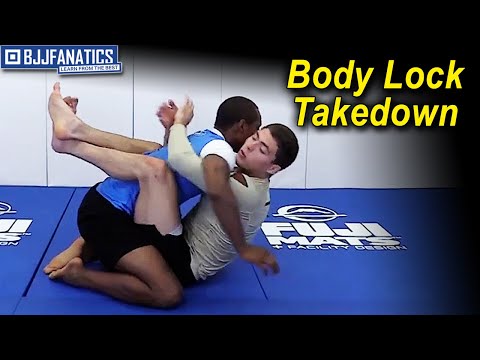
M.G.C. Instr. #192: Double Underhooks The Best Body Lock Takedown 🔥
0
Body Lock Takedown·Modesto Judo Club
www.modestograpplingclub.com Double Underhooks Body Lock Takedown
Translation: body lock takedown (katakana)
The Body Lock Takedown group comprises all takedowns initiated from a locked body clinch where the attacker's arms encircle the opponent's torso. [1] The body lock provides a powerful platform for takedowns because the locked grip eliminates the space between fighters and allows the attacker to directly manipulate the opponent's centre of gravity. [1],[2] Techniques in this group are classified by the attacker's position relative to the opponent — front, rear, or side — each offering distinct mechanical advantages and entry opportunities. [2] Body lock takedowns are fundamental in Greco-Roman wrestling where leg attacks are prohibited, making upper-body clinch work the primary offensive pathway. [2],[3] In MMA, body lock takedowns have become increasingly prominent as wrestlers adapted their skills to cage fighting, where the fence provides a wall to press opponents against while securing the lock. [3]
Body lock takedowns are among the oldest wrestling techniques, central to Greco-Roman wrestling since its formalisation in 19th-century France. [1] The technique group gained renewed importance in MMA through wrestlers like Randy Couture and Daniel Cormier, who demonstrated the effectiveness of body lock clinch work against the cage. [2],[3] Georgian and Russian wrestling traditions have historically emphasised body lock mechanics, producing many of the technique's most refined variations. [3]
The body lock takedown uses a clasped grip around the opponent's torso to lift, drive, or trip them to the mat. [1] It is highly effective in both gi and no-gi because it does not depend on sleeve or collar grips. [2] The body lock provides direct control of the opponent's centre of gravity, making it one of the most reliable takedown methods in MMA. [1],[3]
No images yet for this technique.
Sign in to suggest an image.
www.modestograpplingclub.com Double Underhooks Body Lock Takedown
BODY LOCK TAKEDOWN https://bjjfanatics.com this bjj training video teaches the body lock takedown technique. - For all…
No instructional courses yet for this technique.
Sign in to suggest a course.
Risk of injury to the person this technique is applied to
Body lock takedowns use full body weight; rib compression and back impact risk
Skill level needed to execute this technique reliably
Whether this technique is allowed under major competition rule sets
Japanese amateur wrestling terminology
Japanese amateur wrestling terminology
Standard katakana transliteration of Western martial arts terminology (外来語) — used in Japanese MMA, boxing, and BJJ communities
Standard katakana transliteration used in Japanese wrestling (レスリング)
upper body squeeze strength, lifting power, hip drive
thick chest and arms for tight lock, strong lower back for lifts
pectorals, biceps, erector spinae, glutes
Every move, in any martial art, shares a few universal traits. Mix and match below to pinpoint the right tool — or compare equivalents across styles.
The Front Body Lock Takedown family covers all takedowns executed from a front-facing body lock position where the attacker's arms encircle the opponent's torso from the front. [1] The attacker typically secures a Gable grip or clasp around the opponent's midsection, then uses a combination of lifting, rotating, and driving forces to bring the opponent to the mat. [1,2] Front body lock entries commonly arise from clinch exchanges where the attacker achieves double underhooks or transitions from head-and-arm control to a locked body position. [2] This family is particularly effective against opponents who maintain an upright posture, as the locked grip allows the attacker to displace the opponent's hips directly. [2,3]
The Rear Body Lock Takedown family encompasses all takedowns executed from behind the opponent with a locked grip around the torso. [1] Rear body lock position is one of the most dominant standing clinch configurations because the opponent cannot effectively attack and has limited defensive options — their primary recourse is grip fighting and hip positioning to prevent the lift or return. [1,2] Techniques in this family include mat returns (lifting and replacing the opponent on the mat) and rear lifts (elevating the opponent before bringing them down). [2] Rear body lock takedowns are essential in wrestling and are frequently the result of successful back-take sequences, sprawl-to-back transitions, or cage wrestling scenarios. [2,3]
The Side Body Lock Takedown family covers takedowns executed from a lateral body lock position where the attacker is positioned to the side of the opponent with arms locked around the torso. [1] The side angle provides unique mechanical advantages — the attacker can use hip-to-hip contact as a fulcrum and leverage rotational force to turn the opponent toward the mat. [1,2] Side body lock positions commonly arise during scrambles, when an opponent partially defends a front or rear body lock by turning, or during transitions from single-leg defence. [2] These takedowns are effective in both wrestling and MMA contexts. [2,3]
Body lock takedowns — front, rear, and side — use double-arm control around the opponent's torso. Body lock appears in 84 passages across 16 books. Khabib Nurmagomedov's body lock takedown game dominated UFC competition from 2012-2020. (16 books; MMA competition records; The Ultimate MMA Training Guide)
As you fall, bring one leg over the first side hip, then bring your other leg up—this allows easier pressure and lets you start using your legs to control your opponent. Roberto Jimenez emphasizes bringing your leg behind the opponent's butt to control the situation as they fall.
Pummel in to get one arm under each of your opponent's arms, controlling their elbows. Once you achieve this grip, it's very hard to break even if your opponent is sweating, because you're controlling everything in the clinch.
Control the 'danger zone' between your opponent's legs by stepping in with your leg at the same time you secure the double underhooks. Proper foot placement here prevents your opponent from throwing you even if they attempt to counter.
The Body Lock Takedown group comprises all takedowns initiated from a locked body clinch where the attacker's arms encircle the opponent's torso. The body lock provides a powerful platform for takedowns because the locked grip eliminates the space between fighters and allows the attacker to directly manipulate the opponent's centre of gravity.
Body lock takedowns are among the oldest wrestling techniques, central to Greco-Roman wrestling since its formalisation in 19th-century France. The technique group gained renewed importance in MMA through wrestlers like Randy Couture and Daniel Cormier, who demonstrated the effectiveness of body lock clinch work against the cage.
IJF: legal — Legal takedown technique; IBJJF: legal — Legal at all belt levels, scored as takedown (2 points); UWW: legal — Legal in both freestyle and Greco-Roman; Unified MMA: legal — Legal takedown technique; ADCC: legal — Legal, scored 2-4 points in second half of match; FIAS Sport Sambo: legal — Legal — all takedowns permitted; FIAS Combat Sambo: legal — Legal; NCAA Folkstyle: legal — Legal, scored as takedown (2 points)
Danger rating 5/10. High — body lock takedowns use full body weight; rib compression and back impact risk
The standard setup chain: Close Distance → Establish the Lock → Hip Pressure → Lift or Trip.
Standard counters include: Sprawl — drop hips back and drive weight down to stuff the takedown attempt / Underhook Pummeling — fight for inside position to neutralize the lock / Hip Switch — rotate hips to break the grip angle and create separation / Knee Tap — redirect opponent's momentum with a quick leg attack.
Common variants: Front body lock (securing the lock face-to-face and driving laterally or b…); Rear body lock (securing from behind for mat returns or lifts); Side body lock (angled body lock for trips and throws); Body lock to trip (combining the lock with a foot trip for the finish).
In Greco-Roman wrestling, body lock lifts and throws are the highest-scoring techniques at Olympic and World Championship level. In UFC, fighters like Daniel Cormier, Khabib Nurmagomedov, and Islam Makhachev use the body lock as their primary takedown method.
Top errors to watch for: Locking the grip too high on the chest — the opponent can swim underneath and escape / Trying to lift without hip contact, relying on arm strength alone / Leaving space between your chest and the opponent, allowing frames or pummel resets / Clasping fingers instead of Gable grip — fingers break under explosive resistance.
The Body Lock Takedown is also known as Bodi Rokku Teikudaun, Body Lock, Bear Hug Takedown, Clinch Lock Takedown.