Double Leg Takedown
The double leg takedown is wrestling's foundational attack, with historical origins in ancient Greece and Persia, later systematized through freestyle and collegiate wrestling before dominating early mixed martial arts. The technique involves dropping level by bending at the knees and hips, stepping between the opponent's legs, driving the shoulder into their midsection, and clasping both hands behind their knees with the head positioned outside while driving forward and upward. On concrete surfaces, a successful execution results in the opponent's skull impacting pavement with full body weight, creating immediate trauma. The technique eliminates punching range by taking the opponent airborne and destroying balance before meaningful strikes can be generated, making it effective regardless of size differential since it targets structural base rather than upper body strength.
Single Leg Takedown
The single leg takedown has roots in both wrestling and Sambo, developed as an alternative when the double leg is inaccessible and refined through Soviet combat training. The practitioner drops level to scoop one leg at the knee or ankle, pulls it tight against the chest while keeping the head close to the body, then finishes by driving the opponent backward, elevating to dump, or tripping their standing leg. Maintaining a more upright posture protects the head from strikes while controlling one leg, immediately destroying balance and power generation capability. The technique functions effectively in confined spaces like hallways or between vehicles and allows disengagement after impact rather than committing to extended ground engagement.
Body Lock Takedown
The body lock originates from Greco-Roman wrestling and judo, emphasizing upper body control and adopted into military close quarters combat systems for its simplicity and effectiveness. The practitioner locks hands around the opponent's torso, creates compression through grip strength while arching the back, then either lifts explosively or combines the lock with a leg trip. This technique works immediately from clinching or grabbing range where most confrontations naturally begin, requiring no level change or setup time. When executed with a lift and slam, the opponent's entire body weight drops from elevated height onto concrete, creating massive trauma to ribs, spine, and head while completely preventing strikes or defensive breaks.
Ankle Pick
The ankle pick originated in wrestling as a quick reactive takedown built on timing rather than strength, particularly effective in freestyle and folk-style competition. The practitioner reaches down quickly to grab the opponent's ankle, pulls it up and forward while simultaneously driving the shoulder or forearm into their chest, destroying base and sending them falling forward. This technique counters wild kicks and works when opponents step forward aggressively with poor balance or overcommit to strikes, causing them to faceplant onto concrete with no reaction time. The ankle pick executes while backing away or creating distance, making it ideal for defensive scenarios and requiring only timing rather than physical strength.
Hip Toss
The hip toss derives from judo techniques like Ogoshi and Koshi Guruma, refined from Japanese jujutsu in the late 1800s. The practitioner steps in close and turns their back to the opponent's front, positioning hips below their center of gravity while gripping the arm and upper body, then pulls them forward and rotates hips explosively to throw them over and down. On concrete, full rotation causes the opponent's head to impact pavement first with no ability to break the fall, creating knockout potential while the practitioner lands on top with positional control. The hip toss activates naturally from grabbing range when opponents grab clothing, shove, or charge forward, with one clean execution potentially ending the confrontation through impact alone.
Foot Sweep
The foot sweep originates from judo and sambo, designed to off-balance opponents with minimal effort through techniques like daishibare and kochigari. The practitioner times the opponent's step, sweeps their supporting foot or ankle while simultaneously pulling their upper body in the direction they're already moving, breaking balance and causing a fall. This technique requires zero strength and works effectively while moving backward or evading, making it suitable for defensive situations and backward falls that are particularly dangerous on concrete. The sweep executes with minimal telegraphing and allows practitioners to retreat while preserving energy and distance without committing to extended engagement.
Outside Trip
The outside trip is universal across wrestling, judo, and sambo, known as osodogari in Japanese martial arts. The practitioner positions their leg behind the opponent's leg on the outside, drives their chest and upper body forward while pulling the opponent's upper body, sweeping their leg backward to combine forward pressure with leg removal and send them falling. The technique executes naturally from clinching or collar tie positions where most confrontations occur, sending the opponent backward onto their spine with uncontrolled momentum where their head impacts the ground and hands cannot post or break the fall. The practitioner remains standing and mobile throughout execution, allowing immediate disengagement after impact without committing to ground entanglement.
Inside Trip
The inside trip comes from wrestling and judo, known as ko-uchigari, and is designed for close range execution. The practitioner steps between the opponent's legs, hooks their leg around the inside of the opponent's near leg, and pulls or pushes their upper body back to execute the throw.
Every Takedown That ACTUALLY Works In The Street
Key Takeaways
- •Double Leg Takedown
- •Single Leg Takedown
- •Body Lock Takedown
- •Ankle Pick
Every Takedown That ACTUALLY Works In The Street, explained. If you enjoyed, please like, subscribe and comment what you would like to see next. Timestamps 0:00 – Double-Leg Takedown 1:04 – Single-Leg Takedown 1:52 – Body Lock 2:39 – Ankle Pick 3:26 – Hip Toss 4:13 – Foot Sweep 5:00 – Outside Trip 5:44 – Inside Trip 6:26 – Fireman’s Carry 7:15 – The Tackle
Frequently Asked Questions
What does this video teach about sport-specific takedown?
This video covers double leg takedown, single leg takedown, body lock takedown. It provides detailed instruction from MMA Unpacked.
How long does it take to learn sport-specific takedown?
The basic mechanics can be understood in a single session, but developing reliable execution requires consistent drilling over weeks of practice. This 8-part breakdown helps structure your training by isolating each phase of the technique.
What are the key details for finishing sport-specific takedown?
The outside trip is universal across wrestling, judo, and sambo, known as osodogari in Japanese martial arts. The practitioner positions their leg behind the opponent's leg on the outside, drives their chest and upper body forward while pulling the opponent's upper body, sweeping their leg backward to combine forward pressure with leg removal and send them falling. The technique executes naturally from clinching or collar tie positions where most confrontations occur, sending the opponent backward onto their spine with uncontrolled momentum where their head impacts the ground and hands cannot post or break the fall. The practitioner remains standing and mobile throughout execution, allowing immediate disengagement after impact without committing to ground entanglement.
Related videos
GSP’s Takedown System EXPLAINED | A Blueprint to Take Anyone Down
Systematic Wrestling
Self defense Taekwondo Martial art (Take down techniques) 태권도 호신술 테이크 다운
MASTER HAN TV전설의발차기
MMA Takedown from the Clinch Tutorial
Stuart Tomlinson
Snap Down BJJ For Kids
Murray Ballenden - BJJ and S&C Coach
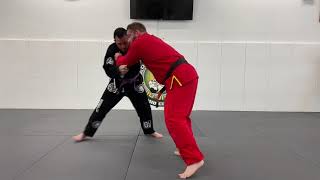
Snap Down using the Gi
Coach Travis Clark