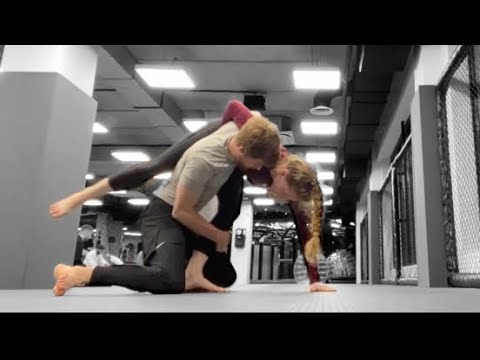
Single Leg Trip Takedown Technique, Concepts, and Drilling
0
Trip Takedown·StellaTina_BJJ
Merch out now https://theconflictcontinuum.company.site/ ___ ● Watch Grappling Concepts @conflictcontinuum ● Get o…
Translation: reaping/tripping takedown
The Trip Takedown group encompasses all takedowns that primarily use the attacker's legs or feet to disrupt the opponent's base by tripping, sweeping, or reaping their feet or legs. [1] Unlike leg-attack takedowns that grab the opponent's legs with the arms, trip takedowns use the attacker's own lower body as the primary mechanical tool — blocking, hooking, or sweeping the opponent's feet out from under them while upper body control provides the directing force. [1],[2] This group includes foot sweeps, inside trips, outside trips, and scissor takedowns, drawing techniques from judo (ashi-waza), wrestling, sambo, and various traditional martial arts. [2] Trip takedowns are energy-efficient because they exploit the opponent's momentum and weight distribution rather than requiring the attacker to lift or carry the opponent's mass. [2],[3] Many trip takedowns function best as timing-based counter-attacks, catching opponents in motion. [3]
Trip techniques are among the oldest and most universal categories of takedowns, appearing in virtually every wrestling and martial arts tradition worldwide. [1] Judo's ashi-waza (foot techniques) represent the most systematised classification of trips, codified by Jigoro Kano and refined through over a century of competition. [2] Wrestling traditions from Turkey, Mongolia, India, and Europe all independently developed sophisticated tripping systems. [2],[3]
No images yet for this technique.
Sign in to suggest an image.
Merch out now https://theconflictcontinuum.company.site/ ___ ● Watch Grappling Concepts @conflictcontinuum ● Get o…
This is a system used by Khabib Nurmagomedov. He often uses the upper body lock to setup his leg trips and double leg en…
No instructional courses yet for this technique.
Sign in to suggest a course.
Risk of injury to the person this technique is applied to
Trips cause sudden loss of balance; head/back impact risk on hard surfaces
Skill level needed to execute this technique reliably
Whether this technique is allowed under major competition rule sets
Kodokan Judo — Official Nage-waza Classification
Traditional Judo throwing/takedown terminology (Kodokan Institute)
Official Kodokan ground technique classification system
Mixed Japanese-Western terminology — combines traditional Japanese terms with katakana loanwords
Traditional Judo throwing/takedown terminology (Kodokan Institute)
timing, balance, upper body control for push-pull
good coordination and sense of opponent's weight distribution
core stabilisers, hip adductors/abductors, calves
Every move, in any martial art, shares a few universal traits. Mix and match below to pinpoint the right tool — or compare equivalents across styles.
The Foot Sweep family covers techniques where the attacker uses their foot to sweep the opponent's foot or ankle out from under them while simultaneously directing the upper body in the opposite direction. [1] Foot sweeps exploit timing and the opponent's weight transfer — the optimal moment for a sweep is when the opponent's weight is shifting onto the target foot, making it the sole point of balance. [1,2] Sweeping that loaded foot away creates an instantaneous base collapse. [2] Foot sweeps are predominantly drawn from judo's ashi-waza classification and include techniques like de ashi barai, ko soto gari, okuri ashi barai, and sasae tsurikomi ashi. [2,3] These techniques are among the most technically refined and timing-dependent takedowns in any martial art. [3]
The Inside Trip family covers techniques where the attacker uses their leg to trip the opponent from the inside — threading the tripping leg between or inside the opponent's legs to hook, reap, or block the ankle or lower leg. [1] Inside trips exploit the close-range clinch position where the attacker's legs naturally have access to the inside of the opponent's stance. [1,2] The family includes inside ankle trips and ko uchi gari (minor inner reap), both of which attack the opponent's base from an interior angle while upper body control directs the fall. [2] Inside trips are among the most commonly used clinch takedowns in both wrestling and judo. [2,3]
The Outside Trip family covers techniques where the attacker uses their leg to trip the opponent from the outside — attacking the outside of the opponent's leg by stepping around or behind to hook, reap, or block the outer ankle or leg. [1] Outside trips attack the opponent's base from the exterior angle, which provides the advantage of a longer lever arm and the ability to generate powerful rotational force. [1,2] The family includes o soto gari (major outer reap) and outside ankle trips, both powerful techniques that can produce devastating high-amplitude falls. [2] Outside trips are particularly effective when the opponent's weight is on their heels or shifted to the targeted side. [2,3]
The Scissor Takedown family covers techniques where the attacker uses a scissors-like leg action — one leg attacking high and the other attacking low simultaneously — to take the opponent to the ground. [1] The scissoring motion creates opposing forces on the opponent's body: one leg sweeps or blocks above the knee while the other sweeps or blocks below, creating an irresistible rotational force. [1,2] The most notable technique in this family is kani basami (scissors sweep/crab scissors), which is one of the most controversial throws in judo due to its effectiveness but significant injury risk. [2] Scissor takedowns have been banned or restricted in several competition rulesets due to the knee injury potential of the scissoring action on the opponent's legs. [2,3]
Trip takedowns — inside trips, outside trips, foot sweeps, and scissor takedowns — use the legs to unbalance the opponent. Inside trip and outside trip each appear in 20 passages across our corpus. Foot sweep appears in 172 passages across 46 books. (46+ books; Kano, Kodokan Judo; US Army FM 3-25.150)
You want to catch the foot mid-step as the opponent is coming back down, not when their foot is planted firmly. Steven Strangles People emphasizes timing the hook to the calf or Achilles area as they're stepping, then throwing your head to the opposite side to complete the takedown.
Make sure your elbow is tight and get a tight waist control to prevent the underhook. Steven Strangles People stresses that a loose elbow position makes it easy for opponents to underhook and turn you off the wall.
There's no single correct way to grip—you can grab the back of the collar, push with your shoulder, or use whatever grip maintains momentum. StellaTina_BJJ notes that the important thing is keeping the momentum going rather than finding the 'right' hand position.
The Trip Takedown group encompasses all takedowns that primarily use the attacker's legs or feet to disrupt the opponent's base by tripping, sweeping, or reaping their feet or legs. Unlike leg-attack takedowns that grab the opponent's legs with the arms, trip takedowns use the attacker's own lower body as the primary mechanical tool — blocking, hooking, or sweeping the opponent's feet out from under them while upper body control provides the directing force.
Trip techniques are among the oldest and most universal categories of takedowns, appearing in virtually every wrestling and martial arts tradition worldwide. Judo's ashi-waza (foot techniques) represent the most systematised classification of trips, codified by Jigoro Kano and refined through over a century of competition.
IJF: legal — Legal (ashi-waza) — trips executed without grabbing opponent's legs are permi…; IBJJF: legal — Legal at all belt levels, scored as takedown (2 points); UWW: restricted — Legal in freestyle, restricted in Greco-Roman (leg-to-leg contact prohibited); Unified MMA: legal — Legal takedown technique; ADCC: legal — Legal, scored 2-4 points in second half of match; FIAS Sport Sambo: legal — Legal — all takedowns permitted; FIAS Combat Sambo: legal — Legal; NCAA Folkstyle: legal — Legal, scored as takedown (2 points)
Danger rating 5/10. High — trips cause sudden loss of balance; head/back impact risk on hard surfaces
The standard setup chain: Establish Grip → Off-Balance (Kuzushi) → Execute the Reap/Sweep.
Standard counters include: Sprawl — drop hips back and drive weight down to stuff the takedown attempt / Lift the Targeted Leg — raise the foot being attacked to avoid the reap or sweep / Step Over — lift the targeted leg over the sweeping limb to evade / Counter-Throw — use opponent's committed weight shift to execute a counter technique.
Common variants: Standard trip (blocking or sweeping the support leg while driving the up…); Combination trip (chaining an inside trip with an outside trip when the opp…); Counter trip (using the trip as a counter when the opponent attacks); Clinch trip (executing the trip from a tight clinch position).
In judo competition, ashi-waza techniques (foot sweeps and trips) account for a significant percentage of ippon scores at Olympic and World Championship level. In MMA, trips are commonly used from the clinch.
Top errors to watch for: Tripping before loading the opponent's weight onto the target foot — they simply lift the foot / Using the trip without upper body control, so there's no directional force to topple them / Over-committing to the trip and losing your own balance / Tripping too high on the leg (calf or knee) instead of at the ankle where leverage is greatest.
The Trip Takedown is also known as Kari Teikudaun, Trip, Foot Technique, Ashi Waza.