Frame Construction
The escape begins with establishing two frames: one across the opponent's neck and one against the hip. The hip frame should use the upper arm and elbow rather than inserting the hand deeply, as this creates a solid bone structure that resists collapse if the opponent applies downward pressure.
Initial Knee Insertion
The defender bases the outside foot and rotates the hips slightly, bringing the knee through the initial position while maintaining frame pressure. Rather than extending the knee fully across the body, the defender keeps it framed against the opponent's hip alongside the upper arm, creating two contact points the opponent must penetrate.
Space Creation and Arm Transition
Once sufficient distance is created between the bodies, the defender can transition from a bent-arm frame to a straight-arm position on the hip. This straight-arm configuration eliminates vulnerability to wrist locks and allows the defender to maximize the space created by the knee and arm pressure.
Inside Control and Knee Positioning
The defender circles the inside arm to block the cross-face while advancing the knee in low and flaring it outward. The elbow positions underneath the knee, creating a bubble-shaped frame that prevents the opponent from collapsing the position and maintains structural integrity.
Transition to Underhook and Dog Fight
From the knee frame position, the defender lifts with the leg to create space, threads the underhook arm through, and comes up to an elbow position. This leads into the dog fight position, from which the defender can execute follow-up techniques such as driving the opponent flat or securing positional control.
Underhook Acquisition During Guard Pass
When defending against a guard pass such as a knee cut, the defender maintains an elbow-tight position along the ribs to facilitate early underhook acquisition. By keeping the elbow concealed against the body, the defender makes it difficult for the opponent to re-scoop or escape the underhook once established.
Knee Pressure and Elbow Clearance
The defender places the knee against the opponent's hip to prevent upward knee transition into a dominant position. Combined with frame pressure, this knee placement creates sufficient space to bring the elbow to the inside and secure the underhook before the opponent can reposition.
Escape with Scissor and Scoop
Using the underhook and knee pressure to bump and unbalance the opponent, the defender initiates a scissor motion with the legs while escaping upward. The top leg scoops over the opponent's leg during the turn to prevent the opponent from stepping over the knee and reestablishing top control.
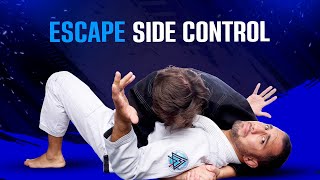
Using the UNDERHOOK to Escape Side Control
Key Takeaways
- •Frame Construction
- •Initial Knee Insertion
- •Space Creation and Arm Transition
- •Inside Control and Knee Positioning
Using the underhook to escape side control. In this video we look at finding the underhook then how to use it effectively to escape. Firstly we use the hip escape to set up the underhook. Then how position your body when your partner is passing to try hit the early underhook and lastly an option when our partner goes heavy on the underhook and its difficult to get our shoulders off the floor. #bjj #jiujitsu #sidecontrol Please don't forget to 'LIKE' this video and if you enjoyed the content please make sure you leave a 'COMMENT' and 'SUBSCRIBE' to the channel ... Thank you ❤️ // LINKS Facebook www.facebook.com/thegrapplelab Instagram https://www.instagram.com/thegrapplelab/ TikTok https://www.tiktok.com/thegrapplelab
Related Techniques
Frequently Asked Questions
What does this video teach about underhook side control escape?
This video covers frame construction, initial knee insertion, space creation and arm transition. It provides detailed instruction from The Grapple Lab.
How long does it take to learn underhook side control escape?
The basic mechanics can be understood in a single session, but developing reliable execution requires consistent drilling over weeks of practice. This 8-part breakdown helps structure your training by isolating each phase of the technique.
What are the key details for finishing underhook side control escape?
The defender places the knee against the opponent's hip to prevent upward knee transition into a dominant position. Combined with frame pressure, this knee placement creates sufficient space to bring the elbow to the inside and secure the underhook before the opponent can reposition.
Related videos
Fundamentals: Underhook escape from side control
Bellingham BJJ
The Easy Way to Learn Side Control Escape
JonThomasBJJ
Dealing With Frames by Using Your Own Frame - Andre Galvao
Atos Jiu-Jitsu HQ | World's Best BJJ Academy - Home Page
Video 8 - Side Control Escape Bridge and Roll Series
Brazilian Jiu Jitsu Incorporated
The Easiest Way to Escape Side Control (Even Against Bigger Opponents!)
Matt Arroyo Jiu Jitsu