Progressive Escape Training Approach
Rather than attempting full side control escapes immediately, the instructor recommends developing skills through easier intermediate positions first. This methodical progression builds foundational mechanics that make complete escapes significantly more achievable. Students should master these prerequisite positions before attempting escapes against fully locked-in side control.
Framing and Arm Angle Mechanics
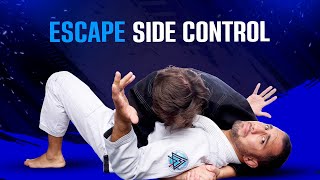
Proper framing begins with the lower forearm and maintaining arms slightly above 90 degrees to prevent collapse. Wrist pressure allows the opponent to fold the defender's arms inward, while the correct angle distributes pressure through the elbow. This positioning prevents the opponent's weight from fully settling into side control.
Knee Insertion and Hip Connection
The defender keeps the elbow and knee connected to prevent the opponent from fully collapsing into position. The knee functions as a space-creator, similar to a battering ram, maintaining separation even under sustained pressure. This knee positioning is foundational for subsequent escape movements.
Escape Against Back-Grab Control
When the opponent controls the gi material at the back, the defender uses the inserted knee to make progressive space by driving upward repeatedly. Once sufficient space develops, the defender swings the heel over the opponent's body rather than attempting a direct knee-to-chest path. The final movement presses the knee back toward the chest while retracting the leg completely, avoiding recenter positioning that risks re-passing.
Escape Against Clasped Hands
When the opponent clasps both hands for tighter control, the defender places the shin on the bottom-side hip and frames the opponent's hip with the hand, creating dual-hip blocks. The defender then pivots to the side and places the foot's edge (not flat) against the hip. The defender quickly moves the head out and underneath the opponent's clasped arms before using the foot-on-hip pressure to extract the bottom leg.
Hip Switch Defense Setup
Before the opponent switches hips, the defender establishes proper elbow positioning with a scraping motion, turning the elbow backward to frame the ribs or hips. This preemptive blocking prevents the opponent from freely following the defender's escape movements. Mastering elbow control in this static position transfers directly to dynamic hip-switch scenarios.
Forward Shrimp with Floor Weight
When the opponent maintains weight primarily on the floor, the defender executes a forward shrimp by placing the foot down and rotating the hips from side to flat, creating a jack-like lifting effect. This movement generates sufficient space to swing the knee and begin pressing toward escape. The foot is then placed on the opponent's hip as the leg is extracted.
Bridge and Roll Against Loaded Weight
When the opponent loads weight directly onto the defender's torso, a forward shrimp alone becomes ineffective as the opponent follows the movement. The defender responds by loading both feet onto the toes and bridging straight up over the head, angling slightly sideways to force the opponent to either roll or post out. If the opponent posts with a hand, the defender lifts the bottom leg to tighten the hips and swing the knee through.
The Easy Way to Learn Side Control Escape
Key Takeaways
- •Progressive Escape Training Approach
- •Framing and Arm Angle Mechanics
- •Knee Insertion and Hip Connection
- •Escape Against Back-Grab Control
0:25 Classic Side Knee In 3:36 Hip Switch 6:24 North South and Forward Shrimp Full Side Escape Guide https://youtu.be/DYUaYue-6BU?si=nUj8exLQh1XcY5EH Free Double Sleeve Course Here https://www.mavericksjj.com/courses/double-sleeve-foundation
Frequently Asked Questions
What does this video teach about hip escape side control?
This video covers progressive escape training approach, framing and arm angle mechanics, knee insertion and hip connection. It provides detailed instruction from JonThomasBJJ.
How long does it take to learn hip escape side control?
The basic mechanics can be understood in a single session, but developing reliable execution requires consistent drilling over weeks of practice. This 8-part breakdown helps structure your training by isolating each phase of the technique.
What are the key details for finishing hip escape side control?
When the opponent maintains weight primarily on the floor, the defender executes a forward shrimp by placing the foot down and rotating the hips from side to flat, creating a jack-like lifting effect. This movement generates sufficient space to swing the knee and begin pressing toward escape. The foot is then placed on the opponent's hip as the leg is extracted.
Related videos
Using the UNDERHOOK to Escape Side Control
The Grapple Lab
Fundamentals: Underhook escape from side control
Bellingham BJJ
Dealing With Frames by Using Your Own Frame - Andre Galvao
Atos Jiu-Jitsu HQ | World's Best BJJ Academy - Home Page
Video 8 - Side Control Escape Bridge and Roll Series
Brazilian Jiu Jitsu Incorporated
The Easiest Way to Escape Side Control (Even Against Bigger Opponents!)
Matt Arroyo Jiu Jitsu