The Problem: Trapped Under Superior Pressure
When a larger, stronger opponent achieves side control with shoulder pressure, the bottom player often feels immobilized and helpless. Traditional escape attempts—bridging, knee insertion, and underhook positioning—fail against an opponent who simply holds position without advancing. Energy depletion becomes the real threat, as the top player can transition to mount or submission once the bottom player exhausts themselves.
Core Principle: Deception Through Relaxation
The escape's foundation relies on eliminating visible resistance. By relaxing completely while maintaining proper hand and leg positioning, the bottom player prevents the top player from sensing active escape attempts. This psychological element causes the opponent to enter a static holding pattern rather than actively controlling the position.
Hand Positioning: The Inner Thigh Contact
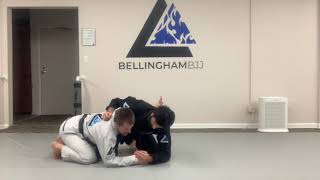
The bottom player's lower arm transitions from the hip to the inner thigh near the opponent's knee, pushing outward only three to four inches. This subtle adjustment must remain passive—no driving pressure—to avoid alerting the top player. The upper arm stays firmly under the throat to prevent the opponent from securing a better position.
Lower Body Setup: Leg Flattening and Knee Placement
The bottom player flattens their legs and rotates their hips directly toward the opponent. The knee slides up until it contacts the opponent's knee, preventing a free mount position. This configuration creates the mechanical advantage needed for the subsequent escape while appearing vulnerable to mounting.
The Trigger: Forcing the Opponent's Knee Elevation
As the opponent attempts to mount, the wide leg position forces them to elevate their knee higher than normal to achieve proper mount geometry. This elevated knee position creates the exact space needed for the bottom player's knee to slip underneath. The escape happens almost automatically if the setup is correct.
Execution: Transitioning to Half Guard with Underhook
When the opponent's knee passes over the top player's torso, the bottom player drives their own knee underneath, immediately achieving half guard. The bottom player's underhook is already established, forcing the top player to either release the grip or attempt a technical adjustment like a whizzer. This transition provides multiple follow-up options for continued escape or advancement.
The Easiest Way to Escape Side Control (Even Against Bigger Opponents!)
Key Takeaways
- •The Problem: Trapped Under Superior Pressure
- •Core Principle: Deception Through Relaxation
- •Hand Positioning: The Inner Thigh Contact
- •Lower Body Setup: Leg Flattening and Knee Placement
GET MY FREE COURSE - THE SIDE CONTROL ESCAPE KIT! https://intro.mattarroyo.com/home-page-575004 Getting crushed in side control by bigger, stronger opponents? In this Jiu-Jitsu side control escape tutorial, UFC veteran and BJJ black belt Matt Arroyo shows you the easiest, most effective way to escape side control—even if your opponent is heavier, stronger, and trying to hold you down with full pressure. Whether you’re a beginner or advanced grappler, this side control escape works in both Gi and NoGi, and gives you the exact frames, timing, and hip movement to survive, create space, and escape with control. ⸻ ✅ In this video, you’ll learn: • The #1 mistake people make when escaping side control • How to create frames that actually hold up against pressure • The key movement that makes your hips slippery • A step-by-step side control escape system that works against bigger grapplers • How to turn defense into offense using this escape ⸻ 💪 Who This Is For: • White belts struggling to survive heavy pressure • Smaller grapplers who roll with bigger, stronger partners • Any belt level looking to escape side control without brute force Join My Online Academy to Improve Your Jiu Jitsu FAST!!! https://academy.mattarroyo.com/
Related Techniques
Frequently Asked Questions
What does this video teach about underhook to single leg?
This video covers the problem: trapped under superior pressure, core principle: deception through relaxation, hand positioning: the inner thigh contact. It provides detailed instruction from Matt Arroyo Jiu Jitsu .
How long does it take to learn underhook to single leg?
The basic mechanics can be understood in a single session, but developing reliable execution requires consistent drilling over weeks of practice. This 6-part breakdown helps structure your training by isolating each phase of the technique.
What are the key details for finishing underhook to single leg?
As the opponent attempts to mount, the wide leg position forces them to elevate their knee higher than normal to achieve proper mount geometry. This elevated knee position creates the exact space needed for the bottom player's knee to slip underneath. The escape happens almost automatically if the setup is correct.
Related videos
Use your UNDERHOOK to ESCAPE bottom SIDE CONTROL - Professor Steven Williams
Steven Strangles People
Underhook Escape by Andre Galvao
BJJ Fanatics
Modesto Grappling Club Instructional #3: Side-Control/Underhook Escape
Modesto Judo Club
Using the UNDERHOOK to Escape Side Control
The Grapple Lab
Fundamentals: Underhook escape from side control
Bellingham BJJ