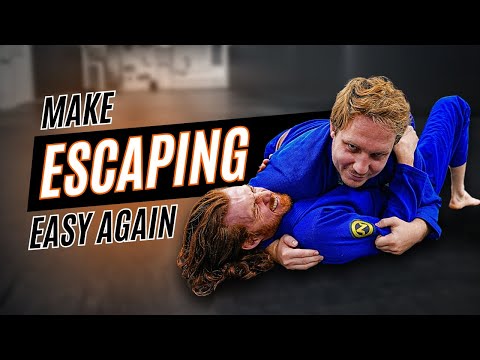
The Easy Way to Learn Side Control Escape
0
Hip Escape Side Control·JonThomasBJJ
0:25 Classic Side Knee In 3:36 Hip Switch 6:24 North South and Forward Shrimp Full Side Escape Guide https://youtu.…
Translation: hip escape side control
The Hip Escape Side Control subfamily covers side control escapes that primarily use the hip escape (shrimp) movement to create the lateral space needed to reinsert the legs and recover guard. [1] The hip escape from side control is the most fundamental and frequently drilled escape in BJJ, forming the basis of most side control escape sequences. [1],[2] Variations include the standard hip escape (shrimp to recover guard) and the ghost escape (a dynamic hip escape that slides underneath the opponent). [2],[3]
The hip escape (shrimp) is the most fundamental ground movement in BJJ. [1]
Used in BJJ and MMA competition at all levels. [1]
No images yet for this technique.
Sign in to suggest an image.
0:25 Classic Side Knee In 3:36 Hip Switch 6:24 North South and Forward Shrimp Full Side Escape Guide https://youtu.…
No instructional courses yet for this technique.
Sign in to suggest a course.
Risk of injury to the person this technique is applied to
Bottom escapes from mount/side control; bridge and hip escape mechanics (Ribeiro 2008)
Skill level needed to execute this technique reliably
Whether this technique is allowed under major competition rule sets
Jiu-Jitsu University (Saulo Ribeiro, 2008)
Alias sources — [1] Jiu-Jitsu University (Saulo Ribeiro, 2008) [2] Kodokan Judo (Jigoro Kano, 1986) [3] Gracie Jiu-Jitsu (Gracie & Gracie, 2001)
Effectiveness sources — [1] Jiu-Jitsu University (Ribeiro, 2008) [2] Mastering Jujitsu (Gracie & Danaher, 2003)
Standard Japanese martial arts terminology (kanji/hiragana)
Established Japanese martial arts naming convention — native Japanese term (和語/漢語)
Alias sources — [1] Jiu-Jitsu University (Saulo Ribeiro, 2008) [2] Kodokan Judo (Jigoro Kano, 1986) [3] Gracie Jiu-Jitsu (Gracie & Gracie, 2001)
Effectiveness sources — [1] Jiu-Jitsu University (Ribeiro, 2008) [2] Mastering Jujitsu (Gracie & Danaher, 2003)
hip escape (shrimping) speed, framing strength, timing
flexible hips and quick lateral movement
hip flexors, obliques, triceps (framing), core
Every move, in any martial art, shares a few universal traits. Mix and match below to pinpoint the right tool — or compare equivalents across styles.
Keep your arms slightly above 90 degrees rather than pushing with your wrist or arms fully extended, as this prevents your arms from collapsing and keeps the opponent's weight loaded on your elbows instead of driving through. Jon Thomas BJJ emphasizes that if you push with the wrist or have your arms at 90 degrees or less, the opponent can collapse you.
Use your knee like a ram to make space rather than trying to come all the way through to close guard, which gets your leg stuck. Once you create space with your knee, get your heel over and then retract your knee back to your chest to bring it out. Jon Thomas BJJ warns against recentering too quickly, as this causes your leg to get stuck again.
Attempting to come all the way through at the knee to reach closed guard causes your leg to get stuck, preventing a successful escape. Instead, create space with your knee first, then get your heel over before retracting back to your chest.
Don't stay flat on your back, as it makes movement difficult. Instead, shuck out to your side so you can get the side of your foot on the opponent's hip, which gives you better positioning to escape and prevents your leg from getting stuck.
The Hip Escape Side Control subfamily covers side control escapes that primarily use the hip escape (shrimp) movement to create the lateral space needed to reinsert the legs and recover guard. The hip escape from side control is the most fundamental and frequently drilled escape in BJJ, forming the basis of most side control escape sequences.
The hip escape from side control is one of the foundational techniques of BJJ, directly descended from judo's ground escape methodology. The shrimp from side control is considered one of the most essential skills in all of grappling.
Unified MMA: legal — Legal defensive technique; IBJJF: legal — Legal — escapes and sweeps are fundamental to BJJ, sweep from bottom scores 2…; IJF: legal — Legal; ADCC: legal — Legal, sweep scores 2 points (4 from mount/back); FIAS Sport Sambo: legal — Legal; FIAS Combat Sambo: legal — Legal
Danger rating 3/10. Moderate — bottom escapes from mount/side control; bridge and hip escape mechanics (Ribeiro 2008)
The standard setup chain: Create Space → Disrupt Control → Execute Escape → Recover Position.
Standard counters include: Crossface — drive forearm across the face to prevent the hip escape / Underhook — thread arm under the far shoulder to control upper body rotation / Knee-on-Belly — transition to knee-on-belly to maintain pressure and mobility.
Common variants: Shrimp to guard (framing and hip-escaping to recover full guard or half guard); Underhook escape (winning the underhook and coming to knees or reversing); Bridge to knees (bridging into the opponent and transitioning to turtle or…); Ghost escape (inverting under the opponent to re-guard from the opposit…).
Used in BJJ and MMA competition at all levels.
Top errors to watch for: Flat shrimping without turning to the side — the hip escape requires you to turn on your side for proper hip movement / Not using the bottom foot to drive the shrimp — the foot is the engine; without it, the shrimp has no power / Shrimping toward the opponent — always shrimp away / Not framing before shrimping — the frame creates and maintains the space.
The Hip Escape Side Control is also known as Koshi Nige Yoko-shiho, Shrimp Escape, Ebi From Side Control, Hip Switch Escape.