Strike & defenceLocksClose rangeFighting multiple people
Distance
CloseMiddleLong
Overview
The Frame And Reguard subfamily covers side control escapes that use defensive frames to create space, then leverage that space to reinsert the legs and recover a guard position. [1] The frame and reguard approach focuses on incremental space creation through proper frame placement, followed by the critical step of reguarding before the opponent can collapse the space. [1],[2] This escape method is considered more reliable than the bridge and roll because it doesn't require explosive timing — it uses systematic frame placement and hip movement. [2],[3]
Also known as
Frame Escape[1]Reguard From Side Control[2]Stiff Arm Escape[3]
The frame and reguard from side control became the primary side control escape methodology in modern BJJ, emphasising the combination of skeletal framing and hip movement over explosive reversals. [1] It is now the most commonly taught side control escape approach. [2],[3]
Country of origin· shown in random order
🇧🇷BrazilBrazilian Jiu-Jitsu, MMA
🇯🇵JapanBrazilian Jiu-Jitsu
🇺🇸USAMMA
Effectiveness
Frame and reguard creates space using forearm frames and hip escapes to recover guard from side control. [1],[2]
Lineage
Frame and reguard is the most fundamental side control escape in BJJ. [1]
Competition Record
Used in BJJ and MMA competition at all levels. [1]
Images
No images yet for this technique.
Sign in to suggest an image.
Biomechanical Mechanism
Primary Action — Breaking the opponent's leg control to advance to a more dominant position
Joints Involved — Hips (posture and pressure), knees (opening the guard with knee-in or standing), hands (grip fighting)
Force Vector — Forward pressure (stack/smash) or backward posture (stand-up break) to open the closed guard
Passing Mechanic — Once the guard is opened, speed passing, pressure passing, or toreando passing advances the position
Position & Entry
From bottom side control — Create frames with the forearms against the opponent's neck and hip, hip escape (shrimp) to create space, insert the knee to recover guard
From underhook escape — Swim the near arm to an underhook, bridge into the opponent and come to knees or reverse
From opponent's transition — When the opponent moves to mount or north-south, use the movement to create space and escape
✓The frame-and-reguard from side control uses forearm frames to create space and shrimping to recover guard (Saulo Ribeiro, Jiu-Jitsu University, 2008)
✓The frame structure: near forearm on the opponent's hip, far forearm on their neck or shoulder — this creates a protective frame between your bodies
✓The escape sequence: frame → bridge to create momentary space → shrimp hips away → insert knee → close guard
✓The knee insertion (knee shield) is the critical moment — it prevents the opponent from re-establishing side control
✓The frame-and-reguard is the most commonly successful side control escape because it's incremental and safe
✓Multiple shrimps may be needed — each one gains distance until the knee can be inserted
✓After recovering guard, immediately establish grips — don't let the opponent pass again
✓The frame-and-reguard works against heavier opponents because it uses frames and hip movement, not strength
Common Mistakes
!Framing too far from the body — keep frames close and structural; extended frames are weak
!Not using the forearm (using hands instead) — forearms provide rigid, sustainable frames
!Shrimping without framing — the frame creates the space that the shrimp expands
!Only shrimping once — multiple shrimps are often required
!Not inserting the knee aggressively — the knee shield must be established firmly
!Framing on the chest — hip and neck frames are structurally superior
!Recovering guard but not establishing grips — the opponent will immediately re-pass without grip control
What are the main frames my opponent uses to defend against guard passes?
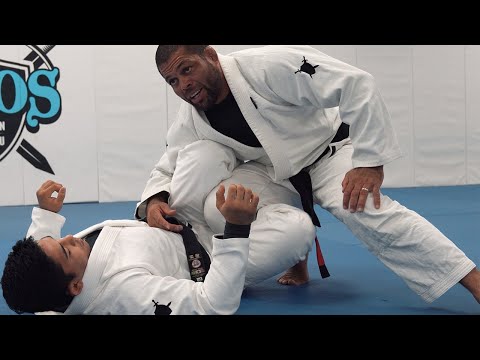
According to Andre Galvao, the foot and shin are the first and most important frames your opponent will use to block you during guard passing—they'll try to hook your hips or place their leg to stop your advance. Additionally, once you get past the lower frame, your opponent will build an outside frame by bringing their leg over to push you away.
How do I neutralize my opponent's frame when passing?
Andre Galvao emphasizes positioning yourself between the thigh and upper arm by underhooking the arm and placing your head below and behind the tricep—this eliminates their frame and gives you access to mount or the back without resistance. You must also control or defeat the shin frame by maintaining pressure on top of it, which is why techniques like the lahiva hook and headquarters position are effective.
What should I do if my opponent traps my leg during a shin slide pass?
Andre Galvao recommends sliding toward the side of the shin to escape the leg trap rather than fighting it head-on. Once your foot escapes and your opponent faces away from you, the frame becomes much easier to control, and you can transition into a leg drag without dealing with the inside frame anymore.
How do I prevent my opponent from building frames after I pass their guard?
Andre Galvao stresses that you must use your own frames against your opponent's frames throughout the pass—use knee cuts, shin slides, and control the collar and pants to limit their ability to establish frames. When you underhook and get on the side, you eliminate their inside frame and control their positioning before they can build an effective outside frame.
How does the Frame And Reguard work?
The Frame And Reguard subfamily covers side control escapes that use defensive frames to create space, then leverage that space to reinsert the legs and recover a guard position. The frame and reguard approach focuses on incremental space creation through proper frame placement, followed by the critical step of reguarding before the opponent can collapse the space.
Where does the Frame And Reguard come from?
The frame and reguard from side control became the primary side control escape methodology in modern BJJ, emphasising the combination of skeletal framing and hip movement over explosive reversals. It is now the most commonly taught side control escape approach.
Is the Frame And Reguard legal in competition?
Unified MMA: legal — Legal defensive technique; IBJJF: legal — Legal — escapes and sweeps are fundamental to BJJ, sweep from bottom scores 2…; IJF: legal — Legal; ADCC: legal — Legal, sweep scores 2 points (4 from mount/back); FIAS Sport Sambo: legal — Legal; FIAS Combat Sambo: legal — Legal
How dangerous is the Frame And Reguard?
Danger rating 3/10. Moderate — bottom escapes from mount/side control; bridge and hip escape mechanics (Ribeiro 2008)
How do I set up the Frame And Reguard?
The standard setup chain: Create Space → Disrupt Control → Execute Escape → Recover Position.
How do I defend against the Frame And Reguard?
Standard counters include: Heavy Hips — maintain low hip pressure and wide base to absorb the bridge / Grapevine — hook legs inside opponent's thighs to neutralize hip movement / Post Hand — post arm on the mat in the direction of the bridge to maintain balance.
What are the variants of the Frame And Reguard?
Common variants: Shrimp to guard (framing and hip-escaping to recover full guard or half guard); Underhook escape (winning the underhook and coming to knees or reversing); Bridge to knees (bridging into the opponent and transitioning to turtle or…); Ghost escape (inverting under the opponent to re-guard from the opposit…).
How effective is the Frame And Reguard in competition?
Used in BJJ and MMA competition at all levels.
What are common mistakes when doing the Frame And Reguard?
Top errors to watch for: Framing too far from the body — keep frames close and structural; extended frames are weak / Not using the forearm (using hands instead) — forearms provide rigid, sustainable frames / Shrimping without framing — the frame creates the space that the shrimp expands / Only shrimping once — multiple shrimps are often required.
What are other names for the Frame And Reguard?
The Frame And Reguard is also known as Furēmu Rigādo, Frame Escape, Reguard From Side Control, Stiff Arm Escape.