Introduction to Parry and Riposte
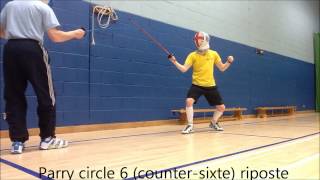
This lesson introduces the fundamental mechanics of parrying an attack and executing an immediate counterattack. The parry of sixte serves as the foundational defensive technique for longsword practitioners.
Parrying Principles and Variations
Multiple valid parrying methods exist for defending against the same attack, each with distinct advantages and limitations. Parries vary in blade angle, positioning relative to the opponent, and footwork—whether stationary, retreating, or lateral. Understanding these variations allows practitioners to select the most appropriate response for any given situation.
Foundation: The Fendinterverso Riposte
The riposte begins as a descending cut from left to right, initiated from the Dona Sinestra guard with the right foot forward. Practitioners must engage their entire body—hips, feet, and core—to generate power and ensure proper form. The sword concludes in front of the right hip with the tip directed forward.
Transitioning Through Guard Positions
After executing the initial cut, practitioners transition by advancing the left foot forward. Body mechanics—particularly hip rotation and foot positioning—ensure the Fendinterverso maintains proper alignment despite the wider angle created by the new stance. This transition mirrors the final position achieved during an actual parry.
The Pota di Ferro Starting Position
The Pota di Ferro (iron door) guard provides balanced offensive and defensive positioning, making it the optimal starting point for the parry and riposte combination. From this guard, practitioners twist their torso and pivot their rear foot to achieve the frontale position, creating structural stability and increased speed through proper weight distribution.
Executing the Complete Parry and Riposte
From Pota di Ferro, the defender transitions to frontale through body rotation, establishing a solid defensive structure. The riposte is then released explosively, utilizing the accumulated tension from the parry position to accelerate the reverso cut toward the opponent's right hip.
Partner Drill: Variable Footwork
The attacker executes a basic cut using either simple footwork (single passing step) or complex footwork (half or full steps), depending on the starting distance. The defender must time the parry precisely and respond with an immediate riposte. Footwork variations should match those introduced in previous lessons.
Progressive Training Methodology
Practitioners should begin at slow speeds to establish correct form and develop conscious understanding of timing and mechanics. Once the defensive action becomes instinctive, focus shifts to reading the opponent's attack initiation to refine parry timing. Speed should increase only after proper mechanics are internalized.
Long-Term Development and Practice Discipline
Mastering the parry and riposte requires consistent practice over an extended period. Practitioners must prioritize proper form over speed and follow a methodical progression rather than rushing advancement. Patience and disciplined repetition form the foundation for developing reliable defensive reflexes.
Longsword Beginners Guide #4 - Parry and Riposte
Key Takeaways
- •Introduction to Parry and Riposte
- •Parrying Principles and Variations
- •Foundation: The Fendinterverso Riposte
- •Transitioning Through Guard Positions
Follow me on: PATREON - https://www.patreon.com/MalaguttiFederico Instagram - https://www.instagram.com/federicomalagutti/ Facebook - https://www.facebook.com/MalaguttiMartialArts/ Twitter - https://twitter.com/Fede_Duellist Wordpress Blog - https://fedemalablog.wordpress.com/ Tumblr - https://www.tumblr.com/blog/malaguttifederico
Frequently Asked Questions
What does this video teach about parry of sixte?
This video covers introduction to parry and riposte, parrying principles and variations, foundation: the fendinterverso riposte. It provides detailed instruction from Federico Malagutti HEMA.
How long does it take to learn parry of sixte?
The basic mechanics can be understood in a single session, but developing reliable execution requires consistent drilling over weeks of practice. This 9-part breakdown helps structure your training by isolating each phase of the technique.
What are the key details for finishing parry of sixte?
Practitioners should begin at slow speeds to establish correct form and develop conscious understanding of timing and mechanics. Once the defensive action becomes instinctive, focus shifts to reading the opponent's attack initiation to refine parry timing. Speed should increase only after proper mechanics are internalized.