Strike & defenceLocksClose rangeFighting multiple people
Distance
CloseMiddleLong
Body target
Upper bodyMiddle bodyLower body
Overview
The D'Arce choke applied from the front headlock position, one of the most common entries for this arm-triangle variation. The attacker uses a snap-down or sprawl to establish front headlock control, then threads the choking arm under the opponent's near-side arm and around the neck. This entry is favoured in both MMA and no-gi grappling because the front headlock is a natural position reached from wrestling exchanges.
Also known as
D'Arce From Front HeadlockWrestlingBrabo Choke From Snap-DownNo-Gi D'Arce Entry
The D'Arce choke is one of the highest-percentage front headlock submissions, particularly effective in no-gi grappling. [1],[2]
Lineage
Named after Joe D'Arce; closely related to the Brabo choke from Brazil. [1]
Competition Record
The D'Arce choke is commonly finished in MMA and no-gi competition. [1]
Images
No images yet for this technique.
Sign in to suggest an image.
Biomechanical Mechanism
Primary Action — Threading the choking arm under the opponent's near-side armpit and around the neck from the front headlock, creating bilateral compression using the attacker's arms and the opponent's own trapped shoulder
Joints Involved — Choking arm (threads under the armpit and around the neck), secondary arm (clasps with the choking arm to complete the figure-four), chest (drives into the opponent to tighten the compression)
Force Vector — Bilateral compression — the D'Arce squeezes the neck between the choking arm on one side and the opponent's own trapped shoulder on the other
Submission Mechanic — The D'Arce works by trapping the opponent's arm against their own neck, then using the figure-four arm configuration to squeeze — the opponent's shoulder becomes part of the choking mechanism
Position & Entry
From D’Arce Choke From Front Headlock — Establish control in this specific position, thread the choking arm under the near-side armpit, wrap around the neck, clasp with the secondary arm, and squeeze
Front Headlock: Submission Chain for MMA (D'Arce to Guillotine)
0
D’Arce Choke From Front Headlock·fightTIPS
Knowing how to lock in a submission in MMA is good, but knowing how to chain a few different ones together makes you a m…
1 / 2
3 videos
What Instructors Say
The D'Arce choke from front headlock is a blood choke that targets both carotid arteries by positioning one arm underneath the opponent's neck and threading it to grip the bicep, while the opponent's own shoulder provides counter-pressure on the opposite side of the neck. FightTIPS emphasizes secure positional control—shoulders pressed on top of the spine rather than high on the back—before executing the choke, with the defender dropping to their side as they thread the arm through while keeping the opponent's head compressed to prevent posturing. Chewjitsu presents the D'Arce as part of a three-choke sequence (anaconda, guillotine, D'Arce), noting that it can be accessed when an opponent rolls out of a guillotine attempt; the finish involves either a figure-four grip on the bicep or forearm, with finishing options including a side-lying position with hooks for enhanced squeeze. Jordan Teaches Jiujitsu provides detailed biomechanical instruction on proper elbow positioning—raising the elbow toward the armpit to align the forearm parallel with the soft part of the neck (carotid artery location) rather than the hard muscle—and emphasizes the necessity of rotational pressure via torso rotation and head pressure to force the neck into the forearm, treating it as dual-motion compression rather than isolated squeezing. All three instructors agree on the importance of keeping the opponent off their knees and preferably on their side to generate rotational pressure, and all stress that proper technique targets the soft tissue of the neck to avoid neck cranking.
Synthesized from 3 instructors
FightTIPS — Front Headlock: Submission Chain for MMA (D'Arce to Guillotine): Foundational positional setup and entry mechanics; emphasis on shoulder placement for control and arm-threading technique; practical MMA context and chaining to guillotine as backup
Chewjitsu — Finish More Subs in Front Headlock with This 3 Choke Attack Sequence: Integration of D'Arce within a flowing three-choke sequence; finishing details including figure-four grip and side-lying finishing variation with hooks
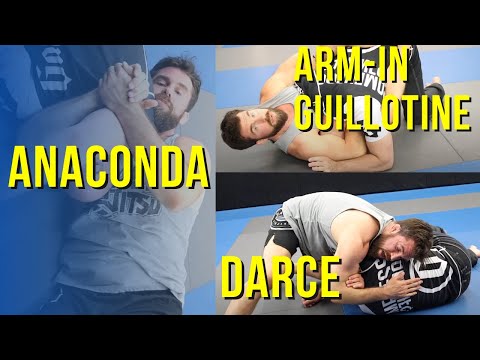
Jordan Teaches Jiujitsu — Choking Mechanics You WON'T Learn In Class... D'arce, Anaconda & Arm-In Guillotine Complete System: Detailed biomechanical analysis of elbow positioning, choke bite mechanics, and rotational pressure; distinction between shallow vs. deep grips; positional requirements (side vs. back vs. knees); multiple entry points and finishing positions
Learn This Technique
No instructional courses yet for this technique.
Sign in to suggest a course.
Ratings
Danger Rating
Risk of injury to the person this technique is applied to
8
Very High8/10
The D'Arce choke compresses the carotid arteries and can cause unconsciousness in 6-10 seconds; the trapped arm adds additional compression
Difficulty
Skill level needed to execute this technique reliably
Intermediate
Competition Legality
Whether this technique is allowed under major competition rule sets
Illegal
— FIAS Sport Sambo — All chokes prohibited in Sport Sambo
How do I properly compress the neck in a D'Arce choke from front headlock?
You need to compress both sides of the neck rather than yanking or cranking. According to fightTIPS, keep your thumb above the neck so the blade of your forearm cuts off the carotid artery on the far side, focusing on cutting off oxygen flow rather than just pulling.
What should I do with my legs when finishing the D'Arce to prevent my opponent from escaping?
Cover your opponent's head with your top leg to prevent them from hopping around and getting out. According to fightTIPS, letting them move freely makes escape much easier, so keeping them locked in position is critical.
Why is it important to bring my opponent to the side when setting up the choke?
Jordan Teaches Jiujitsu emphasizes that if you try to lock and finish from a centered position, you won't be able to apply rotational pressure to push their head into your forearm—you'll only be able to squeeze, which is ineffective unless you're significantly stronger.
Should I finish the D'Arce or switch to a guillotine if the initial choke doesn't work?
FightTIPS recommends going for the D'Arce and arm-in guillotine sequence because you can keep your opponent locked into position the entire time, allowing you to transition between submissions while maintaining control.
How does the D’Arce Choke From Front Headlock work?
The D'Arce choke applied from the front headlock position, one of the most common entries for this arm-triangle variation. The attacker uses a snap-down or sprawl to establish front headlock control, then threads the choking arm under the opponent's near-side arm and around the neck.
Where does the D’Arce Choke From Front Headlock come from?
The D'Arce choke was named after Joe D'Arce who popularised the technique in the early 2000s. It is closely related to the Brabo choke.
Is the D’Arce Choke From Front Headlock legal in competition?
IBJJF: legal — Legal at all belt levels, gi and no-gi — chokes are the safest submission cat…; IJF: legal — Legal (shime-waza) — strangulation techniques are one of three permitted subm…; ADCC: legal — Legal; Unified MMA: legal — Legal — choke submissions are among the most common finishes in MMA; FIAS Sport Sambo: banned — All chokes prohibited in Sport Sambo; FIAS Combat Sambo: legal — Legal
How dangerous is the D’Arce Choke From Front Headlock?
Danger rating 8/10. High — the D'Arce choke compresses the carotid arteries and can cause unconsciousness in 6-10 seconds; the trapped arm adds additional compression
How do I set up the D’Arce Choke From Front Headlock?
The standard setup chain: Establish front headlock/half guard top → Thread choking arm under armpit → Wrap around neck → Clasp hands → Apply chest pressure and squeeze.
How do I defend against the D’Arce Choke From Front Headlock?
Standard counters include: Posture up before the arm is threaded / Lock the hands together to prevent arm isolation / Turn into the choke to relieve angle.
What are the variants of the D’Arce Choke From Front Headlock?
Common variants: Short D'Arce (partial arm thread for shorter arms); Long D'Arce (deep arm thread for maximum compression); Gable grip finish; RNC-style figure-four finish.
How effective is the D’Arce Choke From Front Headlock in competition?
The D'Arce choke is commonly finished in MMA and no-gi competition.
What are common mistakes when doing the D’Arce Choke From Front Headlock?
Top errors to watch for: Not threading deep enough / Squeezing with arms only (use chest pressure) / Not controlling the opponent's hip to prevent escape / Applying from too far away.
What are other names for the D’Arce Choke From Front Headlock?
The D’Arce Choke From Front Headlock is also known as D'Arce From Front Headlock, Brabo Choke From Snap-Down, No-Gi D'Arce Entry.