The Front Headlock Choke System
The D'Arce, Anaconda, and Arm-In Guillotine form an interconnected system originating from the front headlock position. All three techniques share identical setup mechanics: one arm under the neck and one arm under the armpit, allowing seamless transitions based on opponent reaction and available pathways.
Grip Distinctions Between Chokes
Each choke variant is differentiated solely by grip placement while maintaining the same foundational position. The Anaconda uses a bicep grip under the armpit; the D'Arce uses a bicep grip under the neck; the Arm-In Guillotine employs a hand-over-hand grip under the chin. This structural similarity enables practitioners to fluidly transition between techniques.
Critical Choking Mechanics Overview
Proper execution requires mastery of three mechanical principles: choke bite positioning, elbow alignment, and rotational pressure. Many practitioners inadvertently apply neck cranks rather than clean chokes due to incomplete understanding of these fundamental mechanics.
Targeting the Carotid Artery
The neck contains both muscular (hard) and vascular (soft) regions. Pressure applied to the hard portion causes pain without restricting blood flow; pressure on the soft portion—where the carotid artery resides—effectively cuts off cerebral circulation. Clean technique targets the soft portion exclusively.
Elbow Positioning and Choke Bite
Elbow height determines forearm angle relative to the neck's soft tissue. A lowered elbow directs pressure toward muscular tissue; raising the elbow toward the armpit aligns the forearm with the carotid artery. A strong choke bite minimizes the gap between the pivot point (inner elbow) and the neck, achieved through proper elbow elevation.
Deep-to-Shallow Grip Transition
Initial arm insertion requires a deep bicep grip to secure proper positioning, but finishing requires arm retraction to shallow placement. This counter-intuitive transition allows elbow elevation necessary for correct mechanical alignment and pressure application.
Dual-Motion Pressure Application
Effective finishing requires simultaneous upward forearm pressure and downward head pressure—analogous to scissor blades closing from opposite directions. Rotation of both elbows combined with torso pressure on the head ensures maximum carotid compression without relying on strength advantage.
Positional Transition to Side Control
From the standard front headlock with hips down, the practitioner must transition to the opponent's side using a quarter nelson grip. This positional shift enables deeper arm insertion and, critically, allows for the rotational pressure necessary to force the neck into the forearm. Attempting the finish from turtle position restricts pressure to a single direction, limiting effectiveness.
Finishing Mechanics and Leg Control
After flipping the opponent to their side, execute the choke by shooting the arm deep, retracting to shallow placement, raising the elbow for proper angle, then simultaneously squeezing and rotating. Securing the opponent's legs prevents circular escape movement and maintains consistent rotational pressure throughout the finish.
Belly-Up D'Arce Variation
When an opponent is inadvertently flipped to their back, transition to the belly-up D'Arce by rolling through and reorienting the body. This variation requires dropping the elbow downward (opposite the belly-down position) and walking the legs to establish rotational pressure through downward head pressure.
Choking Mechanics You WON'T Learn In Class... D'arce, Anaconda & Arm-In Guillotine Complete System
Key Takeaways
- •The Front Headlock Choke System
- •Grip Distinctions Between Chokes
- •Critical Choking Mechanics Overview
- •Targeting the Carotid Artery
👊Thanks to LMNT for sponsoring this video! Head to http://DrinkLMNT.com/JORDANTEACHES to get your free sample pack with any purchase. ✅ BJJ Beginner Course: https://bjjbeginnercourse.com ✅ Jiu-Jitsu Theory Course: https://jiujitsutheorycourse.com 📩 Newsletter: http://jordanteachesjiujitsu.com/newsletter/ ✅ BJJ Games: A Constraints-Led Approach To Grappling: https://playbjjgames.com ✅ Wrestling For BJJ Course: http://wrestlingforbjj.com/ 💥 Kimura Trap Mastery: http://kimuratrapmastery.com ✅ Rides & Escapes Course: https://ridesescapes.com 🏖️ Trinidad & Tobago BJJ Camp: https://www.rollingintobago.com/ 🔥 X-Martial - https://www.xmartial.com/search?q=limitless --- Support my work: ❤️ Patreon: https://www.patreon.com/jordanteachesjiujitsu 👕 Merch: https://limitless-apparel-22.creator-spring.com/ 🥋 BJJ Fanatics: https://bjjfanatics.com/collections/new-releases/products/jordan-teaches-bottom-half-guard-by-jordan-preisinger Social: 💥 Instagram: https://www.instagram.com/jordanteachesjiujitsu/?hl=en 💥 Facebook: https://www.facebook.com/jordanteachesjiujitsu 💥 Facebook group: https://www.facebook.com/groups/jordanteachesjiujitsugroup/ 💥 TikTok: https://www.tiktok.com/@jordanteachesjiujitsu Timestamps: 00:00 - Intro 01:36 - D'Arce Choke: mechanics and entries 09:06 - Anaconda Choke: mechanics and entries 10:55 - Arm-In Guillotine Choke: mechanics and entries 13:52 - Front Head Lock entries 16:35 - Outro
Related Techniques
Frequently Asked Questions
What does this video teach about d’arce choke from front headlock?
This video covers the front headlock choke system, grip distinctions between chokes, critical choking mechanics overview. It provides detailed instruction from Jordan Teaches Jiujitsu.
How long does it take to learn d’arce choke from front headlock?
The basic mechanics can be understood in a single session, but developing reliable execution requires consistent drilling over weeks of practice. This 10-part breakdown helps structure your training by isolating each phase of the technique.
What are the key details for finishing d’arce choke from front headlock?
After flipping the opponent to their side, execute the choke by shooting the arm deep, retracting to shallow placement, raising the elbow for proper angle, then simultaneously squeezing and rotating. Securing the opponent's legs prevents circular escape movement and maintains consistent rotational pressure throughout the finish.
Related videos
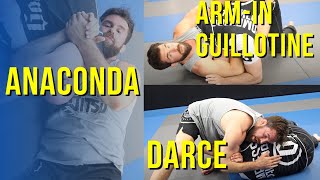
Finish More Subs in Front Headlock with This 3 Choke Attack Sequence
Chewjitsu
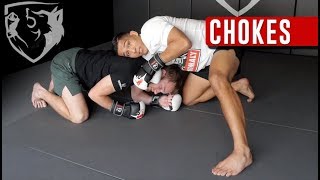
Front Headlock: Submission Chain for MMA (D'Arce to Guillotine)
fightTIPS
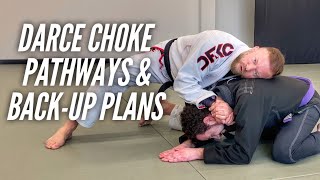
All About the Darce Choke - Pathways & Back-Up Plans
Knight Jiu-Jitsu
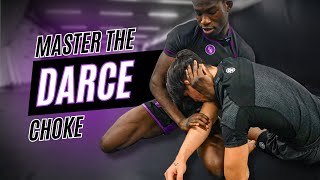
UFC BJJ Star Davis Asare Teaches World Class Darce
JonThomasBJJ
Front Headlock: Submission Chain for MMA (D'Arce to Guillotine)
fightTIPS