Translation: D'Arce Choke (katakana loanword); also スピニングチョーク
Range & classification
Category
Strike & defenceLocksClose rangeFighting multiple people
Distance
CloseMiddleLong
Body target
Upper bodyMiddle bodyLower body
Overview
The D'Arce choke (also called the Brabo choke) is a front headlock arm triangle where the attacker threads one arm under the opponent's armpit, across the neck, and locks a figure-four grip with the other arm around the head. [1],[2] The threaded arm compresses one carotid while the opponent's trapped arm wedges against the other side. [1],[3] The D'Arce is typically entered from half guard top, side control, or when the opponent turtles, and is finished by sprawling the hips to tighten the compression. [1],[4] It is the mirror-image of the anaconda choke — in the D'Arce, the arm goes under the armpit first. [1],[5]
The D'Arce choke is named after Joe D'Arce, a Renzo Gracie black belt who popularized the technique in competition during the early 2000s. [1],[2] The same technique was independently developed in Brazil and called the Brabo choke. [1],[3] The arm-threading mechanic has parallels in judo and catch wrestling headlock strangles, but the modern figure-four configuration was systematized in BJJ. [1],[4],[5]
The D'Arce is one of the highest-percentage front headlock submissions in no-gi grappling. The under-neck threading creates extreme compression — when properly locked, the tap comes within seconds. [1]
Lineage
Named after Joe D'Arce (Renzo Gracie lineage). The mechanics exist in catch wrestling as the 'no-gi brabo.' Also called the Brabo choke in some Brazilian lineages (Milton Vieira). [1]
Competition Record
Extremely common at ADCC and no-gi worlds. Frequently finished in UFC and professional MMA. One of the top 5 submissions at elite no-gi competition. [1]
Images
No images yet for this technique.
Sign in to suggest an image.
Biomechanical Mechanism
Primary Action — Bilateral compression of the carotid arteries — restricts blood flow to the brain, causing unconsciousness within seconds
Joints Involved — Cervical spine (lateral flexion), glenohumeral joint of the trapped arm (if arm-in), nuchal region
Force Vector — Lateral squeeze creates inward pressure on both sides of the neck simultaneously
Choking Mechanism — Vascular strangle — occludes carotid arteries and jugular veins, distinct from airway (tracheal) chokes
Position & Entry
From top half guard — Thread the arm under opponent's far arm and around the neck, lock the figure-four behind their shoulder, sprawl and squeeze
From side control — Opponent turns in, thread the arm under their armpit and around the neck, connect hands and apply pressure
From front headlock — Snap-down creates access, thread arm under the far armpit, circle to the choking side and lock
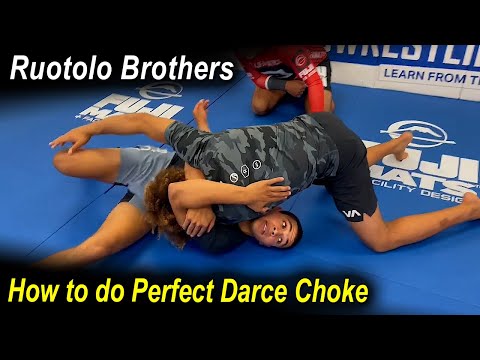
How to do the Perfect Darce Choke
-
Click Here To Check Out Ruotolo Brother's Instructional Videos - https://bjjfanatic…
1 / 2
3 videos
What Instructors Say
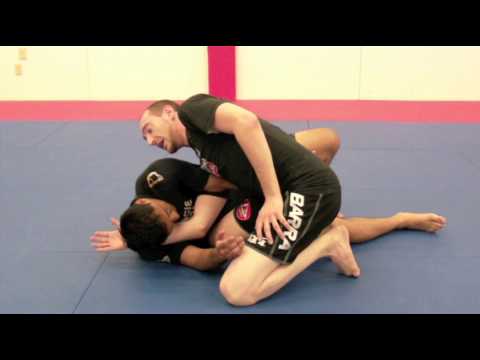
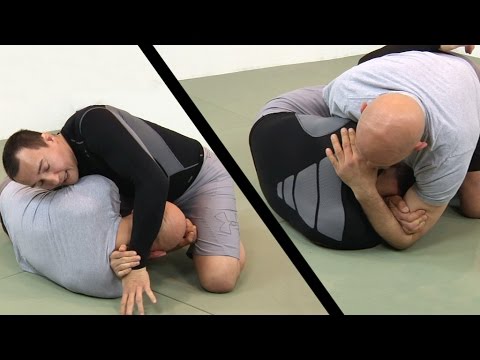
The Darce choke (also called the Brabo choke or, in one variation, the Japanese necktie) is a front-headlock submission that can be applied from multiple positions including half guard, side control, bottom guard, and turtle. Stephan Kesting and Dennis Kang emphasize the fundamental mechanics: threading one arm deep under the opponent's arm and across the neck, establishing a two-handed grip (traditionally bicep-to-bicep, or forearm-to-forearm for shorter-armed practitioners), then driving forward to apply pressure. The Ruotolo Brothers, presented by Bernardo Faria, stress the critical importance of using the blade of the wrist—the sharp inner edge—against the opponent's neck rather than relying solely on arm squeeze, which creates both pain and choke simultaneously and is essential for finishing against resilient opponents. They also emphasize keeping the elbow pointed outward rather than rolling over it, as rolling diminishes power. Tim Gillette (Gracie Barra Twin Cities) demonstrates the technique from side control, highlighting the importance of arm depth (achieved by turning the body and bringing the ear to the opponent's lat), using a gable grip to control the head, and finishing by sitting underneath with the knee against the hip rather than sprawling backward. All three instructors agree on the value of depth and proper hand positioning; the Ruotolo Brothers uniquely emphasize wrist-blade engagement and elbow positioning as differentiators in finishing strength.
Synthesized from 3 instructors
Stephan Kesting (Grapplearts) — How to Do the D'Arce Choke (aka the No Gi Brabo Choke): Foundational mechanics from half guard, demonstrating standard bicep grip and the forearm-to-forearm variation for practitioners with shorter arms or thicker opponents; introduces the Japanese necktie naming variant.
Bernardo Faria BJJ Fanatics — The PERFECT Darce Choke with Ruotolo Brothers: Advanced finishing details emphasizing blade-of-wrist engagement for pain and choke combination, proper elbow positioning (pointing outward vs. rolling over), and bottom-position entry with frame-release setup; developed over 16+ years of competition.
Gracie Barra Twin Cities — No Gi Grappling Video: Chokes from Side Control - Darce Choke (aka Brabo Choke) with Tim Gillette: Side control application triggered by opponent's underhook pummel, detailed arm-threading mechanics (body rotation, ear-to-lat positioning for depth), gable grip control, and sit-underneath finishing method with knee placement for leverage.
Learn This Technique
No instructional courses yet for this technique.
Sign in to suggest a course.
Ratings
Danger Rating
Risk of injury to the person this technique is applied to
9
Extreme9/10
Arm-thread chokes (D'Arce/Brabo) compress the neck using the arm threaded under the opponent's armpit
Difficulty
Skill level needed to execute this technique reliably
Advanced
Competition Legality
Whether this technique is allowed under major competition rule sets
Illegal
— FIAS Sport Sambo — All chokes prohibited in Sport Sambo
✓The D'Arce choke (also called Brabo choke in some lineages) threads the arm under the opponent's neck and over their near arm — creating an arm triangle from the front headlock or side control position (Danaher, Front Headlock System: Go Further Faster, 2019)
✓The D'Arce is the 'reverse anaconda': where the anaconda threads over the neck and under the arm, the D'Arce threads under the neck and over the arm — the arm enters from the opposite direction
✓Named after Joe D'Arce, a Renzo Gracie black belt who popularised the technique — though the mechanics exist in catch wrestling as the 'no-gi brabo'
✓The choking mechanism: the attacker's arm threads under the neck, the hand connects to the bicep of the other arm (figure-four), and the opponent's trapped arm pushes their shoulder into the carotid
✓The D'Arce is commonly entered from the front headlock, half guard, or during guard passing — any time the opponent's head and one arm are exposed
✓The finish involves a sprawling motion: drive the hips down and forward while squeezing the figure-four — the hip pressure tightens the arm triangle
✓The D'Arce is one of the highest-percentage front headlock submissions in no-gi grappling: the arm-under-neck threading creates extreme compression
Common Mistakes
!Threading the arm too shallow — the arm must pass under the neck deep enough to reach the bicep of the other arm for the figure-four connection
!Attempting without the opponent's arm trapped — the D'Arce requires the near arm inside the loop; without the arm, the shoulder doesn't compress the carotid
!Not sprawling during the finish — the hip sprawl is the primary tightening mechanism; arm squeezing alone is insufficient for most opponents
!Confusing the D'Arce with the anaconda — the D'Arce threads under-neck-over-arm, the anaconda threads over-neck-under-arm; using the wrong threading path creates the wrong choke
!Attempting from too far away — the D'Arce requires close body contact; distance between the attacker and opponent loosens the triangle
!Not walking the hips to the choking side — hip position determines compression angle; walking to the correct side optimises the shoulder-into-neck mechanism
!Releasing when the initial connection is loose — adjust the threading depth and hip position rather than abandoning; the D'Arce often tightens with positional adjustments
Why isn't my Darce Choke working even though it feels tight?
According to Bernardo Faria, the blade of your wrist is critical—many people fail to get the choke because while it may feel tight, there's no pain being created. Make sure you're using the sharp blade of your wrist to engage the opponent's neck, not just squeezing with depth alone.
What's the most common mistake when rolling into the Darce Choke?
Bernardo Faria emphasizes that rolling over your elbow pulls the power out of the choke—it becomes hard to squeeze effectively. Instead, find the blade in the neck first with one hand, then bring your other hand up tight to pull the blade into the neck.
Should I use arm strength or biomechanics to finish the Darce?
Stephan Kesting explains that while you can finish by squeezing if you're very strong, using biomechanics is more effective: drive forward with your body weight while driving one arm up into the neck and the other down, keeping your elbows tight in a small package.
How do I get my arm deep enough through the Darce setup?
Tim Gillette (Gracie Barra Twin Cities) recommends using your free hand to pick the opponent's head up slightly, which allows you to shoot your arm through nice and deep—about two to three inches further than you might otherwise reach.
How does the DArce Choke (Brabo) work?
The D'Arce choke (also called the Brabo choke) is a front headlock arm triangle where the attacker threads one arm under the opponent's armpit, across the neck, and locks a figure-four grip with the other arm around the head. The threaded arm compresses one carotid while the opponent's trapped arm wedges against the other side.
Where does the DArce Choke (Brabo) come from?
The D'Arce choke is named after Joe D'Arce, a Renzo Gracie black belt who popularized the technique in competition during the early 2000s. The same technique was independently developed in Brazil and called the Brabo choke.
Is the DArce Choke (Brabo) legal in competition?
IBJJF: legal — Legal at all belt levels, gi and no-gi — chokes are the safest submission cat…; IJF: legal — Legal (shime-waza) — strangulation techniques are one of three permitted subm…; ADCC: legal — Legal; Unified MMA: legal — Legal — choke submissions are among the most common finishes in MMA; FIAS Sport Sambo: banned — All chokes prohibited in Sport Sambo; FIAS Combat Sambo: legal — Legal
How dangerous is the DArce Choke (Brabo)?
Danger rating 9/10. Arm-thread chokes (D'Arce/Brabo) compress the neck using the arm threaded under the opponent's armpit
How do I set up the DArce Choke (Brabo)?
The standard setup chain: Achieve Controlling Position → Isolate the Neck → Set the Grip → Apply Pressure.
How do I defend against the DArce Choke (Brabo)?
Standard counters include: Tuck Chin — protect the neck by lowering the chin to prevent the choke from sinking / Two-on-One Grip Fight — use both hands to strip the choking grip before it locks / Turn Into — rotate toward the choking arm to relieve carotid pressure / Posture Up — straighten the spine and create distance to break the choking angle.
What are the variants of the DArce Choke (Brabo)?
Common variants: Standard triangle (classic figure-four leg lock around the head and one arm …); Reverse triangle (legs locked from behind or inverted angle for different a…); Mounted triangle (applied from mount position with gravity assisting the sq…); No-arm triangle (both arms excluded, legs-only compression on the neck).
How effective is the DArce Choke (Brabo) in competition?
Extremely common at ADCC and no-gi worlds. Frequently finished in UFC and professional MMA.
What are common mistakes when doing the DArce Choke (Brabo)?
Top errors to watch for: Threading the arm too shallow — the arm must pass under the neck deep enough to reach the bicep of the other arm for … / Attempting without the opponent's arm trapped — the D'Arce requires the near arm inside the loop; without the arm, th… / Not sprawling during the finish — the hip sprawl is the primary tightening mechanism; arm squeezing alone is insuffic… / Confusing the D'Arce with the anaconda — the D'Arce threads under-neck-over-arm, the anaconda threads over-neck-under….
What are other names for the DArce Choke (Brabo)?
The DArce Choke (Brabo) is also known as Dāsu Chōku, Brabo Choke, D'Arce, No-Gi Arm Triangle.