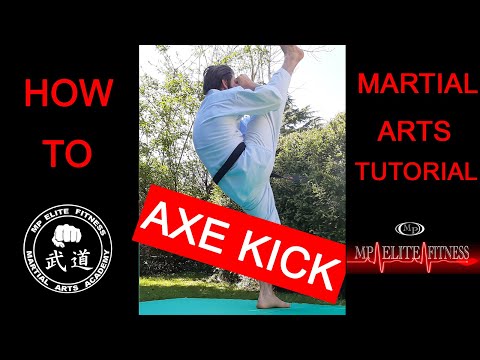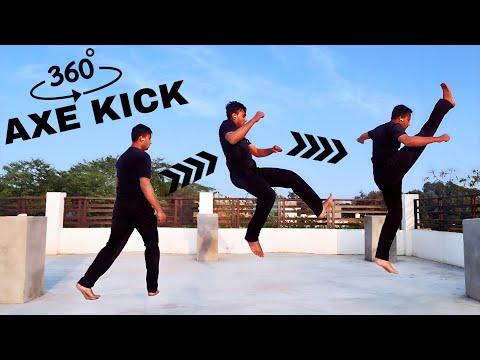
360' Axe Kick Tutorial | 360 Kick | How to do 360' Axe kick .
0
Axe Kick·Akashkrt
360' Axe Kick Tutorial. 360' Axe kick is a very powerful and effective kick. It especially used in takewondo, mma and…
Translation: axe kick / heel drop
The Axe Kick family groups kicking techniques in which the leg is raised high — often above the opponent's head — and then brought straight down onto the target in a chopping motion, using the heel or sole of the foot as the impact surface. [1] The axe kick generates force through the combination of gravitational acceleration and the active hip flexor contraction that pulls the leg downward, creating a hammering effect capable of striking the collarbone, shoulder, top of the head, or face of an opponent. [1],[2] Axe kicks are most closely associated with taekwondo, where they are a competition staple scoring technique, but they also appear in karate (kakato geri) and MMA. [2],[3] The technique requires exceptional hip flexibility and hamstring length to raise the leg above head height before executing the downward chop. [3]
The axe kick developed primarily within Korean martial arts, becoming a signature technique in taekwondo competition where its dramatic overhead trajectory scores as a head kick. [1] The technique was influenced by Chinese northern kung fu styles that emphasised high, flexible kicking, and was refined for modern taekwondo sport competition in the 1970s and 1980s. [1],[2] Andy Hug, the Swiss-born karate and K-1 champion, popularised the axe kick in full-contact kickboxing during the 1990s, demonstrating its knockout potential against world-class opponents. [2],[3]
The axe kick raises the leg high and brings it down onto the opponent's head or shoulder. [1]
The axe kick is prominent in taekwondo and karate. [1]
The axe kick is used in taekwondo, karate, and MMA competition. [1]
No images yet for this technique.
Sign in to suggest an image.
360' Axe Kick Tutorial. 360' Axe kick is a very powerful and effective kick. It especially used in takewondo, mma and…
Axe kick. This video demonstrates how to axe kick, including the kick technique, foot position, where to strike to and h…
No instructional courses yet for this technique.
Sign in to suggest a course.
Risk of injury to the person this technique is applied to
Downward heel strike; collarbone/head impact risk
Skill level needed to execute this technique reliably
Whether this technique is allowed under major competition rule sets
Karate-Do Kyohan: The Master Text (Gichin Funakoshi, 1935)
Alias sources — [1] Kukkiwon Textbook (2006) [2] Dynamic Karate (Nakayama, 1966) [3] Kukkiwon Textbook (2006)
Effectiveness sources — [1] Comprehensive Asian Fighting Arts (Draeger & Smith, 1969)
Official karate technique names (和語/漢語)
Established Japanese martial arts naming convention — native Japanese term (和語/漢語)
Alias sources — [1] Kukkiwon Textbook (2006) [2] Dynamic Karate (Nakayama, 1966) [3] Kukkiwon Textbook (2006)
Effectiveness sources — [1] Comprehensive Asian Fighting Arts (Draeger & Smith, 1969)
exceptional hip flexibility, hamstring length, leg raising speed
extremely flexible hips for raising the leg above head height
hip flexors, hamstrings (eccentric), quadriceps, core
Every move, in any martial art, shares a few universal traits. Mix and match below to pinpoint the right tool — or compare equivalents across styles.
The Inside Axe Kick subfamily covers axe kicks where the leg is raised by swinging it upward from the inside (medial side) of the opponent's guard and then brought straight down onto the target. [1] The inside trajectory means the kicking leg passes close to or between the opponent's arms as it ascends, making it more difficult to block because it enters through the centreline. [1,2] The inside axe kick targets the collarbone, shoulder, or head of the opponent, and its inside arc can bypass defences oriented to block lateral or outside attacks. [2,3]
The Outside Axe Kick subfamily covers axe kicks where the leg is raised by swinging it upward from the outside (lateral side) of the body in a wide arc before being brought straight down onto the target. [1] The outside trajectory gives the kick a wider, more visible path than the inside variant, but it can generate more momentum due to the larger arc and is effective at clearing the opponent's guard from the outside before striking downward. [1,2] The outside axe kick targets the same areas — collarbone, shoulder, face, and top of head — but approaches from a different angle. [2,3]
The axe kick (naeryeo chagi in TKD, kakato otoshi geri in karate) drops the heel vertically onto the target. Andy Hug popularized the technique in K-1 kickboxing in the 1990s. (De Bremaeker & Faige, Essential Book of Martial Arts Kicks)
You strike with the heel, which in Japanese is called Kekato. You pull your toes all the way back to ensure the heel makes contact with the target.
A common mistake is swinging the leg all the way through, which turns it into a kyage kick instead. You must bring the leg down the centre line straight through rather than allowing it to swing across.
Place two cones or items on the floor in front of you and practice so your leg finishes between the cones. This ensures you don't deviate from the centre line and maintains proper technique.
The heel can come down into the top of the head, or strike straight down onto other target areas on the opponent.
The Axe Kick family groups kicking techniques in which the leg is raised high — often above the opponent's head — and then brought straight down onto the target in a chopping motion, using the heel or sole of the foot as the impact surface. The axe kick generates force through the combination of gravitational acceleration and the active hip flexor contraction that pulls the leg downward, creating a hammering effect capable of striking the collarbone, shoulder, top of the head, or face of an opponent.
The axe kick developed primarily within Korean martial arts, becoming a signature technique in taekwondo competition where its dramatic overhead trajectory scores as a head kick. The technique was influenced by Chinese northern kung fu styles that emphasised high, flexible kicking, and was refined for modern taekwondo sport competition in the 1970s and 1980s.
Unified MMA: legal — Legal striking technique; WBC/Boxing: banned — All kicks prohibited in boxing; WKF: legal — Legal, chudan (body) kick scores 2 points, jodan (head) kick scores 3 points; Kyokushin: legal — Legal at full power to body and head; WT: legal — Legal, body kick 2 points, head kick 3 points, spinning body 4 points, spinni…; WAKO: legal — Legal in Full Contact and Low Kick formats; K: legal — 1/GLORY — Legal; IFMA: legal — Legal — kicks are a core Muay Thai technique
Danger rating 6/10. High — downward heel strike; collarbone/head impact risk
The standard setup chain: Stance and Range → Chamber the Leg → Execute the Kick → Recover.
Standard counters include: Check (Shin Block) — raise the shin to intercept the kick before it lands / Catch and Sweep — catch the kicking leg and sweep the standing leg / Step Inside — close distance inside the kick's effective range to smother it.
Common variants: Outside axe kick (raising the leg outside and bringing the heel straight down); Inside axe kick (raising the leg inside in a crescent arc before chopping …); Spinning axe kick (adding a spin before the downward chop).
The axe kick is used in taekwondo, karate, and MMA competition.
Top errors to watch for: Not raising the leg high enough, so the downward chop hits the guard rather than coming over it / Throwing the axe kick from too far away — it must be in close-to-mid range for the heel to land on the target / Losing balance on the support leg during the high raise — strengthen the standing leg and core / Telegraphing by leaning the upper body back before the leg lifts.
The Axe Kick is also known as Kakato Otoshi, Naeryo Chagi, Kakato Geri, Hammer Kick.