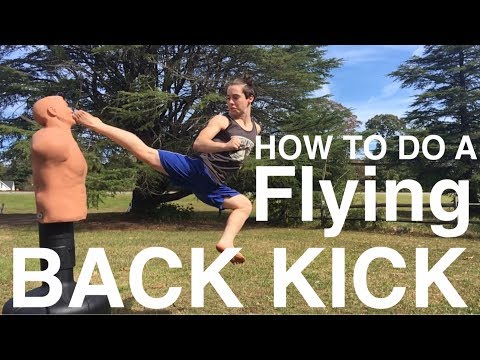
HOW TO DO A FLYING BACK KICK
0
Flying Kick·Looney Goons
Make sure you subscribe!! . . . . . . . . . . . . . . . . . . . . . .. . . . . . . . . . . . key words: taekwondo, marti…
Translation: flying kick
The Flying Kick family encompasses all kicking techniques delivered while the attacker is airborne, having leapt off the ground before executing the kick in midair. [1] Flying kicks sacrifice the stable base of grounded techniques in exchange for added height, distance, and dramatic momentum, using the forward and upward energy of the jump to amplify the force of the kick. [1],[2] These techniques are high-risk, high-reward attacks — a well-timed flying kick can cover significant distance and deliver devastating force, but a missed flying kick leaves the attacker airborne and unable to change direction, vulnerable to counters and takedowns. [2],[3] Flying kicks are prominent in taekwondo, kung fu, and karate, and they occasionally produce spectacular knockouts in MMA and kickboxing. [3]
Flying kicks appear in many Asian martial arts traditions, with Chinese kung fu featuring numerous airborne techniques in styles such as changquan (long fist) and various Shaolin methods dating back centuries. [1] Korean martial arts, particularly taekwondo, elevated the flying kick to a hallmark of the art, with techniques such as the flying side kick (twi-myo yeop chagi) becoming demonstration and breaking staples. [1],[2] In competitive combat sports, flying kicks have produced some of the most memorable knockouts in UFC history, including Anderson Silva's flying front kick knockout of Vitor Belfort at UFC 126 in 2011. [2],[3]
Flying kicks are spectacular techniques found in TKD, karate, and Muay Thai. [1]
Flying kicks have produced memorable knockouts in MMA and TKD competition. [1]
No images yet for this technique.
Sign in to suggest an image.
Make sure you subscribe!! . . . . . . . . . . . . . . . . . . . . . .. . . . . . . . . . . . key words: taekwondo, marti…
No instructional courses yet for this technique.
Sign in to suggest a course.
Risk of injury to the person this technique is applied to
Airborne kicks maximize momentum; high injury risk to both fighters
Skill level needed to execute this technique reliably
Whether this technique is allowed under major competition rule sets
Karate-Do Kyohan: The Master Text (Gichin Funakoshi, 1935)
Alias sources — [1] Dynamic Karate (Nakayama, 1966) [2] Dynamic Karate (Nakayama, 1966) [3] Dynamic Karate (Nakayama, 1966)
Effectiveness sources — [1] Comprehensive Asian Fighting Arts (Draeger & Smith, 1969) [2] Muay Thai Unleashed (Delp, 2006)
Official karate technique names (和語/漢語)
Established Japanese martial arts naming convention — native Japanese term (和語/漢語)
Alias sources — [1] Dynamic Karate (Nakayama, 1966) [2] Dynamic Karate (Nakayama, 1966) [3] Dynamic Karate (Nakayama, 1966)
Effectiveness sources — [1] Comprehensive Asian Fighting Arts (Draeger & Smith, 1969) [2] Muay Thai Unleashed (Delp, 2006)
explosive leg power for jumping, aerial body control, timing
lighter, more explosive athletes with good coordination
quadriceps, calves, hip flexors, core (aerial stability)
Every move, in any martial art, shares a few universal traits. Mix and match below to pinpoint the right tool — or compare equivalents across styles.
The Flying Front Kick subfamily covers front kicks executed while the attacker is airborne, combining a forward leap with a linear front kick thrust to strike the opponent's face, chest, or midsection with increased range and momentum. [1] The jumping motion adds bodyweight and forward momentum to the kick, making the flying front kick substantially more powerful than its grounded counterpart. [1,2] The technique requires explosive leg power for the jump and precise timing to extend the kicking leg at the apex of the leap. [2,3]
The Flying Roundhouse Kick subfamily covers roundhouse kicks delivered while the attacker is airborne, combining a forward leap with a circular kicking motion to strike the opponent's head or body with the shin or instep. [1] The jump adds height to the kick, allowing the attacker to target over the opponent's guard, and the forward momentum increases the mass behind the impact. [1,2] Flying roundhouse kicks are visually spectacular and can be devastatingly powerful, but they require precise timing and distance to avoid landing in a vulnerable position. [2,3]
The Flying Side Kick subfamily covers side kicks delivered while the attacker is airborne, involving a leap followed by a lateral thrusting kick that drives the heel or blade of the foot into the target. [1] The flying side kick is perhaps the most iconic aerial technique in martial arts, frequently used in board-breaking demonstrations, and it combines the linear power of the side kick with the momentum of a full-body leap. [1,2] The technique can cover impressive distance — up to two metres or more in elite practitioners — making it useful for closing the gap against a retreating opponent. [2,3]
Nidan Geri is a jumping double kick where the attacker delivers two kicks at different heights while airborne — typically a front kick to the midsection followed immediately by a front kick to the face, both executed before landing. [1] The name literally means 'two-level kick' (nidan = two levels, geri = kick). [1] It requires explosive jumping ability, rapid leg chambering, and excellent balance in the air. [1]
Flying kicks sacrifice stability for height and closing distance. In traditional martial arts they appear in kata and demonstrations; in MMA, flying knees and flying kicks produce some of the most spectacular KOs. (De Bremaeker & Faige, Essential Book of Martial Arts Kicks)
Pick up your leading leg and turn that shoulder away, then jump with it before implementing your spin. According to Looney Goons, this setup prevents you from just turning in place and instead commits your body to the aerial movement.
The Flying Kick family encompasses all kicking techniques delivered while the attacker is airborne, having leapt off the ground before executing the kick in midair. Flying kicks sacrifice the stable base of grounded techniques in exchange for added height, distance, and dramatic momentum, using the forward and upward energy of the jump to amplify the force of the kick.
Flying kicks appear in many Asian martial arts traditions, with Chinese kung fu featuring numerous airborne techniques in styles such as changquan (long fist) and various Shaolin methods dating back centuries. Korean martial arts, particularly taekwondo, elevated the flying kick to a hallmark of the art, with techniques such as the flying side kick (twi-myo yeop chagi) becoming demonstration and breaking staples.
Unified MMA: legal — Legal striking technique; WBC/Boxing: banned — All kicks prohibited in boxing; WKF: legal — Legal, chudan (body) kick scores 2 points, jodan (head) kick scores 3 points; Kyokushin: legal — Legal at full power to body and head; WT: legal — Legal, body kick 2 points, head kick 3 points, spinning body 4 points, spinni…; WAKO: legal — Legal in Full Contact and Low Kick formats; K: legal — 1/GLORY — Legal; IFMA: legal — Legal — kicks are a core Muay Thai technique
Danger rating 7/10. Very High — airborne kicks maximize momentum; high injury risk to both fighters
The standard setup chain: Stance and Range → Chamber the Leg → Execute the Kick → Recover.
Standard counters include: Check (Shin Block) — raise the shin to intercept the kick before it lands / Catch and Sweep — catch the kicking leg and sweep the standing leg / Step Inside — close distance inside the kick's effective range to smother it.
Common variants: Standard variation (primary execution of the strike from the most common stance); Power variation (modified mechanics for maximum force generation); Speed variation (minimised telegraph for a faster, harder-to-read attack); Counter variation (timed to exploit the opponent's offensive commitment).
Flying kicks have produced memorable knockouts in MMA and TKD competition.
Top errors to watch for: Jumping straight up instead of forward, wasting the momentum that makes flying kicks effective / Kicking too early (while still rising) or too late (while already descending), losing maximum force / Not committing to the full leap, resulting in a weak, half-airborne kick / Dropping the guard during the jump — both hands should stay near the face.
The Flying Kick is also known as Tobi-geri, Jumping Kick, Aerial Kick, Tobi Geri.