Taekwondo Crescent Kick Tutorial
0
Crescent Kick· ATA Martial Arts Master T
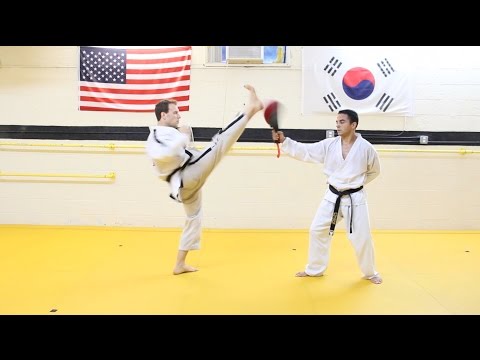
In this Taekwondo tutorial video, Master Ian Thokar teaches how to do a crescent kick, as well as training techniques to…
Translation: crescent kick
The Crescent Kick family groups kicking techniques that follow a wide, sweeping arc — rising from low to high in a curved crescent-shaped path — using the sole, instep, or blade of the foot to strike or deflect. [1] Unlike linear kicks, crescent kicks travel in a large semicircular trajectory that can be directed either inward (medial to lateral) or outward (lateral to medial), giving them the ability to bypass straight-line defences and attack from unexpected angles. [1],[2] Crescent kicks are used both offensively to strike the head or body and defensively to parry or deflect an opponent's guard, and they feature prominently in taekwondo, karate, and kung fu. [2],[3]
Crescent kicks have deep roots in Chinese and Korean martial arts, where sweeping, circular kicking motions were developed in northern Chinese kung fu styles emphasising long-range leg techniques. [1] In taekwondo, the crescent kick (bandal chagi variants) became a competition technique valued for its ability to score around an opponent's guard. [1],[2] Karate systems include the mikazuki geri (crescent kick) as a standard technique, and it appears in numerous traditional kata. [2],[3]
Crescent kicks sweep in a circular arc, striking with the inside or outside of the foot. [1]
Crescent kicks are found in taekwondo, karate, and kung fu. [1]
Used in TKD and MMA competition. [1]
No images yet for this technique.
Sign in to suggest an image.
In this Taekwondo tutorial video, Master Ian Thokar teaches how to do a crescent kick, as well as training techniques to…
This tutorial introduces the practitioner to the Crescent Kick both inside and outside, in most of its incarnations. We …
No instructional courses yet for this technique.
Sign in to suggest a course.
Risk of injury to the person this technique is applied to
Arcing kick; primarily used for guard manipulation
Skill level needed to execute this technique reliably
Whether this technique is allowed under major competition rule sets
Karate-Do Kyohan: The Master Text (Gichin Funakoshi, 1935)
Alias sources — [1] Dynamic Karate (Nakayama, 1966) [2] Kukkiwon Textbook (2006) [3] Dynamic Karate (Nakayama, 1966)
Effectiveness sources — [1] Comprehensive Asian Fighting Arts (Draeger & Smith, 1969)
Official karate technique names (和語/漢語)
Established Japanese martial arts naming convention — native Japanese term (和語/漢語)
Alias sources — [1] Dynamic Karate (Nakayama, 1966) [2] Kukkiwon Textbook (2006) [3] Dynamic Karate (Nakayama, 1966)
Effectiveness sources — [1] Comprehensive Asian Fighting Arts (Draeger & Smith, 1969)
speed, power generation through kinetic chain, striking surface conditioning
athletic build with fast-twitch muscle fibres
varies by strike — hip rotators, shoulders, core
Every move, in any martial art, shares a few universal traits. Mix and match below to pinpoint the right tool — or compare equivalents across styles.
The 360 Spin Crescent Kick completes a full 360-degree body rotation before delivering the crescent kick, generating maximum centrifugal force through the longest possible spinning path — the entire body serves as a flywheel that accelerates the kicking leg to its highest possible velocity. [1] While a standard spinning crescent kick uses a 180-degree rotation (half turn), and a tornado kick uses approximately 270 degrees, the 360 Spin Crescent completes the full circle: the practitioner begins facing the opponent, rotates an entire revolution, and delivers the crescent kick upon returning to the original facing direction. [1] This means the kick arrives from the SAME direction the practitioner was originally facing, but with an entire revolution's worth of rotational momentum behind it — the foot travels through the longest possible arc, building speed continuously throughout the rotation. [1] The 360 Spin Crescent is a high-risk, high-reward technique: the full rotation is slow (approximately 0.8-1.2 seconds), highly telegraphed (the opponent sees the spin developing), and leaves the practitioner off-balance during the rotation — but if the kick connects, the accumulated centrifugal force produces one of the most powerful single impacts achievable with a human body. [1] De Bremaeker and Faige document the 360 Spin Crescent as the final technique in the crescent kick chapter of their 89-kick compilation, noting that it represents the extreme end of the power-versus-risk spectrum in kicking martial arts. [1] In taekwondo competition (particularly WT rules, which award bonus points for spinning and jumping techniques), the 360 Spin Crescent and related full-rotation kicks are used as dramatic scoring techniques, especially in the final seconds of a round when a high-value technique is needed to overcome a points deficit. [2] In demonstration and exhibition martial arts (XMA, tricking, wushu), the 360 Spin Crescent and its airborne variants are among the most visually spectacular techniques performed. [3]
The Armada is a spinning outside crescent kick in Capoeira where the fighter turns their back to the opponent, spins on one foot, and delivers a sweeping kick that travels in an outward circular arc. [1] The kicking leg swings outward (like an outside crescent kick) powered by the full body rotation. It is one of the most versatile and commonly used kicks in Capoeira, appearing in both the ginga (basic movement) sequences and in the jogo (game/sparring). [1] The Armada can target the head, body, or legs depending on the height of execution. [1]
The Front Leg Crescent Kick delivers the inside crescent kick from the lead leg using a skip-step or direct lift, offering faster delivery than the rear-leg version. [1] It is effective as a quick strike to the face or as a blocking/deflecting tool against incoming punches. [1]
The Front Leg Outside Crescent Kick delivers the outside (outward-sweeping) crescent kick from the front leg, using the lead position for speed. [1] This kick sweeps from inside to outside across the opponent's guard. [1]
The Inside Crescent Kick subfamily covers crescent kicks that travel from the outside to the inside in a sweeping arc, with the kicking leg crossing the body's centreline as it strikes. [1] The inside crescent kick uses hip adduction to swing the extended leg inward, impacting with the sole or ball of the foot against the opponent's temple, jaw, or the side of the head. [1,2] This kick can also be used to slap down an opponent's guard or deflect a lead hand, opening a path for follow-up strikes. [2,3]
The Outside Crescent Kick subfamily covers crescent kicks that travel from the inside to the outside in a sweeping arc, with the kicking leg swinging away from the body's centreline as it strikes. [1] The outside crescent kick uses hip abduction to swing the extended leg outward, impacting with the outer edge of the foot or heel against the opponent's head, shoulder, or extended arm. [1,2] This kick can be used to sweep aside an opponent's guard or to strike the temple with a powerful outward-swinging arc. [2,3]
The Outward Ghost Groin Kick is a deceptive crescent-arc kick that feints toward the groin before redirecting outward, exploiting the opponent's protective reflex. [1] Like its inward counterpart (the Phantom Groin Kick), it uses the groin-protection instinct as a tactical weapon. [1] The outward redirection can strike the side of the head or ribs. [1]
The Spin-Back Outside Crescent Kick combines a 180-degree spin with an outside crescent kick, generating tremendous centrifugal force. [1] The spinning outside crescent is one of the most visually dramatic kicks and delivers significant power to the side of the head. [1]
The Switch Downward Heel Kick is an axe kick preceded by a stance switch, bringing the rear leg forward for the downward heel drop. [1] The switch adds speed by using the forward momentum of the stance change to power the upward phase of the kick. [1]
The crescent kick travels in a wide vertical arc — inward or outward — and is used primarily as a setup, deflection, or surprise attack rather than a power technique. Common in TKD and karate point-fighting. (De Bremaeker & Faige, Essential Book of Martial Arts Kicks)
The crescent kick keeps your leg primarily straight without the snap that a front kick uses. According to ATA Martial Arts Master T, the crescent kick's leg stays straight and positioned behind you before the strike, rather than bending and snapping like a front kick.
Your striking surface is not the ball of your foot like in a front kick. ATA Martial Arts Master T explains that the crescent kick uses a different striking surface, with the shape having more of a peak rather than two crescent shapes.
Keep your hands up for protection while standing on one leg, and keep your standing foot flat on the floor rather than going up on your tiptoes. Simon Scher emphasizes that sacrificing your balance and foundation by rising onto your toes will hurt your technique.
Start with the lead leg crescent kick, then progress to turning crescent kicks with your back leg, and eventually work up to spinning variations. Simon Scher recommends practicing on a focus paddle or focus shield once you have the basic forms down.
The Crescent Kick family groups kicking techniques that follow a wide, sweeping arc — rising from low to high in a curved crescent-shaped path — using the sole, instep, or blade of the foot to strike or deflect. Unlike linear kicks, crescent kicks travel in a large semicircular trajectory that can be directed either inward (medial to lateral) or outward (lateral to medial), giving them the ability to bypass straight-line defences and attack from unexpected angles.
Crescent kicks have deep roots in Chinese and Korean martial arts, where sweeping, circular kicking motions were developed in northern Chinese kung fu styles emphasising long-range leg techniques. In taekwondo, the crescent kick (bandal chagi variants) became a competition technique valued for its ability to score around an opponent's guard.
Unified MMA: legal — Legal striking technique; WBC/Boxing: banned — All kicks prohibited in boxing; WKF: legal — Legal, chudan (body) kick scores 2 points, jodan (head) kick scores 3 points; Kyokushin: legal — Legal at full power to body and head; WT: legal — Legal, body kick 2 points, head kick 3 points, spinning body 4 points, spinni…; WAKO: legal — Legal in Full Contact and Low Kick formats; K: legal — 1/GLORY — Legal; IFMA: legal — Legal — kicks are a core Muay Thai technique
Danger rating 5/10. High — arcing kick; primarily used for guard manipulation
The standard setup chain: Stance and Range → Chamber the Leg → Execute the Kick → Recover.
Standard counters include: Check (Shin Block) — raise the shin to intercept the kick before it lands / Catch and Sweep — catch the kicking leg and sweep the standing leg / Step Inside — close distance inside the kick's effective range to smother it.
Common variants: Standard variation (primary execution of the strike from the most common stance); Power variation (modified mechanics for maximum force generation); Speed variation (minimised telegraph for a faster, harder-to-read attack); Counter variation (timed to exploit the opponent's offensive commitment).
Used in TKD and MMA competition.
Top errors to watch for: Throwing the crescent kick as a power technique — it is primarily a scoring, sweeping, or disruption tool / Bending the knee during the arc, which shortens the range and reduces the centrifugal force / Not controlling the descent of the kick — the leg must be pulled down actively, not dropped / Over-committing to the wide arc and losing balance on the support leg.
The Crescent Kick is also known as Mikazuki-geri, Mikazuki Geri, Bandal Chagi, Crescent Moon Kick.