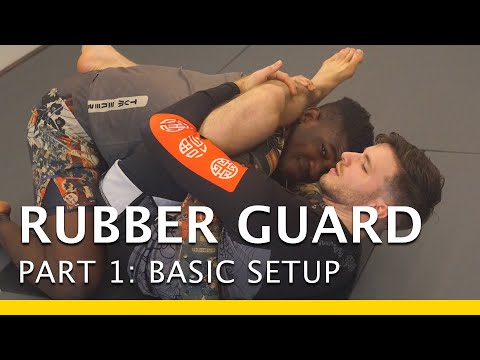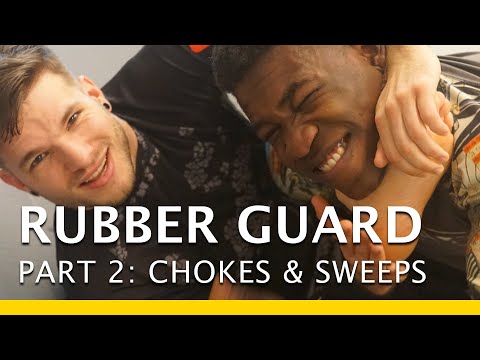
Rubber Guard (part 2)
0
Rubber Guard·Energia Martial Arts
Rubber Guard (part 2) In part 1 we covered a basic set-up into the different rubber guard positions and some fundamental…
Translation: rubber guard
The Rubber Guard family covers the guard system developed by Eddie Bravo that uses extreme leg flexibility to control the opponent's posture from the guard by pulling the shin over the opponent's shoulder and controlling it with the hand. [1] The rubber guard eliminates the need for traditional gi grips by using the guard player's own leg as a controlling mechanism, making it specifically designed for no-gi grappling. [1],[2] The rubber guard system includes a series of named positions — Mission Control, Chill Dog, New York — that form a progressive pathway to submissions. [2],[3]
The rubber guard provides powerful posture control in no-gi situations by using the guard player's own leg to control the opponent's head and shoulder, eliminating the need for gi grips. [1] Its effectiveness is debated — it requires significant hip flexibility and is vulnerable to guard passes if the leg control is broken, but provides excellent posture control and submission setups when properly applied. [1]
No images yet for this technique.
Sign in to suggest an image.
Rubber Guard (part 2) In part 1 we covered a basic set-up into the different rubber guard positions and some fundamental…
Rubber Guard (part 1) So I got a lot of messages asking for a video on the rubber guard and we finally got to filming it…
No instructional courses yet for this technique.
Sign in to suggest a course.
Risk of injury to the person this technique is applied to
Guard positions are defensive; injury risk comes from transitions, not the position itself
Skill level needed to execute this technique reliably
Whether this technique is allowed under major competition rule sets
Advanced Brazilian Jiu-Jitsu Techniques (Marcelo Garcia, 2011)
Alias sources — [1] Mastering the Rubber Guard (Bravo, 2006) [2] Mastering the Rubber Guard (Bravo, 2006)
Effectiveness sources — [1] Mastering the Rubber Guard (Bravo, 2006)
Standard katakana transliteration of Western martial arts terminology (外来語) — used in Japanese MMA, boxing, and BJJ communities
Alias sources — [1] Mastering the Rubber Guard (Bravo, 2006) [2] Mastering the Rubber Guard (Bravo, 2006)
Effectiveness sources — [1] Mastering the Rubber Guard (Bravo, 2006)
hip flexibility, active legs, grip management
long legs for distance control and guard retention
hip flexors, adductors, quadriceps, core, grip
Every move, in any martial art, shares a few universal traits. Mix and match below to pinpoint the right tool — or compare equivalents across styles.
The Advanced Rubber Guard covers the deeper positional sequences beyond Mission Control in Eddie Bravo's Rubber Guard system — including the Chill Dog, New York, Meathook, Zombie, and Dead Orchid positions that create pathways to omoplata, gogoplata, and triangle submissions. [1] These advanced positions require greater hip flexibility than the basic Rubber Guard and create offensive angles that are inaccessible from traditional closed guard. [1,2]
The Chill Dog subfamily covers the rubber guard position where the guard player has advanced past Mission Control by threading the arm through and securing a deeper leg position, creating set-ups for the gogoplata and other submissions. [1] Chill Dog is an intermediate position in the rubber guard pathway, providing more control and closer proximity to submissions than Mission Control. [1,2] The position requires significant flexibility and is part of the progressive rubber guard sequence. [2,3]
The Mission Control subfamily covers the fundamental rubber guard position where the guard player pulls the shin over the opponent's shoulder and holds it in place with the opposite hand, controlling the opponent's posture while keeping one hand free for grip fighting and set-ups. [1] Mission Control is the entry-level rubber guard position — the first position in the rubber guard sequence that establishes the leg-over-shoulder control. [1,2] From Mission Control, the guard player can progress to Chill Dog, New York, and other advanced positions in the rubber guard pathway. [2,3]
The New York subfamily covers the advanced rubber guard position where the guard player has progressed past Chill Dog to establish a deeper, more controlling configuration that directly threatens submissions. [1] New York is one of the more advanced positions in the rubber guard sequence, providing very tight control and direct access to the gogoplata, omoplata, and triangle choke. [1,2] The position requires significant flexibility and technical proficiency in the rubber guard system. [2,3]
Eddie Bravo's rubber guard system uses extreme hip flexibility to control the opponent's posture from bottom guard using the legs. Developed for MMA where holding closed guard is dangerous due to ground-and-pound. (Bravo, Mastering the Rubber Guard, 2006)
It can be if done incorrectly. Throwing your leg up carelessly to catch your leg can be dangerous for your knees and may cause injury, so proper technique is essential.
No—instead of relying solely on leg strength to lift your leg, use your arms to assist yourself by grabbing your shin or leg to help establish the position more safely and effectively.
If you burst upward suddenly while maintaining tight control on your opponent's leg, you risk giving yourself an ankle lock, so controlled movements are important.
First stretch your opponent out before going for the finish—you can butt scoot forward or stretch them out to make it harder for them to roll or escape the submission.
The Rubber Guard family covers the guard system developed by Eddie Bravo that uses extreme leg flexibility to control the opponent's posture from the guard by pulling the shin over the opponent's shoulder and controlling it with the hand. The rubber guard eliminates the need for traditional gi grips by using the guard player's own leg as a controlling mechanism, making it specifically designed for no-gi grappling.
The rubber guard was created by Eddie Bravo and is the centrepiece of his 10th Planet Jiu-Jitsu system. Bravo developed the system for no-gi competition and MMA, where traditional gi grips are unavailable and posture control is essential for attacking from the guard.
IBJJF: legal — Legal — guard is fundamental to BJJ, sweeps from guard score 2 points; IJF: restricted — Guard pulling penalized as non-combativity — groundwork from guard permitted …; ADCC: legal — Legal, guard pull penalized -1 point in points portion; Unified MMA: legal — Legal — no penalty for playing guard; FIAS Sport Sambo: legal — Legal
Danger rating 2/10. Low — guard positions are defensive; injury risk comes from transitions, not the position itself
The standard setup chain: Achieve Guard Contact → Control Grips → Manage Distance → Threaten Submissions/Sweeps.
Standard counters include: Guard Pass — systematically work to clear the legs and establish a dominant position / Leg Pin — control one or both legs to neutralize guard retention / Pressure Passing — use heavy chest pressure to flatten and immobilize the guard player.
Common variants: Standard guard (primary leg and grip configuration for control and attack…); Offensive guard (configured for sweeps and submissions); Defensive guard (prioritising distance management and preventing passes); Transition guard (moving between guard types to adjust to the opponent's pa…).
Eddie Bravo defeated Royler Gracie at ADCC 2003, one of the most famous upsets in grappling history, using a triangle choke from a rubber guard-style position. 10th Planet competitors such as Ben Saunders have used rubber guard techniques in UFC competition.
Top errors to watch for: Attempting rubber guard without adequate hip flexibility — the position requires significant flexibility; develop it … / Forcing the position when the opponent is postured — break their posture first with standard guard tools, then apply … / Staying in rubber guard without progressing through the stages — move from mission control to submissions / Using rubber guard in the gi when standard closed guard grips are available — rubber guard was designed for no-gi.
The Rubber Guard is also known as Rabā Gādo, 10th Planet Guard, Mission Control System.