Introduction and Acknowledgment
The instructor welcomes viewers back to part two of the rubber guard series, assuming familiarity with part one covering the position fundamentals and basic submissions. Credit is given to Eddie Bravo and 10th Planet for developing the system, while noting the instructor's independent discovery of the technique through mission control training.
Arm-Trap Collar Choke from New York
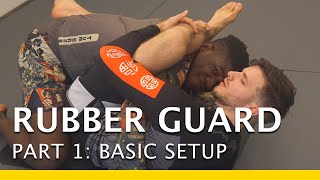
From the rubber guard position known as New York, the practitioner controls the opponent's shin while switching grip placement. The near-side arm underhooks and grabs the shin, followed by the far-side arm passing over the opponent's face to grab the same shin. The position creates a collar choke effect by scissoring the elbows upward while maintaining shin contact against the neck.
Ninja Choke Counter from Chill Dog
From the chill dog variation of rubber guard, the instructor demonstrates a counter that capitalizes on the opponent's defensive head pressure. As the opponent pushes the head to escape, the guard player releases and cups the head while changing angles. The arm slides over the opponent's head into a figure-four grip with closed guard, applying a front naked choke with minimal arm involvement.
Meat Hook Arm Trap Setup
The practitioner identifies the moment when the opponent's elbow elevates during guard passing attempts. The guard player grabs the opponent's arm and positions their foot underneath the elbow to trap it—either by lifting the wrist and inserting the foot, or by hooking the entire arm over the knee. Wrist control is emphasized as critical to prevent escape despite the opponent's strength or flexibility.
Sweep from Meat Hook Position
With the arm trapped via the meat hook technique, the guard player applies pressure to the trapped side of the opponent's body. The sweeping action involves stepping the foot to the inside of the opponent's hip while maintaining arm control, enabling a reversal from the bottom position.
Rubber Guard (part 2)
Key Takeaways
- •Introduction and Acknowledgment
- •Arm-Trap Collar Choke from New York
- •Ninja Choke Counter from Chill Dog
- •Meat Hook Arm Trap Setup
Rubber Guard (part 2) In part 1 we covered a basic set-up into the different rubber guard positions and some fundamentals into the rubber guard system with some of well known submissions. In part 2 we go a bit deeper with some more fancy stuff! As always, thank you for watching and if you have any questions let us know. Shoutout to Rubberguardassassins! Check them out here on Youtube or Instagram for daily top rubber guard content! Or visit their website: https://rubberguardassassins.com Chapters: 0:00 - Start & Intro 0:59 - Cross Choke 2:50 - Ninja Choke from chill dog 5:08 - Meathook Sweep 7:45 - Sweep walkthrough 8:43 - Summary ! Remember to put on notifications to receive an update anytime we drop a new video ! For more content, videos, solo drills and behind the scenes click on this link: https://www.patreon.com/Energia_martialarts?fan_landing=true To check out our gear go to: https://www.energia-martialarts.com/gear Instruction: Tum Energia Assisting: Ees Jore Music: Mr. Ortiz #rubberguard #rubber guard #choke #omoplata #gogoplata #energiamartialarts #bjj #submissiongrappling #mma #brazilianjiujitsu #UFC #submission #triangle #meathooksweep #ninjachoke
Frequently Asked Questions
What does this video teach about rubber guard?
This video covers introduction and acknowledgment, arm-trap collar choke from new york, ninja choke counter from chill dog. It provides detailed instruction from Energia Martial Arts.
How long does it take to learn rubber guard?
The basic mechanics can be understood in a single session, but developing reliable execution requires consistent drilling over weeks of practice. This 5-part breakdown helps structure your training by isolating each phase of the technique.
What are the key details for finishing rubber guard?
The practitioner identifies the moment when the opponent's elbow elevates during guard passing attempts. The guard player grabs the opponent's arm and positions their foot underneath the elbow to trap it—either by lifting the wrist and inserting the foot, or by hooking the entire arm over the knee. Wrist control is emphasized as critical to prevent escape despite the opponent's strength or flexibility.