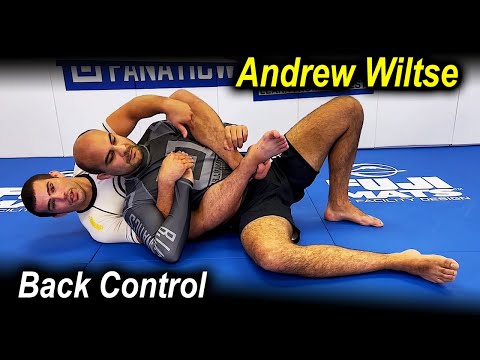
Understanding The Jiu Jitsu Back Control by Andrew Wiltse
0
Mission Control·Bernardo Faria BJJ Fanatics
Understanding Back Control by Andrew Wiltse - Click Here To Check Out Andrew Wiltse's Instructional Videos - https://bjj…
Translation: mission control
The Mission Control subfamily covers the fundamental rubber guard position where the guard player pulls the shin over the opponent's shoulder and holds it in place with the opposite hand, controlling the opponent's posture while keeping one hand free for grip fighting and set-ups. [1] Mission Control is the entry-level rubber guard position — the first position in the rubber guard sequence that establishes the leg-over-shoulder control. [1],[2] From Mission Control, the guard player can progress to Chill Dog, New York, and other advanced positions in the rubber guard pathway. [2],[3]
Mission Control is the foundational posture control position in the rubber guard system, providing a secure platform from which all other rubber guard positions and submissions branch. [1] When properly established, mission control makes it extremely difficult for the top player to posture up or create distance. [1]
Mission Control was developed by Eddie Bravo as the primary entry and control position within the 10th Planet rubber guard system. [1]
Mission control is a key rubber guard position used in EBI and no-gi competition. [1]
No images yet for this technique.
Sign in to suggest an image.
Understanding Back Control by Andrew Wiltse - Click Here To Check Out Andrew Wiltse's Instructional Videos - https://bjj…
No instructional courses yet for this technique.
Sign in to suggest a course.
Risk of injury to the person this technique is applied to
Guard positions are defensive; injury risk comes from transitions, not the position itself
Skill level needed to execute this technique reliably
Whether this technique is allowed under major competition rule sets
Advanced Brazilian Jiu-Jitsu Techniques (Marcelo Garcia, 2011)
Alias sources — [1] Advanced Rubber Guard (Bravo, 2006) [2] Advanced Rubber Guard (Bravo, 2006) [3] Advanced Rubber Guard (Bravo, 2006)
Effectiveness sources — [1] Mastering the Rubber Guard (Bravo, 2006)
Standard katakana transliteration of Western martial arts terminology (外来語) — used in Japanese MMA, boxing, and BJJ communities
Alias sources — [1] Advanced Rubber Guard (Bravo, 2006) [2] Advanced Rubber Guard (Bravo, 2006) [3] Advanced Rubber Guard (Bravo, 2006)
Effectiveness sources — [1] Mastering the Rubber Guard (Bravo, 2006)
hip flexibility, active legs, grip management
long legs for distance control and guard retention
hip flexors, adductors, quadriceps, core, grip
Every move, in any martial art, shares a few universal traits. Mix and match below to pinpoint the right tool — or compare equivalents across styles.
You can safely cross your feet once you've peeled your opponent's arm out and it's positioned up over their body rather than down between their legs, as this prevents them from being able to heel hook or break your ankle.
Trapping the arm prevents your opponent from escaping back, though Andrew Wiltse notes he adopted this approach after shoulder injuries made it difficult to maintain pressure with crossed feet and conventional choke mechanics.
Crossing your feet allows you to control the angle up and down and still move your opponent around, whereas hooking under the butt is primarily used to stop the opponent from turning away from you.
The Mission Control subfamily covers the fundamental rubber guard position where the guard player pulls the shin over the opponent's shoulder and holds it in place with the opposite hand, controlling the opponent's posture while keeping one hand free for grip fighting and set-ups. Mission Control is the entry-level rubber guard position — the first position in the rubber guard sequence that establishes the leg-over-shoulder control.
Mission Control is the foundational position of Eddie Bravo's rubber guard system, named as the 'control centre' from which all rubber guard attacks originate. It was one of the first positions Bravo developed in the 10th Planet system.
IBJJF: legal — Legal — guard is fundamental to BJJ, sweeps from guard score 2 points; IJF: restricted — Guard pulling penalized as non-combativity — groundwork from guard permitted …; ADCC: legal — Legal, guard pull penalized -1 point in points portion; Unified MMA: legal — Legal — no penalty for playing guard; FIAS Sport Sambo: legal — Legal
Danger rating 2/10. Low — guard positions are defensive; injury risk comes from transitions, not the position itself
The standard setup chain: Achieve Guard Contact → Control Grips → Manage Distance → Threaten Submissions/Sweeps.
Standard counters include: Guard Pass — systematically work to clear the legs and establish a dominant position / Leg Pin — control one or both legs to neutralize guard retention / Pressure Passing — use heavy chest pressure to flatten and immobilize the guard player.
Common variants: Standard guard (primary leg and grip configuration for control and attack…); Offensive guard (configured for sweeps and submissions); Defensive guard (prioritising distance management and preventing passes); Transition guard (moving between guard types to adjust to the opponent's pa…).
Mission control is a key rubber guard position used in EBI and no-gi competition.
Top errors to watch for: Attempting mission control without breaking posture first — the opponent must be broken down in standard closed guard… / Not holding the ankle firmly — the hand must anchor the shin in position across the neck / Applying mission control with insufficient flexibility — the knee must reach the ear; forced application risks knee i… / Staying in mission control without progressing — move to chill dog or new york within seconds.
The Mission Control is also known as Misshon Kontorōru, Mission Control, Mission Control Guard, High Rubber Guard.