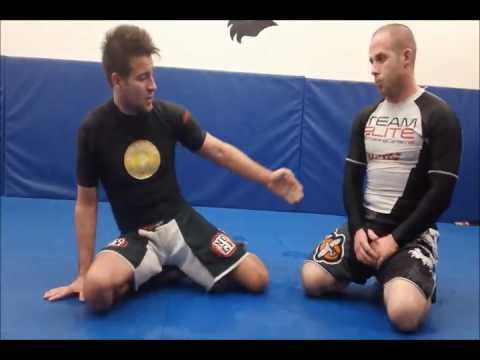
WWW.BJJONLINE.NET- No-Gi- Dog Fight Position Counter - The Leash
0
Chill Dog·Tony Pacenski
http://www.bjjonline.net - go here for Brazilian Jiu-Jitsu Online Education! . "little" Tony PacenskI BJJ Revolution …
Translation: chill dog
The Chill Dog subfamily covers the rubber guard position where the guard player has advanced past Mission Control by threading the arm through and securing a deeper leg position, creating set-ups for the gogoplata and other submissions. [1] Chill Dog is an intermediate position in the rubber guard pathway, providing more control and closer proximity to submissions than Mission Control. [1],[2] The position requires significant flexibility and is part of the progressive rubber guard sequence. [2],[3]
Chill dog is a rubber guard control position that traps the opponent's arm while maintaining high guard control. [1]
Chill dog was developed by Eddie Bravo as part of the 10th Planet Jiu-Jitsu rubber guard system. [1]
Chill dog is used in no-gi competition by 10th Planet practitioners. [1]
No images yet for this technique.
Sign in to suggest an image.
http://www.bjjonline.net - go here for Brazilian Jiu-Jitsu Online Education! . "little" Tony PacenskI BJJ Revolution …
No instructional courses yet for this technique.
Sign in to suggest a course.
Risk of injury to the person this technique is applied to
Guard positions are defensive; injury risk comes from transitions, not the position itself
Skill level needed to execute this technique reliably
Whether this technique is allowed under major competition rule sets
Advanced Brazilian Jiu-Jitsu Techniques (Marcelo Garcia, 2011)
Alias sources — [1] Advanced Rubber Guard (Bravo, 2006) [2] Advanced Rubber Guard (Bravo, 2006)
Effectiveness sources — [1] Mastering the Rubber Guard (Bravo, 2006)
Standard katakana transliteration of Western martial arts terminology (外来語) — used in Japanese MMA, boxing, and BJJ communities
Alias sources — [1] Advanced Rubber Guard (Bravo, 2006) [2] Advanced Rubber Guard (Bravo, 2006)
Effectiveness sources — [1] Mastering the Rubber Guard (Bravo, 2006)
hip flexibility, active legs, grip management
long legs for distance control and guard retention
hip flexors, adductors, quadriceps, core, grip
Every move, in any martial art, shares a few universal traits. Mix and match below to pinpoint the right tool — or compare equivalents across styles.
Tony Pacenski recommends taping around the knuckle in an X pattern rather than locking up the joint, so your fingers maintain some play and mobility. He suggests using thin tape if possible, though thicker tape works too—the key is allowing finger movement to prevent jamming.
From the Chill Dog position, hook your opponent's neck and get the leash control right there while pulling them in, then place your leg in the middle to cut their centerline and establish control.
The Chill Dog subfamily covers the rubber guard position where the guard player has advanced past Mission Control by threading the arm through and securing a deeper leg position, creating set-ups for the gogoplata and other submissions. Chill Dog is an intermediate position in the rubber guard pathway, providing more control and closer proximity to submissions than Mission Control.
Chill Dog was named and developed by Eddie Bravo as part of the 10th Planet Jiu-Jitsu rubber guard system, following his practice of giving distinctive names to each position in the sequence. It represents an intermediate step in the rubber guard pathway to submissions.
IBJJF: legal — Legal — guard is fundamental to BJJ, sweeps from guard score 2 points; IJF: restricted — Guard pulling penalized as non-combativity — groundwork from guard permitted …; ADCC: legal — Legal, guard pull penalized -1 point in points portion; Unified MMA: legal — Legal — no penalty for playing guard; FIAS Sport Sambo: legal — Legal
Danger rating 2/10. Low — guard positions are defensive; injury risk comes from transitions, not the position itself
The standard setup chain: Achieve Guard Contact → Control Grips → Manage Distance → Threaten Submissions/Sweeps.
Standard counters include: Guard Pass — systematically work to clear the legs and establish a dominant position / Leg Pin — control one or both legs to neutralize guard retention / Pressure Passing — use heavy chest pressure to flatten and immobilize the guard player.
Common variants: Standard guard (primary leg and grip configuration for control and attack…); Offensive guard (configured for sweeps and submissions); Defensive guard (prioritising distance management and preventing passes); Transition guard (moving between guard types to adjust to the opponent's pa…).
Chill dog is used in no-gi competition by 10th Planet practitioners.
Top errors to watch for: Reaching for the arm without maintaining mission control — the shin on the neck must stay in place while reaching / Isolating the arm without controlling the wrist — wrist control is necessary to maintain the arm isolation / Staying in chill dog without attacking — chill dog is a transition point; move to the submission immediately / Not maintaining hip position while reaching for the arm — the hips must stay angled to keep the rubber guard active.
The Chill Dog is also known as Chiru Doggu, Chill Dog, Chill Dog Position.