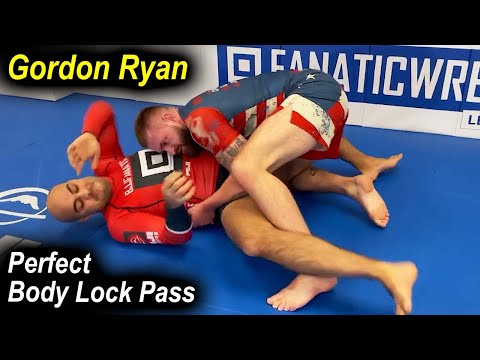
Learn How To Do The Perfect Jiu Jitsu Body Lock Pass by Gordon Ryan
0
Body Lock Pass·Bernardo Faria BJJ Fanatics
If you watch Gordon Ryan training or competing, you will notice that he has a perfect Body Lock Pass. Learn how to do it…
Not yet documented
The Body Lock Pass is a modern pressure-based guard pass where the passer secures a body lock (arms locked around the opponent's waist/hips) and uses heavy forward drive to pass the guard — the technique that defined Gordon Ryan's dominance at ADCC 2019 and 2022. [1] The body lock provides the most secure connection between the passer and the guard player, preventing the guard player from creating distance, re-guarding, or disengaging. [1],[2] Ryan systematised the body lock pass as part of his comprehensive passing hierarchy: secure the body lock, establish heavy pressure, and methodically advance past the legs using hip-switching and leg-clearing techniques while the body lock prevents the guard player from adjusting. [2],[3] The body lock pass has become the dominant passing strategy in modern no-gi grappling because it doesn't rely on gi grips. [3]
Systematised by Gordon Ryan for his ADCC campaigns (2019, 2022). [1]
Gordon Ryan won 2 ADCC absolute titles using the body lock pass as a primary technique. [1]
No images yet for this technique.
Sign in to suggest an image.
If you watch Gordon Ryan training or competing, you will notice that he has a perfect Body Lock Pass. Learn how to do it…
SAVE on my highly reviewed instructionals with the codes below * BJJ Fanatics instructionals (save 10%) with LACHLAN10 h…
No instructional courses yet for this technique.
Sign in to suggest a course.
Risk of injury to the person this technique is applied to
The body lock pass maintains maximum control throughout, minimising offensive options for the guard player
Skill level needed to execute this technique reliably
Whether this technique is allowed under major competition rule sets
Systematically Attacking the Guard (Gordon Ryan, BJJ Fanatics)
Description sources — [1] Gordon Ryan ADCC 2019/2022 performance [2] BJJ Fanatics instructional analysis
Standard katakana transliteration of Western martial arts terminology (外来語) — used in Japanese MMA, boxing, and BJJ communities
Description sources — [1] Gordon Ryan ADCC 2019/2022 performance [2] BJJ Fanatics instructional analysis
grip endurance (maintaining the body lock), heavy pressure ability, hip switching
heavy bodyweight, strong arms (maintaining the lock), good cardio
forearms (grip), chest (pressure), core (hip switching), shoulders (lock maintenance)
Every move, in any martial art, shares a few universal traits. Mix and match below to pinpoint the right tool — or compare equivalents across styles.
The body lock pass uses double underhooks around the opponent's torso to flatten and pass. Popularized at the highest level by Gordon Ryan, whose body lock passing system dominated ADCC 2022. (ADCC competition records)
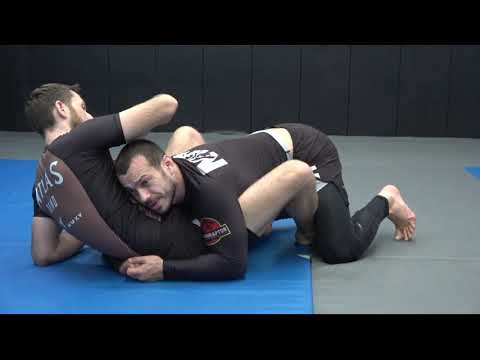
Hand position depends on your movement strategy. According to Gordon Ryan via Bernardo Faria BJJ Fanatics, a 10-finger lock works well if you want to keep your hands in the center, but if you need to move your hands side to side, you can use unlocked hands with an elbow inside instead—both approaches use the same core mechanics.
Gordon Ryan emphasizes making your opponent less athletic rather than trying to out-athlete them by establishing a deep, tight waist lock and placing your ear on their back. This control prevents scrambling and head chasing that allows escape.
Your head must be on the correct side relative to the direction you want to pass, and your hand placement should not be too low or you risk getting caught in a submission. Lock your hands as far back as you can to maintain control.
The Body Lock Pass is a modern pressure-based guard pass where the passer secures a body lock (arms locked around the opponent's waist/hips) and uses heavy forward drive to pass the guard — the technique that defined Gordon Ryan's dominance at ADCC 2019 and 2022. The body lock provides the most secure connection between the passer and the guard player, preventing the guard player from creating distance, re-guarding, or disengaging.
The body lock pass was systematised by Gordon Ryan as part of his comprehensive no-gi passing system, demonstrated at ADCC 2019 (where he won the absolute division) and ADCC 2022 (where he won both his weight and absolute).
IBJJF: legal — Legal, guard pass scores 3 points; IJF: legal — Legal — transitioning past opponent's legs is part of newaza; ADCC: legal — Legal, guard pass scores 3 points; Unified MMA: legal — Legal; FIAS Sport Sambo: legal — Legal
Danger rating 2/10. Low — the body lock pass maintains maximum control throughout, minimising offensive options for the guard player
The standard setup chain: Close Distance → Secure Body Lock (Gable Grip around hips) → Drive Pressure → Hip Switch to Navigate Past Legs → Clear the Legs → Consolidate Side Control or Mount.
Standard counters include: Frame on hips — creating distance before the lock is secured / Underhook from bottom — fighting for the underhook to prevent flattening / Guard re-establishment — using hip movement to re-guard before the pass completes / Inversion — going upside down to recover guard.
Common variants: Standard body lock pass (arms around the waist/hips [1]); High body lock (arms around the chest/upper body); Body lock to leg drag (transitioning from body lock to leg drag when the legs ar…); Body lock to mount (advancing directly to mount from the body lock); Body lock from standing (initiating the pass from standing with the body lock [2]).
Gordon Ryan won 2 ADCC absolute titles using the body lock pass as a primary technique.
Top errors to watch for: Loose body lock — the grip must be tight; a loose lock allows the opponent to create distance / Hips too high — heavy, low hips create maximum pressure / Rushing — the body lock pass is slow and methodical / Not hip switching — static body lock pressure doesn't advance the pass.
The Body Lock Pass is also known as Body Lock, Bear Hug Pass, Body Clinch Pass.