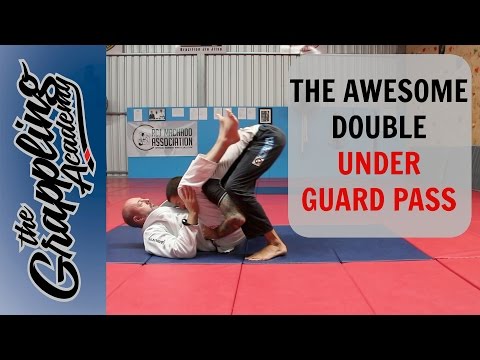
The GREAT DOUBLE UNDER Guard Pass!
0
Double Under Pass·The Grappling Academy
SALE SALE SALE OVER 50% OFF – BOX SET – ALL 4 COURSES 50% OFF CLICK HERE – https://bit.ly/2lAOHmp • The Blue Belt Sup…
Not yet documented
The Double Under Pass is a classic pressure pass where the passer threads both arms under the opponent's legs, stacks them by walking forward, and passes around the compressed guard — one of the most powerful closed guard and open guard passes in BJJ, particularly effective against guard players who rely on hip-based attacks. [1] With both arms under the legs, the passer can control the opponent's entire lower body, stack them to eliminate hip movement, and choose to pass left or right based on the opponent's defensive reactions. [1],[2] The double under position is also a powerful defensive tool — when caught in an armbar from guard, securing double unders and stacking is the primary escape. [2],[3]
One of the oldest BJJ guard passes, present in the Gracie curriculum from the earliest era. [1]
The double under pass is commonly used at all levels of IBJJF competition. [1]
No images yet for this technique.
Sign in to suggest an image.
SALE SALE SALE OVER 50% OFF – BOX SET – ALL 4 COURSES 50% OFF CLICK HERE – https://bit.ly/2lAOHmp • The Blue Belt Sup…
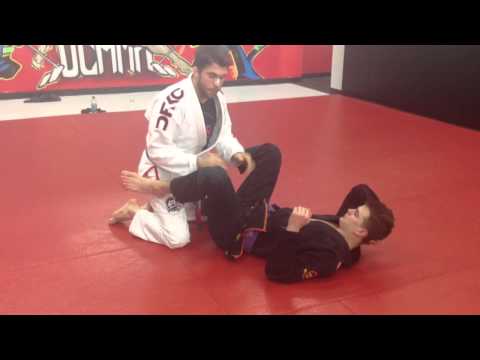
www.chewjitsu.net www.derbycitymma.com A small grip change on the old but still very useful, double under pass..
No instructional courses yet for this technique.
Sign in to suggest a course.
Risk of injury to the person this technique is applied to
The double under provides maximum control; the primary risk is triangle choke if the arms are threaded incorrectly
Skill level needed to execute this technique reliably
Whether this technique is allowed under major competition rule sets
Jiu-Jitsu University (Saulo Ribeiro, 2008)
Description sources — [1] Jiu-Jitsu University (Ribeiro, 2008) [2] BJJ competition analysis
Standard katakana transliteration of Western martial arts terminology (外来語) — used in Japanese MMA, boxing, and BJJ communities
Description sources — [1] Jiu-Jitsu University (Ribeiro, 2008) [2] BJJ competition analysis
leg drive, upper body strength for clasping
heavy bodyweight, strong legs
quadriceps, chest, forearms (clasp)
Every move, in any martial art, shares a few universal traits. Mix and match below to pinpoint the right tool — or compare equivalents across styles.
The double under pass (double underhooks on both legs) stacks the opponent and walks around. One of the most powerful pressure passes — Andre Galvao and Rodolfo Vieira are among its most famous practitioners. (Jiu-Jitsu University, Ribeiro)
Hunch your shoulders like a turtle going into a shell and avoid leaving your neck open, which allows you to pass safely, especially if you need a breather.
In the gi, you can grab the belt, pant material, or upper thigh—Chewjitsu recommends grabbing the upper thigh because if your opponent pushes their knees out, it actually helps you pull up more easily. You can also use a gable grip first to control the legs.
Drive your knee down onto their leg rather than just trying to turn around, then slide to the side while maintaining pressure on the neck with your hand blocking their hip.
Keep your opponent's feet off the ground and slowly change your shape until you pass the guard, while making sure they don't escape back to guard or get to their knees.
The Double Under Pass is a classic pressure pass where the passer threads both arms under the opponent's legs, stacks them by walking forward, and passes around the compressed guard — one of the most powerful closed guard and open guard passes in BJJ, particularly effective against guard players who rely on hip-based attacks. With both arms under the legs, the passer can control the opponent's entire lower body, stack them to eliminate hip movement, and choose to pass left or right based on the opponent's defensive reactions.
The double under pass is one of the oldest guard passes in BJJ, used since the earliest competition era.
IBJJF: legal — Legal, guard pass scores 3 points; IJF: legal — Legal — transitioning past opponent's legs is part of newaza; ADCC: legal — Legal, guard pass scores 3 points; Unified MMA: legal — Legal; FIAS Sport Sambo: legal — Legal
Danger rating 3/10. Low — the double under provides maximum control; the primary risk is triangle choke if the arms are threaded incorrectly
The standard setup chain: Break Guard → Thread Both Arms Under Legs → Clasp Hands → Walk Forward to Stack → Choose Pass Direction → Pass Around Compressed Legs → Consolidate.
Standard counters include: Triangle choke — if one arm is out / Frame on hips — preventing the forward drive / Hip escape before the stack / Ankle grab — grabbing the passer's ankles to prevent walking.
Common variants: Standard double under stack (both arms under, walk forward to stack [1]); Double under to leg drag (transitioning to leg drag from double under); Double under to toreando (throwing the legs to one side from double under); Double under to body lock (converting the double under into a body lock around the hips); Sao Paulo pass (a specific double under variation popular in Brazilian co…).
The double under pass is commonly used at all levels of IBJJF competition.
Top errors to watch for: One arm out — leaving one arm outside the legs creates a triangle choke opening / Leaning forward instead of walking — the power comes from the legs walking forward / Not clasping hands — loose arms lose control / Stacking without purpose — stack to PASS, not to hold.
The Double Under Pass is also known as Double Unders, Double Under Hook Pass, Stacking Pass.