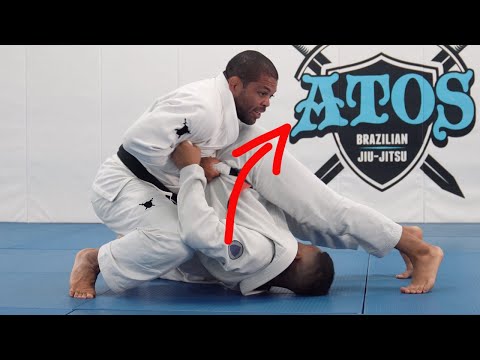
Basic Stack Pass to Flow Pass - Andre Galvao
0
Stack Pass·Atos Jiu-Jitsu HQ | World's Best BJJ Academy - Home Page
Discovery of the full power of this technique with parts 2 and 3, now accessible on Atos BJJ on Demand! Part 2- https:…
Not yet documented
The Stack Pass is a pressure-based guard pass where the passer drives the opponent's legs over their head by walking forward with chest pressure, compressing the guard player's spine until their hips leave the mat and their guard structure collapses — one of the most powerful and demoralising passes in BJJ. [1] The stack exploits the guard player's flexibility limit — by walking the hips forward while driving chest-to-chest, the passer progressively bends the guard player in half until their legs are over their head, at which point passing around the compressed legs is straightforward. [1],[2] The stack pass is particularly effective against closed guard and against guard players who rely on hip movement (shrimping), because the stacking action pins the hips above the head, eliminating all hip-based defence. [2],[3]
One of the oldest BJJ guard passes, present in the Gracie curriculum from the earliest era. [1]
The stack pass is commonly used at all levels of IBJJF competition. [1]
No images yet for this technique.
Sign in to suggest an image.
Discovery of the full power of this technique with parts 2 and 3, now accessible on Atos BJJ on Demand! Part 2- https:…
No instructional courses yet for this technique.
Sign in to suggest a course.
Risk of injury to the person this technique is applied to
The stack pass compresses the guard player's spine, which can cause discomfort in the cervical and thoracic spine; the guard player should tap if the spinal compression becomes dangerous
Skill level needed to execute this technique reliably
Whether this technique is allowed under major competition rule sets
Jiu-Jitsu University (Saulo Ribeiro, 2008)
Description sources — [1] Jiu-Jitsu University (Ribeiro, 2008) [2] BJJ passing methodology
Standard katakana transliteration of Western martial arts terminology (外来語) — used in Japanese MMA, boxing, and BJJ communities
Description sources — [1] Jiu-Jitsu University (Ribeiro, 2008) [2] BJJ passing methodology
leg drive, chest pressure, the ability to walk forward under load
heavy bodyweight, strong legs
quadriceps (walking forward), chest (pressure), core (maintaining the stack)
Every move, in any martial art, shares a few universal traits. Mix and match below to pinpoint the right tool — or compare equivalents across styles.
The stack pass folds the opponent in half by driving their legs over their head, then walking around to side control. A fundamental pressure pass taught in every BJJ curriculum. (Jiu-Jitsu University, Ribeiro)
According to Andre Galvao, you need to watch for triangle and choke attempts when your opponent grabs your collar. To defend, turn your head, shrug your shoulders to make your neck harder to find, and keep your jaw positioned to one side.
Andre Galvao emphasizes that your forearm must be connected to your opponent's hips, not their neck. Placing your forearm on the neck causes escapes, especially against flexible or high-level opponents who can open their elbow and insert their leg.
According to Andre Galvao, you should lift one side of the opponent's body more than the other to bring their leg over your shoulder and near your head, rather than trying to stack both sides equally.
Andre Galvao states that once you trap the arm with your leg, there are many transitions available, including north-south choke, Kimura, and triangle attempts.
The Stack Pass is a pressure-based guard pass where the passer drives the opponent's legs over their head by walking forward with chest pressure, compressing the guard player's spine until their hips leave the mat and their guard structure collapses — one of the most powerful and demoralising passes in BJJ. The stack exploits the guard player's flexibility limit — by walking the hips forward while driving chest-to-chest, the passer progressively bends the guard player in half until their legs are over their head, at which point passing around the compressed legs is straightforward.
The stack pass is one of the oldest guard passes in BJJ, used since the earliest competition era. It was a primary passing technique before modern speed and pressure passing systems were developed.
IBJJF: legal — Legal, guard pass scores 3 points; IJF: legal — Legal — transitioning past opponent's legs is part of newaza; ADCC: legal — Legal, guard pass scores 3 points; Unified MMA: legal — Legal; FIAS Sport Sambo: legal — Legal
Danger rating 4/10. Moderate — the stack pass compresses the guard player's spine, which can cause discomfort in the cervical and thoracic spine; the guard player should tap if the spinal compression becomes dangerous
The standard setup chain: Break Guard → Secure Legs (double under or single) → Walk Forward → Drive Chest Pressure → Compress Until Hips Lift → Pass Around Compressed Legs → Consolidate Side Control.
Standard counters include: Hip Escape before the stack — shrimping before the hips are lifted / Frame on hips — pushing against the passer's hips to prevent the forward drive / Shoulder walk — walking the shoulders backward to escape the compression / Guard re-establishment — using the unstacking moment to recover guard.
Common variants: Double under stack (both arms under the legs [1]); Single stack (stacking with one arm under); Armbar defence stack (stacking to escape an armbar attempt); Stack to leg drag (transitioning from the stack to a leg drag pass); Stack to over-under (combining the stack with over-under grips [2]).
The stack pass is commonly used at all levels of IBJJF competition.
Top errors to watch for: Leaning forward instead of walking — the power comes from leg drive / Not controlling the legs — the guard player's legs must be controlled during the stack / Stacking without purpose — the stack should lead to a pass; stacking and staying there is stalling / Ignoring neck safety — extreme stacking can injure the cervical spine.
The Stack Pass is also known as Stacking Pass, Stack and Smash, Folding Pass.