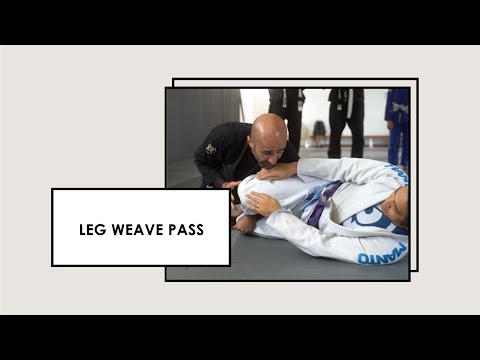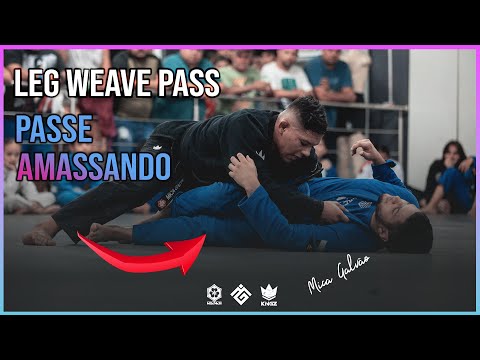
Leg Weave Pass
0
Leg Weave Pass·MICAEL GALVÃO
Não se esqueça de dar seu like no vídeo e se inscrever no meu canal: https://www.youtube.com/channel/UCkAORCQMT3IR65r…
Not yet documented
The Leg Weave Pass is a pressure-based guard pass where the passer weaves one arm through and around the opponent's legs, creating a configuration that pins one leg while clearing the other — a methodical pass that combines elements of the over-under and the smash pass. [1] The weaving arm threads through the guard structure, immobilising one leg and creating a clear lane to pass on the unweaved side. [1],[2]
Developed within the modern BJJ competition passing evolution. [1]
Used at IBJJF and ADCC competition. [1]
No images yet for this technique.
Sign in to suggest an image.
Não se esqueça de dar seu like no vídeo e se inscrever no meu canal: https://www.youtube.com/channel/UCkAORCQMT3IR65r…
In this video, 3rd-degree black belt Miad Najafi gives a comprehensive tutorial on his take on the leg weave pass. Miad…
No instructional courses yet for this technique.
Sign in to suggest a course.
Risk of injury to the person this technique is applied to
Guard passes carry minimal injury risk for both fighters under normal conditions
Skill level needed to execute this technique reliably
Whether this technique is allowed under major competition rule sets
Jiu-Jitsu University (Saulo Ribeiro, 2008)
Description sources — [1] Modern BJJ passing methodology [2] Competition passing analysis
Standard katakana transliteration of Western martial arts terminology (外来語) — used in Japanese MMA, boxing, and BJJ communities
Description sources — [1] Modern BJJ passing methodology [2] Competition passing analysis
hip mobility, grip strength, timing
athletic ability, good reflexes
core, quadriceps, forearms
Every move, in any martial art, shares a few universal traits. Mix and match below to pinpoint the right tool — or compare equivalents across styles.
The leg weave threads one arm under the opponent's leg and weaves through to control the hip, then drives through to side control. Effective against half guard and open guard. (BJJ instructionals)
The primary focus is preventing the bottom knee from coming up and controlling your opponent's spine. According to Jiu Jitsu Brotherhood, you must collapse the knees, control the collar to bring them in, and prevent them from leaning their upper body back—if they do, they'll have the opportunity to pull the knee through and escape.
Place your hand on the front of the knee rather than just grabbing the trouser, as this allows you to properly block the bottom leg and maintain control during the pass, according to Jiu Jitsu Brotherhood.
After controlling and collapsing the knees, walk your hips forward, spike your opponent with your head into their chest, and move past. Jiu Jitsu Brotherhood describes the sequence as: control, collapse, pull—then drive with your head on the far side of their midline to complete the pass.
Shoulder pressure is critical to keep your opponent from settling into the middle range and to weaken their spine, according to Jiu Jitsu Brotherhood. This pressure, combined with proper connection and control, prevents them from generating escape leverage.
The Leg Weave Pass is a pressure-based guard pass where the passer weaves one arm through and around the opponent's legs, creating a configuration that pins one leg while clearing the other — a methodical pass that combines elements of the over-under and the smash pass. The weaving arm threads through the guard structure, immobilising one leg and creating a clear lane to pass on the unweaved side.
This passing technique is part of the modern BJJ guard passing curriculum, refined through competition at IBJJF and ADCC.
IBJJF: legal — Legal, guard pass scores 3 points; IJF: legal — Legal — transitioning past opponent's legs is part of newaza; ADCC: legal — Legal, guard pass scores 3 points; Unified MMA: legal — Legal; FIAS Sport Sambo: legal — Legal
Danger rating 2/10. Low — guard passes carry minimal injury risk for both fighters under normal conditions
The standard setup chain: Establish Position → Strip Grips → Initiate Pass → Navigate Legs → Consolidate Side Control.
Standard counters include: Guard retention / Frame and shrimp / Sweep timing / Re-guarding.
Common variants: Standard execution (the fundamental version of this pass); Modified version (adapted for specific guard types); Chain variant (transitioning to this pass from another pass that was def…).
Used at IBJJF and ADCC competition.
Top errors to watch for: Not establishing grips before initiating / Not consolidating with crossface after passing / Only passing to one side / Rushing without reading the guard player's position.
The Leg Weave Pass is also known as Leg Weave, Weave Pass, Thread-the-Needle Pass.