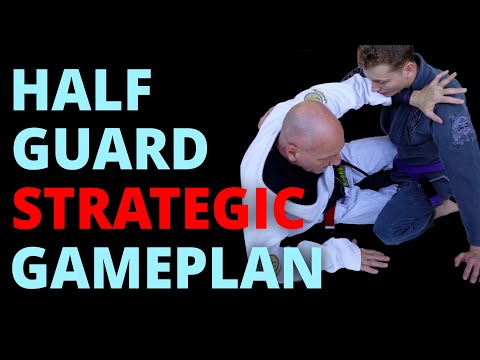
Half Guard Strategic Gameplan
0
Half Guard·The Art of Skill
OLD GRAPPLER SUMMIT IS HAPPENING! An all-inclusive immersion retreat on Halloween weekend 2025. https://oldgrapplersummi…
Translation: half guard
The Half Guard family covers the guard position where the bottom fighter controls one of the opponent's legs between theirs while the opponent has passed the other leg to achieve a partial guard pass. [1] The half guard was transformed from a stalling, defensive position into one of the most dynamic and attack-rich guard positions in BJJ through the innovations of Roberto 'Gordo' Correa, Lucas Leite, and Bernardo Faria. [1],[2] This family covers the standard half guard, deep half guard, Z-guard (knee shield half guard), and the lockdown variation, each offering distinct tactical options. [2],[3]
The half guard was revolutionised by Roberto 'Gordo' Correa in the 1990s, who developed the position into a complete guard system after a knee injury limited his full guard play. [1] Gordo's innovations inspired generations of half guard specialists who further expanded the system into deep half, lockdown, Z-guard, and other variations. [2],[3]
The half guard transformed from a desperation position into one of the most dynamic and effective guard positions in BJJ, offering sweeps, back takes, and submission chains. [1] Ribeiro describes the half guard as a high-percentage sweeping position when played with proper underhook and hip positioning. [1] The half guard's greatest strength is that it is often reached naturally when a full guard pass is partially completed, making it the most commonly encountered guard in competition. [2]
Roberto 'Gordo' Correa revolutionised the half guard in the 1990s after a knee injury limited his closed guard play, developing a complete offensive system from the position. [1] Lucas Leite became the foremost half guard specialist in competition, winning multiple IBJJF No-Gi World titles using the half guard as his primary position. [2] Bernardo Faria further developed the deep half guard into a comprehensive competition system. [3]
No images yet for this technique.
Sign in to suggest an image.
OLD GRAPPLER SUMMIT IS HAPPENING! An all-inclusive immersion retreat on Halloween weekend 2025. https://oldgrapplersummi…
No instructional courses yet for this technique.
Sign in to suggest a course.
Risk of injury to the person this technique is applied to
Guard positions are defensive; injury risk comes from transitions, not the position itself
Skill level needed to execute this technique reliably
Whether this technique is allowed under major competition rule sets
Jiu-Jitsu University (Saulo Ribeiro, 2008)
Alias sources — [1] Jiu-Jitsu University (Ribeiro, 2008) [2] Jiu-Jitsu University (Ribeiro, 2008) [3] Brazilian Jiu-Jitsu: Theory and Technique (Gracie & Gracie, 2001)
Effectiveness sources — [1] Jiu-Jitsu University (Ribeiro, 2008) [2] Mastering Jujitsu (Gracie & Danaher, 2003)
Standard katakana transliteration of Western martial arts terminology (外来語) — used in Japanese MMA, boxing, and BJJ communities
Alias sources — [1] Jiu-Jitsu University (Ribeiro, 2008) [2] Jiu-Jitsu University (Ribeiro, 2008) [3] Brazilian Jiu-Jitsu: Theory and Technique (Gracie & Gracie, 2001)
Effectiveness sources — [1] Jiu-Jitsu University (Ribeiro, 2008) [2] Mastering Jujitsu (Gracie & Danaher, 2003)
hip flexibility, active legs, grip management
long legs for distance control and guard retention
hip flexors, adductors, quadriceps, core, grip
Every move, in any martial art, shares a few universal traits. Mix and match below to pinpoint the right tool — or compare equivalents across styles.
The Deep Half Guard subfamily covers the advanced half guard variation where the guard player dives deep underneath the opponent, positioning the body entirely beneath the opponent's hips with the head and shoulders under the opponent's centre of gravity. [1] Deep half guard provides extraordinary sweeping leverage because the guard player's body is directly under the opponent's weight, making off-balancing and sweeping possible with relatively little effort. [1,2] The position requires comfort with being underneath an opponent and strong hip movement to navigate the under-body space. [2,3]
The Dogfight Position is the neutral/advantageous position reached when the half guard bottom player comes to their knees with an underhook — both fighters are on their knees in a wrestling-like clinch with the underhook determining advantage. [1] From the dogfight, the underhook player can sweep (driving forward), take the back (turning the corner), or transition to a single-leg; the opponent can counter with a whizzer, re-flatten, or attack with a guillotine. [1,2]
The Inverted Guard is an advanced guard position where the bottom player inverts (goes upside down on their shoulders/upper back) to create angles for guard retention, sweeps, and back takes — a high-level defensive and offensive tool used by elite guard players to recover guard when being passed. [1] Inversion allows the guard player to reposition their hips underneath the passer when conventional hip escape cannot create enough space. [1,2]
The Lockdown System is a 10th Planet Jiu-Jitsu half guard control method where the bottom player crosses their feet in a figure-four lock over the opponent's trapped leg, creating an extremely powerful leg control that prevents the top player from freeing the leg or advancing the pass. [1] The Lockdown provides the control foundation for the Electric Chair sweep, the Old School sweep from Lockdown, and the Whip sweep, making it one of the most complete half guard systems in no-gi grappling. [1,2]
The Standard Half Guard subfamily covers the basic half guard configurations where the guard player controls one of the opponent's legs between theirs from a side-lying or flat-on-back position. [1] The standard half guard is the starting point for all half guard play, with variations defined by the upper body control (underhook, overhook, frame) and leg positioning (knee shield, lockdown, flat). [1,2] Standard half guard positions include the underhook half guard (the most offensively oriented), the knee shield half guard (the most defensively oriented), and the lockdown (the most control-oriented). [2,3]
The Z-Guard subfamily covers the half guard variation that combines the knee shield across the opponent's body with half guard leg control, creating a 'Z' shape with the legs. [1] Z-guard is essentially a specific configuration of the knee shield half guard, with the top leg creating a frame across the opponent's chest/belly and the bottom leg controlling the opponent's leg. [1,2] The Z-guard provides excellent distance management and is used as a platform for sweeps, transitions to other guard positions, and submissions. [2,3]
The half guard was traditionally considered a failed position until Roberto 'Gordo' Correa revolutionized it in the 1990s after a knee injury limited his full guard. Today it is one of the most sophisticated guard systems in BJJ. (Ribeiro, Jiu-Jitsu University)
Pinch your knees together tightly—this is critically important since you need both feet on the mat to bridge effectively. The Art of Skill emphasizes crossing your top foot over and around your bottom foot, as this gives the strongest pinch and prevents the pass.
Position your top foot around the front of your bottom foot so you can pinch as hard as possible. The Art of Skill recommends testing this foot placement yourself to feel the difference it makes.
The knee shield acts as a fulcrum that lets you use that connection point to move yourself, which drastically changes the angle you are positioned at relative to your opponent.
You want your center of gravity below your opponent's, and The Art of Skill emphasizes that applying pressure is one of the keys to creating opportunities as you become a more advanced player. Build a game plan with clear pathways worked out ahead of time so you can respond instantly to what you feel in the moment.
The Half Guard family covers the guard position where the bottom fighter controls one of the opponent's legs between theirs while the opponent has passed the other leg to achieve a partial guard pass. The half guard was transformed from a stalling, defensive position into one of the most dynamic and attack-rich guard positions in BJJ through the innovations of Roberto 'Gordo' Correa, Lucas Leite, and Bernardo Faria.
The half guard was revolutionised by Roberto 'Gordo' Correa in the 1990s, who developed the position into a complete guard system after a knee injury limited his full guard play. Gordo's innovations inspired generations of half guard specialists who further expanded the system into deep half, lockdown, Z-guard, and other variations.
IBJJF: legal — Legal — guard is fundamental to BJJ, sweeps from guard score 2 points; IJF: restricted — Guard pulling penalized as non-combativity — groundwork from guard permitted …; ADCC: legal — Legal, guard pull penalized -1 point in points portion; Unified MMA: legal — Legal — no penalty for playing guard; FIAS Sport Sambo: legal — Legal
Danger rating 2/10. Low — guard positions are defensive; injury risk comes from transitions, not the position itself
The standard setup chain: Achieve Guard Contact → Control Grips → Manage Distance → Threaten Submissions/Sweeps.
Standard counters include: Guard Pass — systematically work to clear the legs and establish a dominant position / Leg Pin — control one or both legs to neutralize guard retention / Pressure Passing — use heavy chest pressure to flatten and immobilize the guard player.
Common variants: Standard half guard (one leg trapped between both legs with an underhook); Deep half guard (fully under the opponent with the leg fully entangled); Lockdown half guard (figure-four leg lock on the trapped leg (10th Planet)); Z-guard (knee shield) (knee across the opponent's chest creating a frame).
Lucas Leite won multiple IBJJF No-Gi World Championship titles using the half guard as his primary position, proving its viability at the highest levels. Bernardo Faria won five IBJJF World Championship titles (2012-2015), with the deep half guard as the centrepiece of his game.
Top errors to watch for: Playing flat-on-the-back half guard — get on the side with an underhook for offensive capability / Allowing the crossface without resistance — the crossface pins you flat; fight it with frames and the underhook / Not controlling the trapped leg — maintain the half guard lock with active legs / Playing half guard without a plan — half guard is a launching pad for sweeps and back takes, not a stalling position.
The Half Guard is also known as Hāfu Gādo, Half Guard, Half Bottom, Meia Guarda.