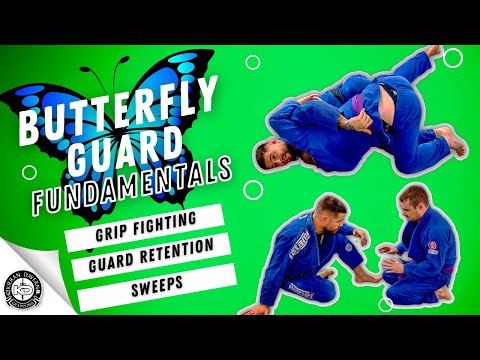
Butterfly Guard Fundamentals
0
Butterfly Guard·KD Grappling | Kieran Davern
In this video we go cover the fundamentals of playing Butterfly Guard after setting up from Seated Guard (A.K.A Upright …
Translation: butterfly guard
The Butterfly Guard family covers the guard position where the bottom fighter sits with both feet hooked inside the opponent's thighs, using the hooks as levers for sweeping, off-balancing, and transitioning. [1] The butterfly guard is one of the most dynamic and effective guard positions in grappling because the hooks provide powerful lifting leverage and the seated posture allows rapid transitions in multiple directions. [1],[2] This family includes the standard seated butterfly guard, the reclined butterfly guard (leaning back for different leverage), and single butterfly hook positions. [2],[3]
The butterfly guard was popularised as an elite fighting position by Marcelo Garcia, whose butterfly guard game is considered one of the most effective guard systems in grappling history. [1] Jean Jacques Machado was also an early butterfly guard pioneer. [2] The butterfly guard's effectiveness in both gi and no-gi has made it one of the most studied positions in modern grappling. [2],[3]
The butterfly guard is one of the most effective sweeping positions in grappling, using double underhooks and butterfly hooks to elevate and off-balance the opponent. [1] Marcelo Garcia demonstrated that the butterfly guard is viable at the highest levels of both gi and no-gi competition, using it as his primary guard position throughout his career. [2]
The butterfly guard gained prominence through Jean Jacques Machado's use of it in the 1990s [1] and was elevated to the highest level by Marcelo Garcia, whose butterfly guard system became the gold standard in modern grappling. [2] Garcia's instructional material and academy teaching has spread the butterfly guard system globally. [2]
Marcelo Garcia used the butterfly guard as his primary position to win four ADCC gold medals (2003, 2005, 2007, 2009) and multiple IBJJF World Championship titles, demonstrating its effectiveness against the best grapplers in the world. [1] The butterfly guard remains one of the most commonly used open guard positions at ADCC. [2]
No images yet for this technique.
Sign in to suggest an image.
In this video we go cover the fundamentals of playing Butterfly Guard after setting up from Seated Guard (A.K.A Upright …
No instructional courses yet for this technique.
Sign in to suggest a course.
Risk of injury to the person this technique is applied to
Guard positions are defensive; injury risk comes from transitions, not the position itself
Skill level needed to execute this technique reliably
Whether this technique is allowed under major competition rule sets
Advanced Brazilian Jiu-Jitsu Techniques (Marcelo Garcia, 2011)
Alias sources — [1] Jiu-Jitsu University (Ribeiro, 2008) [2] Jiu-Jitsu University (Ribeiro, 2008) [3] Jiu-Jitsu University (Ribeiro, 2008)
Effectiveness sources — [1] The Guard (Moreira & Beneville, 2003) [2] Advanced Brazilian Jiu-Jitsu Techniques (Garcia, 2012)
Standard katakana transliteration of Western martial arts terminology (外来語) — used in Japanese MMA, boxing, and BJJ communities
Alias sources — [1] Jiu-Jitsu University (Ribeiro, 2008) [2] Jiu-Jitsu University (Ribeiro, 2008) [3] Jiu-Jitsu University (Ribeiro, 2008)
Effectiveness sources — [1] The Guard (Moreira & Beneville, 2003) [2] Advanced Brazilian Jiu-Jitsu Techniques (Garcia, 2012)
hip flexibility, active legs, grip management
long legs for distance control and guard retention
hip flexors, adductors, quadriceps, core, grip
Every move, in any martial art, shares a few universal traits. Mix and match below to pinpoint the right tool — or compare equivalents across styles.
The Reclined Butterfly Guard subfamily covers the butterfly guard variation where the guard player leans back at an angle rather than sitting fully upright, changing the leverage dynamics of the hooks and creating different sweeping and attacking angles. [1] The reclined position allows the guard player to use the hooks with a more horizontal pull rather than a vertical lift, which can be advantageous for certain sweeps and back takes. [1,2] The reclined angle also makes it harder for the top player to drive forward and flatten the guard player. [2,3]
The Seated Butterfly Guard subfamily covers the standard butterfly guard position where the guard player sits upright with both butterfly hooks inside the opponent's thighs, using the seated posture for maximum lifting leverage and transitional mobility. [1] The seated butterfly guard is the primary butterfly guard configuration, providing the strongest hook elevation for sweeps and the most options for transitions to other positions. [1,2] The upright seated posture allows the guard player to use the full power of the hook lift combined with upper body pulling to execute sweeps. [2,3]
The Single Butterfly Hook subfamily covers positions where only one butterfly hook is inserted inside the opponent's thigh, with the other leg positioned differently — on the hip, on the mat, or in another guard configuration. [1] The single butterfly hook is a common transitional position and serves as an entry point to full butterfly guard, X-guard, and single leg X-guard. [1,2] While providing less control than double hooks, the single butterfly hook offers more flexibility for transitions and can be combined with other guard elements. [2,3]
The butterfly guard uses the insteps hooked inside the opponent's thighs to create elevation for sweeps. Marcelo Garcia's butterfly guard is considered the gold standard — he won multiple ADCC titles primarily from this position. (Garcia, Advanced Brazilian Jiu-Jitsu Techniques)
Playing on one hip puts you in a more athletic position, allowing you to move backwards fast and come up quickly, whereas staying square makes these movements much harder.
You need to prevent your opponent from getting chest-to-chest contact with you and keep their hips away from yours, as allowing either gives them a strong passing position.
The Butterfly Guard family covers the guard position where the bottom fighter sits with both feet hooked inside the opponent's thighs, using the hooks as levers for sweeping, off-balancing, and transitioning. The butterfly guard is one of the most dynamic and effective guard positions in grappling because the hooks provide powerful lifting leverage and the seated posture allows rapid transitions in multiple directions.
The butterfly guard was popularised as an elite fighting position by Marcelo Garcia, whose butterfly guard game is considered one of the most effective guard systems in grappling history. Jean Jacques Machado was also an early butterfly guard pioneer.
IBJJF: legal — Legal — guard is fundamental to BJJ, sweeps from guard score 2 points; IJF: restricted — Guard pulling penalized as non-combativity — groundwork from guard permitted …; ADCC: legal — Legal, guard pull penalized -1 point in points portion; Unified MMA: legal — Legal — no penalty for playing guard; FIAS Sport Sambo: legal — Legal
Danger rating 2/10. Low — guard positions are defensive; injury risk comes from transitions, not the position itself
The standard setup chain: Achieve Guard Contact → Control Grips → Manage Distance → Threaten Submissions/Sweeps.
Standard counters include: Guard Pass — systematically work to clear the legs and establish a dominant position / Leg Pin — control one or both legs to neutralize guard retention / Pressure Passing — use heavy chest pressure to flatten and immobilize the guard player.
Common variants: Standard butterfly guard (both feet hooked inside the opponent's thighs); Single butterfly hook (one hook in while the other leg posts or controls); Butterfly with overhook (combining the hooks with an overhook for sweep setups).
Marcelo Garcia used the butterfly guard as his primary position to win four ADCC gold medals (2003, 2005, 2007, 2009) and multiple IBJJF World Championship titles, demonstrating its effectiveness against the best grapplers in the world. The butterfly guard remains one of the most commonly used open guard positions at ADCC.
Top errors to watch for: Lying flat on the back in butterfly guard — the seated posture is essential for sweep leverage / Playing butterfly guard without an underhook or collar tie — upper body control is mandatory / Keeping the hooks passive — active hooks that elevate and off-balance are the key to butterfly guard / Not transitioning when the opponent stands — butterfly guard must flow to single-leg X or X-guard.
The Butterfly Guard is also known as Batafurai Gādo, Butterfly Hooks, Double Underhook Guard, Seated Guard.