Foundational Requirements
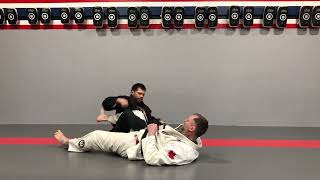
Butterfly guard requires competence in close-range grip fighting and seated positioning. Practitioners must develop the ability to move dynamically in this range, alternating between explosive backward wrestling movements and controlled forward engagement with proper framing.
Opponent Approach Vectors
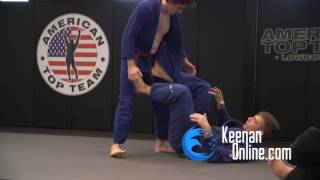
The opponent can address the butterfly guard through four primary approaches: stepping forward with either leg into a standing posture, adopting a half-kneeling position on one knee, moving to a fully kneeling base, or maintaining a conservative square stance at distance. Understanding these entry methods allows the guard player to anticipate and counter specific passing strategies.
Hip Positioning and Athletic Base
Playing on a single hip rather than square-facing generates superior athletic mobility and reactivity. This angled hip position enables faster backward movement, quicker upward wrestling drives when the opponent's posture is compromised, and easier access to arm drag transitions and front headlock entries.
Distance Management and Framing
The guard player must maintain separation by keeping the opponent's shoulders away from their own and preventing hip-to-hip contact. This is accomplished through a combination of lower-body frames applied to the opponent's knees and upper-body frames using the hands and chest, preventing the opponent from achieving the flattened or chest-to-chest positions necessary for passing.
Closing Distance and Grip Establishment
After maintaining defensive hand fighting, the guard player must actively close distance by moving forward while keeping one foot on the opponent's knee at long range. Once closer proximity is achieved, the foot position shifts to the inside of the opponent's leg, allowing secure grip acquisition on the opponent's torso or limbs for executing sweep techniques.
Recovery from Flattened Position—Alternating Side Defense
When the opponent achieves a body lock and begins flattening the guard player, recovery begins by establishing frames with one hand on the opponent's shoulder and the other on their bicep. The guard player then rotates to one side to free one knee and establish a foot on the opponent's hip, then rotates to the opposite side to free the second knee and return to the seated butterfly position.
Recovery from Flattened Position—Rocking Chair Escape
When the opponent clamps a tight hip lock, the guard player lifts their head and shoulders off the mat while pulling the opponent's weight forward using their hands on the opponent's elbows. Using a rocking motion similar to a rocking chair, the guard player extends their hips and sits upright, simultaneously repositioning their feet on the opponent's hips to re-establish the guard.
Butterfly Guard Fundamentals
Key Takeaways
- •Foundational Requirements
- •Opponent Approach Vectors
- •Hip Positioning and Athletic Base
- •Distance Management and Framing
In this video we go cover the fundamentals of playing Butterfly Guard after setting up from Seated Guard (A.K.A Upright Guard). We teach the finer details of controlling your opponents distance with your upper & lower body, help you to perfect your posture & hand/grip fighting along with working on your guard retention to defend when flattened out plus a bonus high percentage set up for a butterfly sweep using the Gi. 00:00 Intro 00:38 Seated Guard Fundamentals, Controlling Distance & Hand Fighting 03:09 Seated Guard Defence & Guard Retention 06:17 Butterfly Sweeping your Opponent 09:33 Outro Thanks for watching, please like & subscribe for more! Come & train with me anytime in: 📍SBG Tullamore, Spollenstown, Tullamore, Co. Offaly, Ireland. 🔗 Keep up to date with me: https://linktr.ee/kierandavern 🦵 BJJ Fanatics Instructional DVD "LegLock The World"https://bjjfanatics.com/collections/all/products/leglock-the-world-by-kieran-davern 🦋 Techniqly Instructional DVD "Irish Butterfly Guard"https://techniqly.com/shop/irish-butterfly-guard/ Kieran Davern | KD Grappling Mixed Grappling Arts (Brazilian Jiu Jitsu (BJJ), Wrestling, Judo, Sambo, NoGi, Gi, Grappling) Mixed Martial Arts (MMA)
Frequently Asked Questions
What does this video teach about butterfly guard?
This video covers foundational requirements, opponent approach vectors, hip positioning and athletic base. It provides detailed instruction from KD Grappling | Kieran Davern.
How long does it take to learn butterfly guard?
The basic mechanics can be understood in a single session, but developing reliable execution requires consistent drilling over weeks of practice. This 7-part breakdown helps structure your training by isolating each phase of the technique.
What are the key details for finishing butterfly guard?
When the opponent achieves a body lock and begins flattening the guard player, recovery begins by establishing frames with one hand on the opponent's shoulder and the other on their bicep. The guard player then rotates to one side to free one knee and establish a foot on the opponent's hip, then rotates to the opposite side to free the second knee and return to the seated butterfly position.