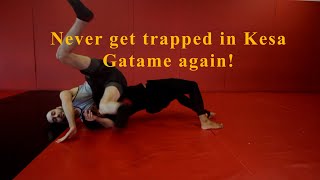
Avoiding Common Side Control Escape Mistakes
The instructor emphasizes that practitioners should not rely on hugging or pushing the opponent while trapped in side control. Instead, the escape requires precise frame placement and positional understanding. Developing correct habits early prevents inefficient movement patterns that become difficult to break.
Establishing the Hip Frame
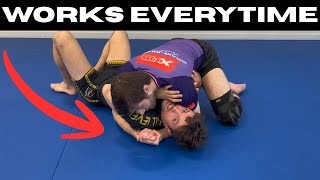
The first frame must be positioned inside the opponent's hip with the elbow bent at more than 90 degrees. The elbow should be lined up with the hip pocket and inserted only about one-third of the way to allow the bone structure to contact the hip rather than relying on forearm pressure. Creating momentum through body movement or leg repositioning helps establish this frame position.
Creating the Cross-Frame Against the Head
The second frame targets the opponent's neck and head by first posting the hand on the neck and pushing the chest toward the opponent. The wrist is then turned down and pummeled under the ear, with the frame curling across the neck. Separation between the defender's shoulder and the opponent's head is essential, achieved by framing the opponent's shoulder and turning away to create space.
Inserting the Knee Frame
Once both arm frames are secured, the knee must be wedged between the defender and opponent at the hip pocket, also requiring an angle greater than 90 degrees. The most critical detail is achieving inside forehead position by placing the forehead inside the opponent's shoulders before attempting the knee insertion. This position prevents the opponent from stopping the knee frame even under strong pressure.
Completing the Escape Sequence
After the knee is positioned inside the hip, the defender transitions to a foot-to-foot stance while maintaining all frames. The final step involves removing the perpendicular angle between the spines by pushing off the feet and frames, transitioning the defender's spine parallel to the opponent's body. This movement creates enough separation to complete the escape and move into counter-offensive positions.
Complete Escape Sequence Summary
The systematic escape process requires five steps: securing the hip frame with proper elbow angle, creating the cross-frame with shoulder separation, achieving inside forehead position, inserting the knee frame at more than 90 degrees, and removing perpendicularity. The inside forehead position is highlighted as the most commonly overlooked detail that determines success under strong opponent pressure. When executed correctly, this sequence works regardless of the opponent's resistance or cross-face pressure.
How I Escape Side Control EVERYTIME
Key Takeaways
- •Avoiding Common Side Control Escape Mistakes
- •Establishing the Hip Frame
- •Creating the Cross-Frame Against the Head
- •Inserting the Knee Frame
Join Ebsayz Jiu Jitsu for 1 on 1 coaching to accelerate your progress and guaranteed results! https://www.skool.com/ebsayz-online-4305/about?ref=c19137b34aca46c08b86ae35c48a0c50
Related Techniques
Frequently Asked Questions
What does this video teach about side control escape?
This video covers avoiding common side control escape mistakes, establishing the hip frame, creating the cross-frame against the head. It provides detailed instruction from Ebsayz.
How long does it take to learn side control escape?
The basic mechanics can be understood in a single session, but developing reliable execution requires consistent drilling over weeks of practice. This 6-part breakdown helps structure your training by isolating each phase of the technique.
What are the key details for finishing side control escape?
After the knee is positioned inside the hip, the defender transitions to a foot-to-foot stance while maintaining all frames. The final step involves removing the perpendicular angle between the spines by pushing off the feet and frames, transitioning the defender's spine parallel to the opponent's body. This movement creates enough separation to complete the escape and move into counter-offensive positions.